Génesis 25
One Unity Resource Bible · Toca un versículo para ver sus referencias cruzadas.
(6) 1Abraham [Father of a multitude] took another wife, and her name was Keturah [Incense]. 2She bore him Zimran, Jokshan, Medan, Midian [Strife], Ishbak, and Shuah. 3Jokshan became the father of Sheba, and Dedan. The sons of Dedan were Asshurim, Letushim, and Leummim. 4The sons of Midian [Strife] were: Ephah, Epher, Hanoch, Abida, and Eldaah. All these were the children of Keturah [Incense]. 5Abraham [Father of a multitude] gave all that he had to Isaac [Laughter], 6but to the sons of Abraham [Father of a multitude]’s concubines, Abraham [Father of a multitude] gave gifts. He sent them away from Isaac [Laughter] his son, while he yet lived, eastward, to the east country. 7These are the days of the years of Abraham [Father of a multitude]’s life which he lived: one hundred seventy-five years. 8Abraham [Father of a multitude] gave up his spirit, and died in a good old age, an old man, and full of years, and was gathered to his people. 9Isaac [Laughter] and Ishmael [Pays attention God], his sons, buried him in the cave of Machpelah [Double], in the field of Ephron [Fawn-like], the son of Zohar the Hittite [Descendant of Trembling fear], which is before Mamre [Bitter, Fatness], 10the field which Abraham [Father of a multitude] purchased of the children of Heth [Trembling fear]. Abraham [Father of a multitude] was buried there with Sarah [Princess], his wife. 11After the death of Abraham [Father of a multitude], God blessed Isaac [Laughter], his son. Isaac [Laughter] lived by Beer Lahai Roi [Well of the one who lives and sees].
(7) 12Now this is the history of the generations of Ishmael [Pays attention God], Abraham [Father of a multitude]’s son, whom Hagar [Flight] the Egyptian [person from Abode of slavery], Sarah [Princess]’s servant, bore to Abraham [Father of a multitude]. 13These are the names of the sons of Ishmael [Pays attention God], by their names, according to the order of their birth: the firstborn of Ishmael [Pays attention God], Nebaioth, then Kedar, Adbeel, Mibsam, 14Mishma, Dumah, Massa, 15Hadad, Tema, Jetur, Naphish, and Kedemah. (Maftir ·Conclusion·) 16These are the sons of Ishmael [Pays attention God], and these are their names, by their villages, and by their encampments: twelve princes, according to their nations. 17These are the years of the life of Ishmael [Pays attention God]: one hundred thirty-seven years. He gave up his spirit and died, and was gathered to his people. 18They lived from Havilah to Shur that is before Egypt [Abode of slavery], as you go toward Assyria [Level plain]. He lived opposite all his relatives.
Haftarah Hayyei Sarah [Princess] · Taking leave · Life of Sarah [Princess]·:
M'lakhim Alef / 1 King 1:1-31
B'rit Hadashah ·New Covenant·: Matt 2:1-23
Parashah 6: Tol'dot ·Generations· 25:19-28:9
19This is the history of the generations of Isaac [Laughter], Abraham [Father of a multitude]’s son. Abraham [Father of a multitude] became the father of Isaac [Laughter]. 20Isaac [Laughter] was forty years old when he took Rebekah [Securely bound], the daughter of Bethuel the Syrian of Paddan Aram [Elevated], the sister of Laban [White] the Syrian, to be his wife. 21Isaac [Laughter] entreated Adonai for his wife, because she was barren. Adonai was entreated by him, and Rebekah [Securely bound] his wife conceived. 22The children struggled together within her. She said, “If it is so, why do I live?” She went to inquire of Adonai. 23Adonai said to her,
“Two nations are in your womb.
Two peoples will be separated from your body.
The one people will be stronger than the other people.
The elder will serve the younger.”
24When her days to be delivered were fulfilled, behold, there were twins in her womb. 25The first came out red all over, like a hairy garment. They named him Esau [Hairy]. 26After that, his brother came out, and his hand had hold on Esau [Hairy]’s heel. He was named Jacob [Supplanter]. Isaac [Laughter] was sixty years old when she bore them.
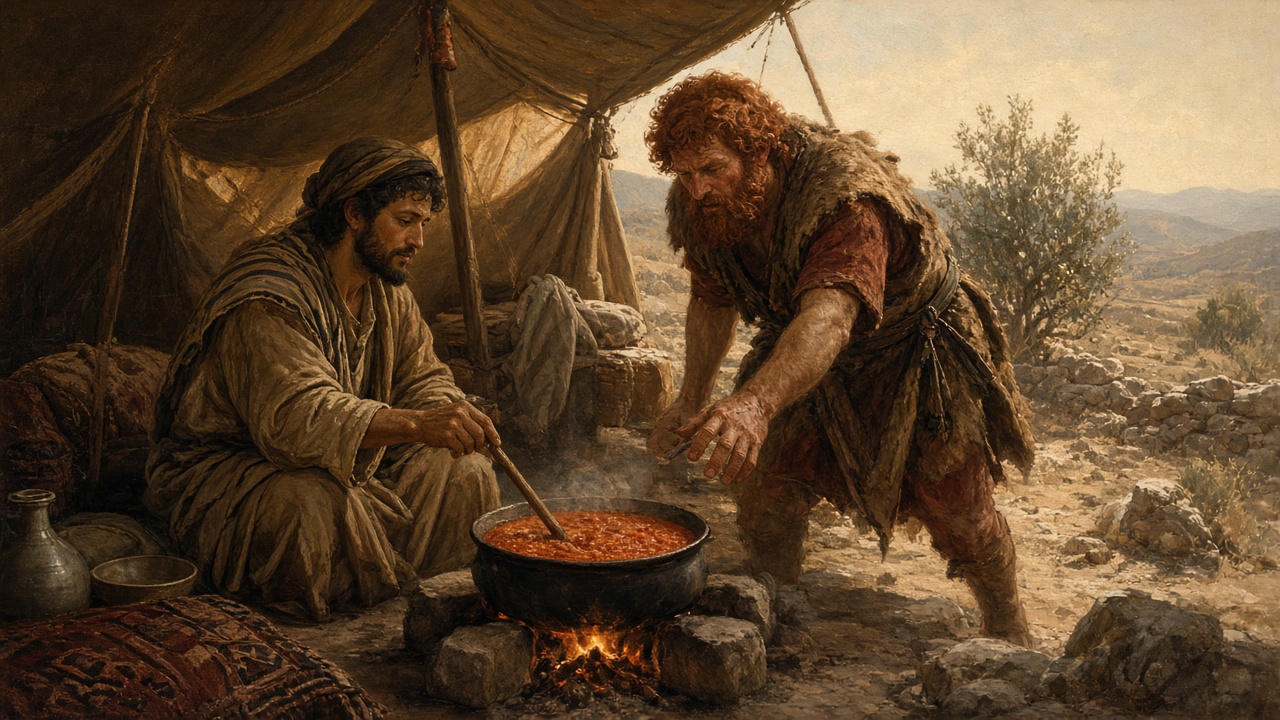
27The boys grew. Esau [Hairy] was a skillful hunter, a man of the field. Jacob [Supplanter] was a quiet man, living in tents. 28Now Isaac [Laughter] 'ahav ·affectionately loved· Esau [Hairy], because he ate Esau’s venison. Rebekah [Securely bound] 'ahav ·affectionately loved· Jacob [Supplanter]. 29Jacob [Supplanter] boiled stew. Esau [Hairy] came in from the field, and he was famished. 30Esau [Hairy] said to Jacob [Supplanter], “Please feed me with that same red stew, for I am famished.” Therefore his name was called Edom [Red].
31Jacob [Supplanter] said, “First, sell me your birthright.”
32Esau [Hairy] said, “Behold, I am about to die. What good is the birthright to me?”
33Jacob [Supplanter] said, “Swear to me first.”
He swore to him. He sold his birthright to Jacob [Supplanter]. 34Jacob [Supplanter] gave Esau [Hairy] bread and stew of lentils. He ate and drank, rose up, and went his way. So Esau [Hairy] despised his birthright.
¿Sabías que…?
Los herederos de Abraham y los hermanos gemelos
- Cetura, cuyo nombre el Easton's Bible Dictionary (1897) explica como “incienso”, aparece aquí como otra esposa de Abraham. Ese diccionario dice que probablemente se casó con ella después de la muerte de Sara, aunque se desconoce su nacionalidad, y señala que 1 Crónicas la llama concubina. Ella le dio seis hijos, entre ellos Jocsán y Madián, padre de los madianitas; mientras Abraham aún vivía, dio regalos a los hijos de sus concubinas y los alejó de Isaac, enviándolos a la tierra de oriente.Fuentes: Keturah · Midian · el propio texto bíblico
- Isaac e Ismael juntos enterraron a Abraham en la cueva de Macpela, cerca de Mamre, en el campo que Abraham había comprado a Efrón el hitita, donde Sara ya había sido enterrada. El Easton's Bible Dictionary (1897) explica Macpela como “porción” o “cueva doble”, situada en la ladera de un monte al este de Hebrón y frente a Mamre, un lugar llamado las encinas —o, en un margen, los terebintos— de Mamre.Fuentes: Machpelah · Mamre · el propio texto bíblico
- Esaú, el gemelo primogénito de Rebeca, nació rojizo y cubierto de pelo como un abrigo de piel. El Easton's Bible Dictionary (1897) vincula el otro nombre, Edom, “rojo”, con el guiso rojo de lentejas por el que vendió el derecho de primogenitura, y explica a Jacob como “el que sigue los talones de otro” o “suplantador”, en consonancia con el relato de que Jacob nació agarrado al talón de Esaú. Esaú creció como un cazador hábil y hombre del campo, mientras que Jacob era un hombre tranquilo que se quedaba en casa.Fuentes: Esau (Edom) · Jacob (Israel) · el propio texto bíblico
Notas escritas con ayuda de IA a partir de fuentes abiertas (Theographic Bible Metadata, CC BY-SA 4.0; Easton’s Bible Dictionary, dominio público) y revisadas antes de publicarse.
Lugares de este capítulo
- East · Hoy: region around Amman · 31.955, 35.934 · versículo 6
- Machpelah · Hoy: Cave of the Patriarchs · 31.525, 35.111 · versículo 9
- Negeb · 31.245, 34.841 · versículo 11
- Assyria · 36.359, 43.153 · versículo 18
- Egypt · 30.129, 31.308 · versículo 18
Solo aparecen lugares identificados con alta confianza (90 % o más según las fuentes académicas reunidas por OpenBible). Mapa de la época: DARE (Digital Atlas of the Roman Empire), CC BY 4.0; mapa actual: © colaboradores de OpenStreetMap; lugares: OpenBible.info (CC BY 4.0).
Créditos y licencia de esta traducción
One Unity Resource Bible
The One Unity Resource Bible translation of the Holy Bible into American English with some transliterated Hebrew notations
Copyright © 2016,2019 Thomas Robinson
Language: English
Dialect: American
Translation by: Thomas Robinson
This translation is made available to you under the terms of the
Creative Commons Attribution Share-Alike license 4.0.
You have permission to share and redistribute this Bible translation in any format and to make reasonable revisions and adaptations of this translation, provided that:
You include the above copyright and source information.
If you make any changes to the text, you must indicate that you did so in a way that makes it clear that the original licensor is not necessarily endorsing your changes.
If you redistribute this text, you must distribute your contributions under the same license as the original.
Pictures included with Scriptures and other documents on this site are licensed just for use with those Scriptures and documents.
For other uses, please contact the respective copyright owners.
Note that in addition to the rules above, revising and adapting God's Word involves a great responsibility to be true to God's Word. See Revelation 22:18-19.
2024-12-05
Fuente: http://ebible.org/engourb/ · eBible.org