Genesis 25
One Unity Resource Bible · Tap a verse to see its cross-references.
(6) 1Abraham [Father of a multitude] took another wife, and her name was Keturah [Incense]. 2She bore him Zimran, Jokshan, Medan, Midian [Strife], Ishbak, and Shuah. 3Jokshan became the father of Sheba, and Dedan. The sons of Dedan were Asshurim, Letushim, and Leummim. 4The sons of Midian [Strife] were: Ephah, Epher, Hanoch, Abida, and Eldaah. All these were the children of Keturah [Incense]. 5Abraham [Father of a multitude] gave all that he had to Isaac [Laughter], 6but to the sons of Abraham [Father of a multitude]’s concubines, Abraham [Father of a multitude] gave gifts. He sent them away from Isaac [Laughter] his son, while he yet lived, eastward, to the east country. 7These are the days of the years of Abraham [Father of a multitude]’s life which he lived: one hundred seventy-five years. 8Abraham [Father of a multitude] gave up his spirit, and died in a good old age, an old man, and full of years, and was gathered to his people. 9Isaac [Laughter] and Ishmael [Pays attention God], his sons, buried him in the cave of Machpelah [Double], in the field of Ephron [Fawn-like], the son of Zohar the Hittite [Descendant of Trembling fear], which is before Mamre [Bitter, Fatness], 10the field which Abraham [Father of a multitude] purchased of the children of Heth [Trembling fear]. Abraham [Father of a multitude] was buried there with Sarah [Princess], his wife. 11After the death of Abraham [Father of a multitude], God blessed Isaac [Laughter], his son. Isaac [Laughter] lived by Beer Lahai Roi [Well of the one who lives and sees].
(7) 12Now this is the history of the generations of Ishmael [Pays attention God], Abraham [Father of a multitude]’s son, whom Hagar [Flight] the Egyptian [person from Abode of slavery], Sarah [Princess]’s servant, bore to Abraham [Father of a multitude]. 13These are the names of the sons of Ishmael [Pays attention God], by their names, according to the order of their birth: the firstborn of Ishmael [Pays attention God], Nebaioth, then Kedar, Adbeel, Mibsam, 14Mishma, Dumah, Massa, 15Hadad, Tema, Jetur, Naphish, and Kedemah. (Maftir ·Conclusion·) 16These are the sons of Ishmael [Pays attention God], and these are their names, by their villages, and by their encampments: twelve princes, according to their nations. 17These are the years of the life of Ishmael [Pays attention God]: one hundred thirty-seven years. He gave up his spirit and died, and was gathered to his people. 18They lived from Havilah to Shur that is before Egypt [Abode of slavery], as you go toward Assyria [Level plain]. He lived opposite all his relatives.
Haftarah Hayyei Sarah [Princess] · Taking leave · Life of Sarah [Princess]·:
M'lakhim Alef / 1 King 1:1-31
B'rit Hadashah ·New Covenant·: Matt 2:1-23
Parashah 6: Tol'dot ·Generations· 25:19-28:9
19This is the history of the generations of Isaac [Laughter], Abraham [Father of a multitude]’s son. Abraham [Father of a multitude] became the father of Isaac [Laughter]. 20Isaac [Laughter] was forty years old when he took Rebekah [Securely bound], the daughter of Bethuel the Syrian of Paddan Aram [Elevated], the sister of Laban [White] the Syrian, to be his wife. 21Isaac [Laughter] entreated Adonai for his wife, because she was barren. Adonai was entreated by him, and Rebekah [Securely bound] his wife conceived. 22The children struggled together within her. She said, “If it is so, why do I live?” She went to inquire of Adonai. 23Adonai said to her,
“Two nations are in your womb.
Two peoples will be separated from your body.
The one people will be stronger than the other people.
The elder will serve the younger.”
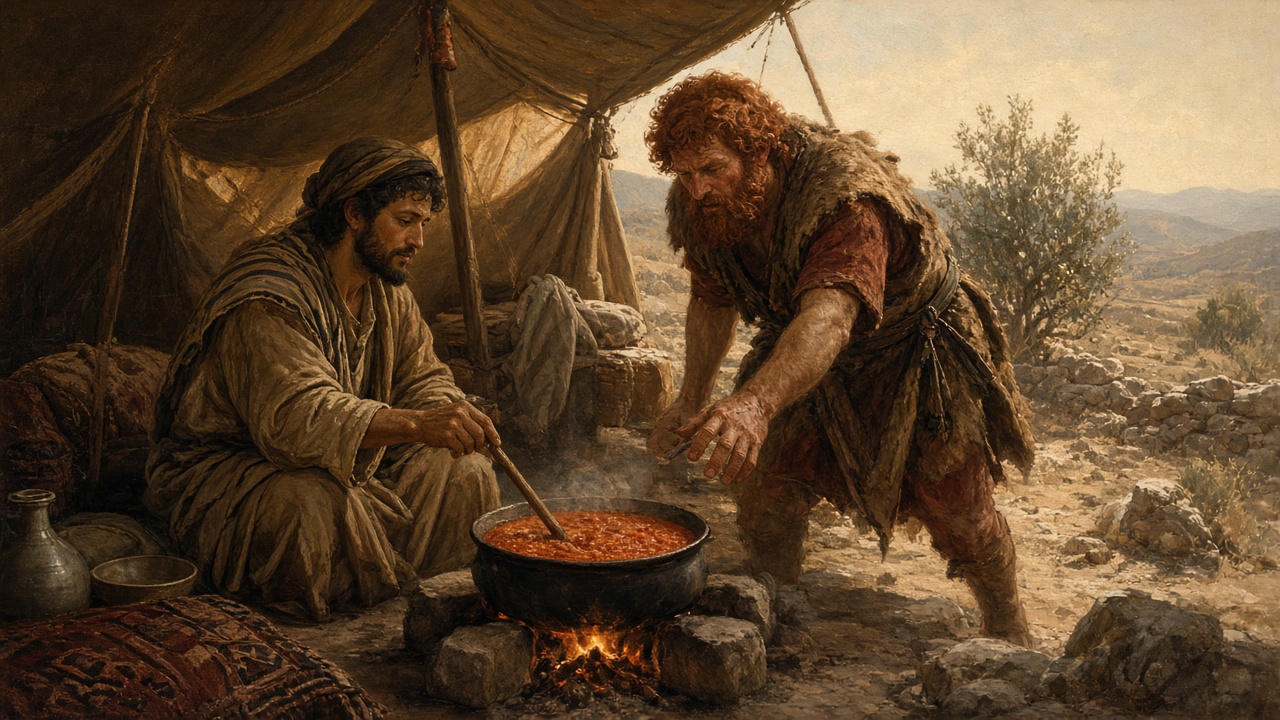
24When her days to be delivered were fulfilled, behold, there were twins in her womb. 25The first came out red all over, like a hairy garment. They named him Esau [Hairy]. 26After that, his brother came out, and his hand had hold on Esau [Hairy]’s heel. He was named Jacob [Supplanter]. Isaac [Laughter] was sixty years old when she bore them.
27The boys grew. Esau [Hairy] was a skillful hunter, a man of the field. Jacob [Supplanter] was a quiet man, living in tents. 28Now Isaac [Laughter] 'ahav ·affectionately loved· Esau [Hairy], because he ate Esau’s venison. Rebekah [Securely bound] 'ahav ·affectionately loved· Jacob [Supplanter]. 29Jacob [Supplanter] boiled stew. Esau [Hairy] came in from the field, and he was famished. 30Esau [Hairy] said to Jacob [Supplanter], “Please feed me with that same red stew, for I am famished.” Therefore his name was called Edom [Red].
31Jacob [Supplanter] said, “First, sell me your birthright.”
32Esau [Hairy] said, “Behold, I am about to die. What good is the birthright to me?”
33Jacob [Supplanter] said, “Swear to me first.”
He swore to him. He sold his birthright to Jacob [Supplanter]. 34Jacob [Supplanter] gave Esau [Hairy] bread and stew of lentils. He ate and drank, rose up, and went his way. So Esau [Hairy] despised his birthright.
Did you know?
Abraham’s heirs and the twin brothers
- Keturah, whose name Easton's Bible Dictionary (1897) explains as “incense,” is introduced here as another wife of Abraham. That dictionary says he probably married her after Sarah’s death, though her nationality is unknown, and notes that 1 Chronicles calls her a concubine. She bore him six sons, including Jokshan and Midian, the father of the Midianites; while Abraham was still alive he gave gifts to the sons of his concubines and sent them away from Isaac to the land of the east.Sources: Keturah · Midian · the Bible text itself
- Isaac and Ishmael together buried Abraham in the cave of Machpelah near Mamre, in the field Abraham had bought from Ephron the Hittite, where Sarah already lay. Easton's Bible Dictionary (1897) explains Machpelah as “portion” or “double cave,” set on a hillside east of Hebron and facing Mamre, a place called the oaks—or, in a margin, the terebinths—of Mamre.Sources: Machpelah · Mamre · the Bible text itself
- Esau, Rebekah’s firstborn twin, was born red and covered with hair like a fur coat. Easton's Bible Dictionary (1897) links the further name Edom, “red,” to the red lentil stew for which he sold his birthright, and explains Jacob as “one who follows on another’s heels” or “supplanter,” matching the report that Jacob was born grasping Esau’s heel. Esau grew up as a skillful hunter and a man of the field, while Jacob was a quiet man who stayed at home.Sources: Esau (Edom) · Jacob (Israel) · the Bible text itself
Notes written with AI assistance from open sources (Theographic Bible Metadata, CC BY-SA 4.0; Easton’s Bible Dictionary, public domain) and reviewed before publishing.
Places in this chapter
- East · Today: region around Amman · 31.955, 35.934 · verse 6
- Machpelah · Today: Cave of the Patriarchs · 31.525, 35.111 · verse 9
- Negeb · 31.245, 34.841 · verse 11
- Assyria · 36.359, 43.153 · verse 18
- Egypt · 30.129, 31.308 · verse 18
Only places identified with high confidence are shown (90% or more according to the scholarly sources compiled by OpenBible). Period map: DARE (Digital Atlas of the Roman Empire), CC BY 4.0; modern map: © OpenStreetMap contributors; places: OpenBible.info (CC BY 4.0).
Credits and license for this translation
One Unity Resource Bible
The One Unity Resource Bible translation of the Holy Bible into American English with some transliterated Hebrew notations
Copyright © 2016,2019 Thomas Robinson
Language: English
Dialect: American
Translation by: Thomas Robinson
This translation is made available to you under the terms of the
Creative Commons Attribution Share-Alike license 4.0.
You have permission to share and redistribute this Bible translation in any format and to make reasonable revisions and adaptations of this translation, provided that:
You include the above copyright and source information.
If you make any changes to the text, you must indicate that you did so in a way that makes it clear that the original licensor is not necessarily endorsing your changes.
If you redistribute this text, you must distribute your contributions under the same license as the original.
Pictures included with Scriptures and other documents on this site are licensed just for use with those Scriptures and documents.
For other uses, please contact the respective copyright owners.
Note that in addition to the rules above, revising and adapting God's Word involves a great responsibility to be true to God's Word. See Revelation 22:18-19.
2024-12-05
Source: http://ebible.org/engourb/ · eBible.org