Números 1
Targum Onkelos Etheridge · Toca un versículo para ver sus referencias cruzadas.
Acerca de este libro
Acerca de Números
- Números es el cuarto libro del Pentateuco. En hebreo se llama be-midbar, “en el desierto”; la Septuaginta griega lo llamó Números, el nombre que sigue siendo usual, porque registra un censo en el desierto de Sinaí y otro posterior en la llanura de Moab.Fuentes: Easton: Numbers, Book of
- El Easton's Bible Dictionary (1897) presenta Números, como los demás libros del Pentateuco, como escrito por Moisés. La historia que contiene va del segundo mes del segundo año después del Éxodo al comienzo del undécimo mes del cuadragésimo año, unos treinta y ocho años y diez meses.Fuentes: Easton: Numbers, Book of
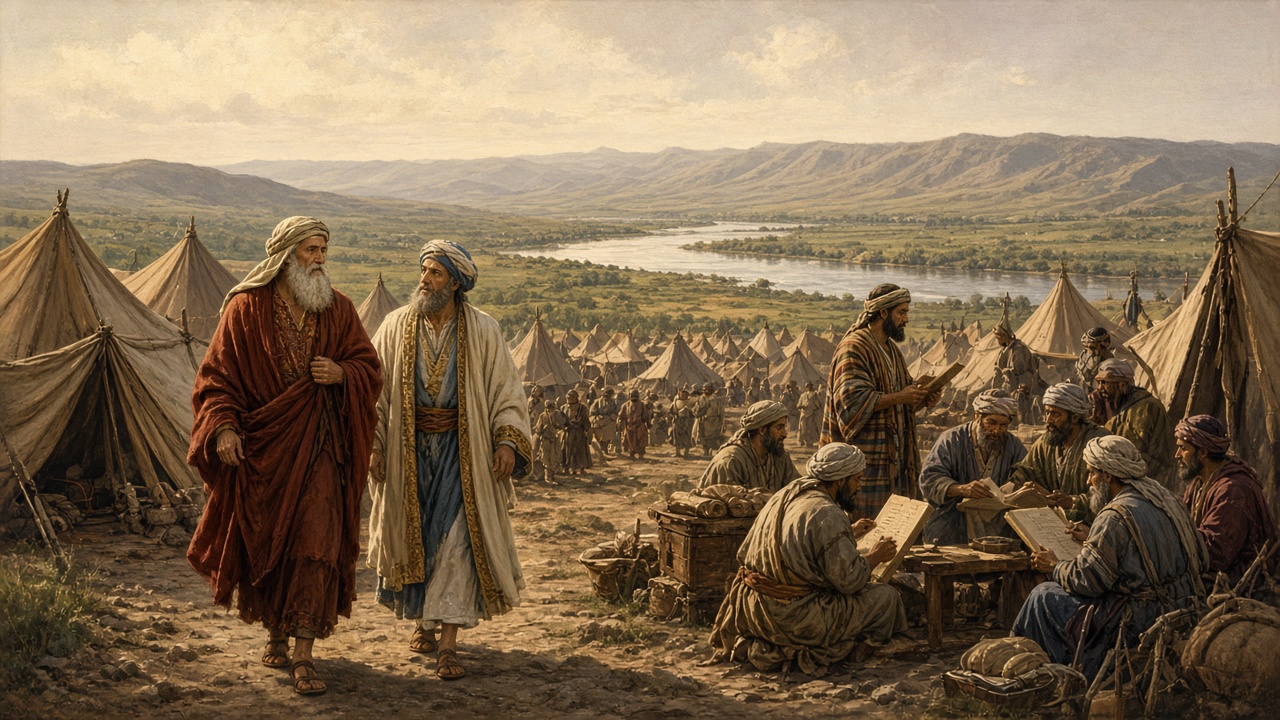
- La narración comienza en Sinaí, la región montañosa a la que Israel llegó en el tercer mes después del Éxodo y donde acampó cerca de un año, y sigue su ruta y sus campamentos por el desierto. Termina en las llanuras de Moab, al este del Jordán y del mar Muerto, frente a Jericó, su último campamento antes de entrar en Canaán, el país al oeste del Jordán. Easton describe esos años como un tiempo de peregrinación en el que aquella generación murió en el desierto, y señala que el pueblo era entonces menos numeroso que cuando salió de Egipto.Fuentes: Easton: Numbers, Book of · Sinai · Moab · Canaan
- Easton divide el libro en tres partes: el censo en Sinaí y los preparativos para reanudar la marcha, incluido el voto de nazareo (1–10:10); el viaje de Sinaí a Moab, el envío de los espías y el informe que trajeron, y las murmuraciones del pueblo, ocho veces, por las penurias del camino (10:11–21:20); y los sucesos en la llanura de Moab antes de cruzar el Jordán (21:21–36).Fuentes: Easton: Numbers, Book of
- Mientras Israel estaba acampado en las llanuras de Moab, Balac, hijo de Zipor y rey de Moab, por temor a ellos, mandó buscar a Petor, en Mesopotamia, a Balaam, hijo de Beor, para maldecirlos; la narración dice que Balaam no pudo hacerlo. Números 21:14 cita también “el libro de las guerras del Señor”, una obra que Easton dice que es incierta, quizá un escrito de Israel hoy perdido o un registro amorreo de las victorias de su rey Sehón.Fuentes: Easton: Numbers, Book of · Balaam · Balak
Notas escritas con ayuda de IA a partir de fuentes abiertas (Theographic Bible Metadata, CC BY-SA 4.0; Easton’s Bible Dictionary, dominio público) y revisadas antes de publicarse.
The First Census of Israel
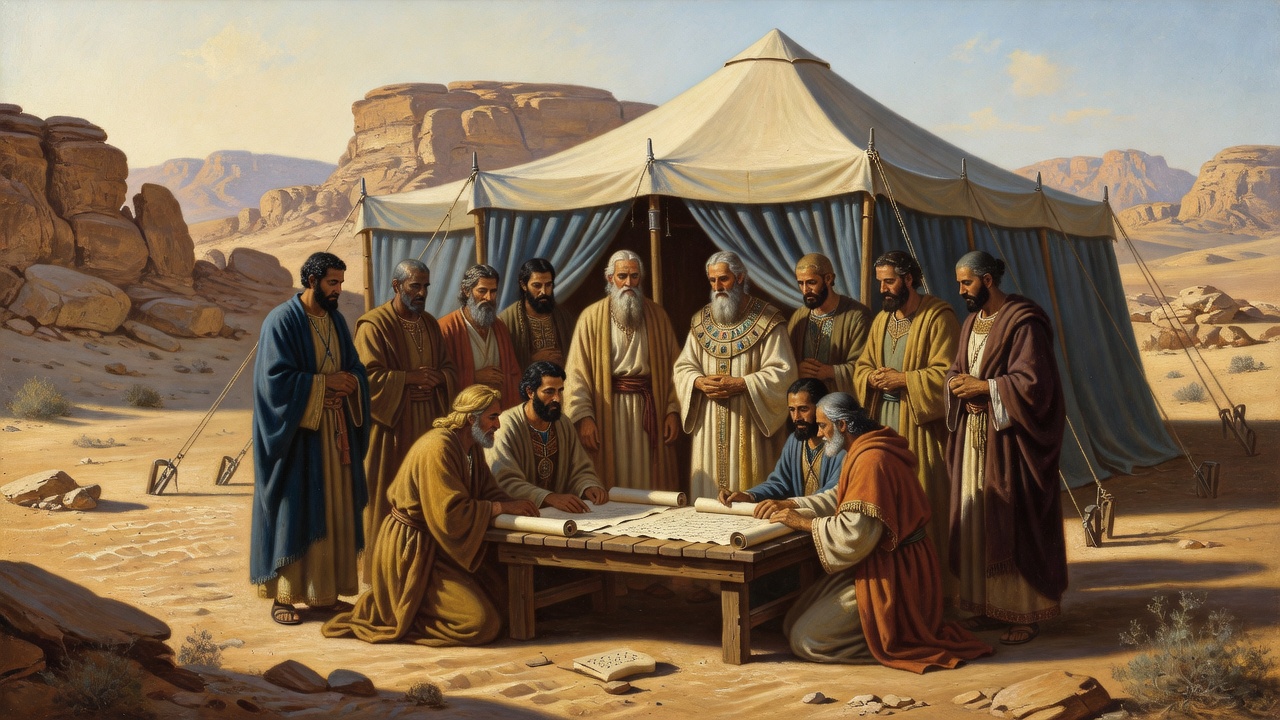
1And the Lord spake with Mosheh in the wilderness of Sinai, in the tabernacle of ordinance, on the first of the second month, in the second year of their coming out from the land of Mizraim, saying: 2Take the sum of all the congregation of the children of Israel after their kindreds, and after the house of their fathers, with the number of their names, every male by their capitations: 3From a son of twenty years and upwards, everyone who can go forth to war in Israel, thou and Aharon number them by their hosts. 4And with you let there be a man of each tribe, a man who is chief of the house of his fathers.
The Leaders of the Tribes
5And these are the names of the men who shall stand with you. Of Reuben, Elizur bar Shedeur; 6of Shemeon, Shelumiel bar Zuri-Shaddai; 7Of Jehudah, Nachshon bar Aminadab; 8Of Issakar, Nethanel bar Zuar; 9Of Zebulon, Eliab bar Chelon; 10Of the Beni-Joseph, of Ephraim, Elishama bar Amihud; of Menasheh, Gamliel bar Pheda-Zur; 11Of Benyamin, Abidan bar Gideoni; 12Of Dan, Achiezer bar Amishaddai; 13Of Asher, Phagiel bar Akran; 14Of Gad, Eljasaph bar Dehuel; 15Of Naphtali, Achira bar Enan. 16These were the called ones of the congregation, princes of the tribes of their fathers, chiefs of the thousands of Israel were they.
The Number of Every Tribe
17And Mosheh and Aharon took these men who were expressed by their names; 18And they assembled all the congregation on the first of the second month, and they declared their pedigrees according to the house of their fathers, with the number of their names from twenty years old and upwards, by their polling. 19As the Lord commanded Mosheh, he numbered them in the wilderness of Sinai.
20And the sons of Reuben the firstborn of Israel, by their generations and their families, according to the house of their fathers, with the number of their names, by their polls; every male from twenty years old and upward, all going forth in the host: 21Of the tribe of Reuben were numbered forty and six thousand and five hundred.
22Of the sons of Shemeon, by their generations and their families and the house of their fathers, were numbered, by the number of their names, according to their polls, every male from twenty years old and upwards, everyone going forth in the host; 23Of the tribe of Shemeon, were numbered fifty and nine thousand and three hundred.
24Of the sons of Gad, the generations of the families of the house of their fathers, according to the number of their names from twenty years old and upwards, everyone going forth in the host; 25Of the tribe of Gad, were numbered forty and five thousand and six hundred and fifty.
26Of the sons of Jehudah, the generations of the families of the house of their fathers, by the number of their names, from twenty years old and upwards, everyone going forth in the host; 27Of the tribe of Jehudah, were numbered seventy and four thousand and six hundred.
28Of the sons of Issakar, the generations of the families of the house of their fathers, by the number of their names, from twenty years old and upwards, everyone going forth in the host; 29Of the tribe of Issakar, were numbered fifty and four thousand and four hundred.
30Of the tribe of Zebulon, the generations of the families of the house of their fathers, by the number of their names, from a son of twenty years and upward, everyone going forth in the host; 31Of the tribe of Zebulon, were numbered fifty and seven thousand and four hundred.
32Of the sons of Joseph, the generations of the Beni-Ephraim by the kindreds of the house of their fathers, in the number of their names, from a son of twenty years and upwards, everyone going forth in the host; 33Of the tribe of Ephraim, forty thousand and five hundred.
34The generations of the Beni Menasheh by the kindreds of the house of their fathers, in the number of their names, from a son of twenty years and upwards, everyone going forth in the host; 35Of the tribe of Menasheh, were numbered thirty and two thousand and two hundred.
36The generations of the sons of Benyamin, by the kindreds of the house of their fathers, in the number of their names, from a son of twenty years and upward, everyone going forth in the host; 37Of the tribe of Benyamin, were numbered thirty and five thousand and four hundred.
38The generations of the Beni Dan, by the kindreds of the house of their fathers, in the number of their names, from a son of twenty years and upward, everyone going forth in the host; 39Of the tribe of Dan, were numbered sixty and two thousand and seven hundred.
40Of the generations or the Beni Asher, by the kindreds of the house of their fathers, in the number of their names, from a son of twenty years and upward, everyone going forth in the host; 41Of the tribe of Asher, were numbered forty and one thousand and five hundred.
42The generations of the sons of Naphtali, by the kindreds of the house of their fathers, in the number of their names, from a son of twenty years and upwards, everyone going forth in the host; 43Of the tribe Naphtali, were numbered fifty and three thousand and four hundred.
44These were the numbered ones whom Mosheh and Aharon, and the twelve men, the princes of Israel, did number, severally, according to the house of their fathers. 45And all those who were numbered of the Beni Israel according to the house of their fathers, from a son of twenty years and upward, everyone going forth in the host of Israel; 46All the numbered ones were six hundred and three thousand and five hundred and fifty.
The Exemption of the Levites
47But the Levites, by the tribe of their fathers, were not numbered among them. 48And the Lord had spoken with Mosheh, saying: 49Only the tribe of Levi thou shalt not number, nor take the account of them among the sons of Israel. 50But thou shalt appoint the Levites over the tabernacle of the testimony, and over all its vessels, and over all that belongeth to it: and they shall carry the tabernacle and all its vessels, and serve it; and they shall encamp round about the tabernacle. 51And when the tabernacle is to go forward, the Levites shall take it apart; and when the tabernacle is to be stationary, the Levites shall set it up; but the stranger who cometh nigh shall be put to death. 52And the sons of Israel shall encamp every man upon his own dwelling-place, and every man by his standard, according to their hosts. 53But the Levites shall dwell round about the tabernacle of the testimony, that there may not be wrath upon the congregation of the sons of Israel; and the Levites shall watch the watching of the tabernacle of testimony. 54And the sons of Israel did according to all that the Lord commanded Mosheh, so did they.
¿Sabías que…?
El censo en el desierto de Sinaí
- El censo se ordenó en el desierto de Sinaí el primer día del segundo mes del segundo año después de que los israelitas salieron de Egipto. Se contó a cada varón de veinte años o más apto para el servicio militar, sumando un total de 603.550 hombres.Fuentes: el propio texto bíblico · Sinai
- Moisés y Aarón llevaron a cabo el registro junto con doce líderes tribales designados. José estuvo representado por dos divisiones tribales distintas con los nombres de sus hijos, Efraín y Manasés.Fuentes: el propio texto bíblico · Ephraim · Manasseh (son of Joseph)
- La tribu de Leví quedó totalmente excluida del censo militar. En su lugar, los levitas fueron asignados exclusivamente a cuidar, transportar, levantar y custodiar el tabernáculo del Testimonio y todos sus utensilios.Fuentes: el propio texto bíblico
Notas escritas con ayuda de IA a partir de fuentes abiertas (Theographic Bible Metadata, CC BY-SA 4.0; Easton’s Bible Dictionary, dominio público) y revisadas antes de publicarse.
Lugares de este capítulo
- Egypt · 30.129, 31.308 · versículo 1
- Wilderness of Sinai · Hoy: about 50 km around Jebel Musa · 28.540, 33.973 · versículos 1, 19
Solo aparecen lugares identificados con alta confianza (90 % o más según las fuentes académicas reunidas por OpenBible). Mapa de la época: DARE (Digital Atlas of the Roman Empire), CC BY 4.0; mapa actual: © colaboradores de OpenStreetMap; lugares: OpenBible.info (CC BY 4.0).
Créditos y licencia de esta traducción
Targum Onkelos Etheridge
The Targums of Onkelos and Jonathan Ben Uzziel On the Pentateuch With The Fragments of the Jerusalem Targum From the Chaldee by J. W. Etheridge, M.A. First Published 1862-65.
Public Domain
Language: English
2020-12-20
Títulos de sección adaptados de la Berean Standard Bible (dominio público); no forman parte del texto bíblico de esta traducción.
Fuente: http://ebible.org/engoke/ · eBible.org