Zacarías 12
The Orthodox Jewish Bible · Toca un versículo para ver sus referencias cruzadas.
The Coming Deliverance of Jerusalem
1The burden of the Devar Hashem concerning Yisroel:
Saith Hashem, who stretcheth forth Shomayim, and layeth the yesod aretz, and formeth the ruach adam within him. 2Hinei, I will make Yerushalayim a cup of reeling unto kol ha'amim (all the peoples) round about, when they shall be in the siege both against Yehudah and against Yerushalayim. 3And on Yom HaHu will I make Yerushalayim an even ma'amasah (a burdensome stone) for kol ha'amim: all that burden themselves with it shall be cut in pieces, though kol Goyei Ha'Aretz be gathered together against her. 4In Yom HaHu, saith Hashem, I will strike every sus with panic, and his rider with madness; and I will open mine eyes upon the Bais Yehudah, and will strike every sus of the people with blindness. 5And the Aluphei Yehudah (leaders of Yehudah) shall say in their lev, The yoshvei Yerushalayim are my strength in Hashem Tzva'os Eloheihem.
6In Yom HaHu will I make the Aluphei Yehudah like a fire pot in the woods, and like a torch of eish in the omer (sheaves); and they shall devour kol haAm round about, on the right hand and on the left; and Yerushalayim shall be inhabited again in her own site, even in Yerushalayim.
7Hashem also shall save the oholei Yehudah (tents of Yehudah) first, that the glory of the Bais Dovid and the glory of the inhabitants of Yerushalayim do not magnify themselves against Yehudah. 8In Yom Hahu shall Hashem defend the inhabitants of Yerushalayim; and he that is feeble among them in Yom Hahu shall be like Dovid; and the Bais Dovid shall be like Elohim, like the Malach Hashem before them. 9And it shall come to pass in Yom Hahu, that I will seek to destroy kol HaGoyim that attack Yerushalayim.
Mourning the One They Pierced
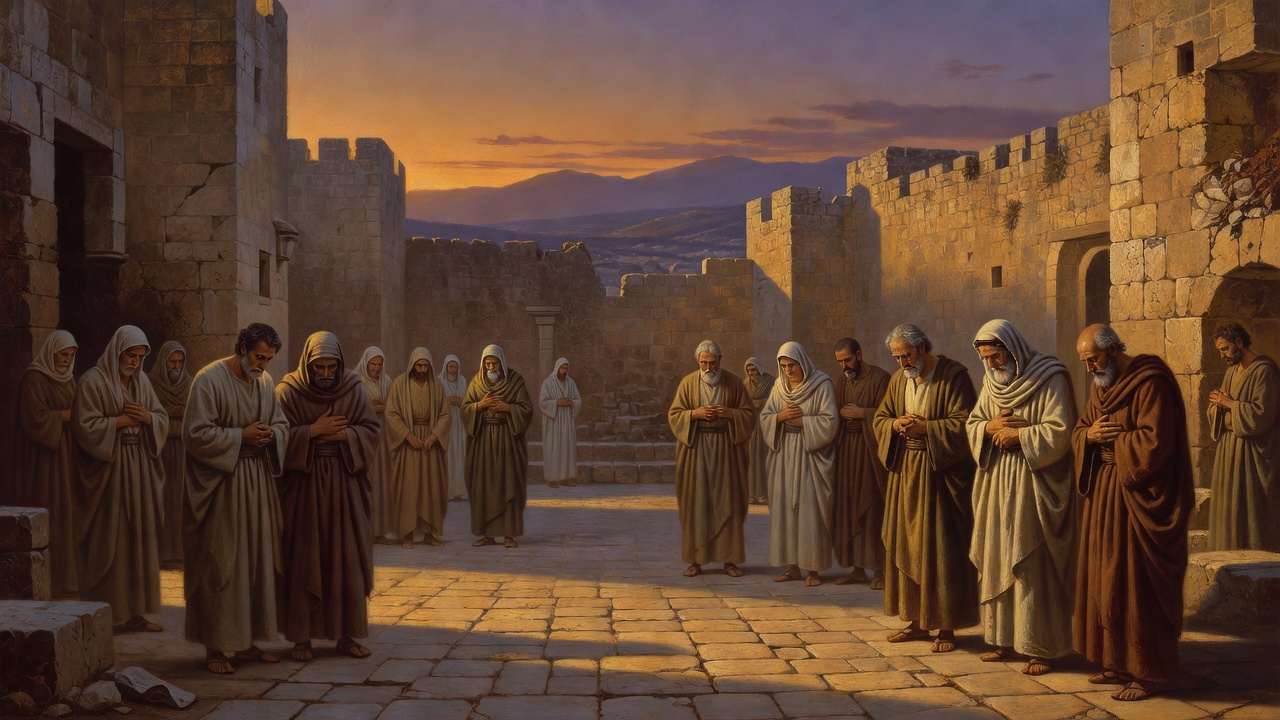
10And I will pour upon the Bais Dovid, and upon the inhabitants of Yerushalayim, the Ruach (Spirit) of Chen (grace) and of Tachanunim (supplications for favor); and they shall look upon Me whom they have pierced, and they shall mourn for Him (Moshiach) as one mourneth for his yachid (only son), and shall grieve in bitterness for him, as one that is in bitterness for his bechor (firstborn). 11In Yom Hahu shall there be a great mourning in Yerushalayim, as the mourning of Hadad-Rimmon in the valley of Megiddo. 12And ha'aretz shall mourn, all mishpochot apart; the mishpachat Bais Dovid apart, and their wives apart; the mishpachat Bais Natan apart, and their wives apart; 13The mishpachat Bais Levi apart, and their wives apart; the mishpachat Shime'i apart, and their wives apart; 14All the mishpochot that remain, all mishpochot apart, and their wives apart.
¿Sabías que…?
Liberación y duelo en Jerusalén
- La referencia al duelo en Hadad-rimón, en la llanura de Meguido, recuerda el lamento nacional por el rey Josías, quien fue herido de muerte cerca de ese lugar. El amplio valle de Meguido era un corredor estratégico y un frecuente campo de batalla en la antigüedad.Fuentes: Hadad-rimmon · Megiddo · el propio texto bíblico
- La profecía menciona familias específicas en duelo por separado, incluidas las líneas reales de David y su hijo Natán, así como la casa sacerdotal de Leví. Esto enfatiza que el profundo dolor y la reflexión personal alcanzarían a todos los estratos de la sociedad, desde los líderes hasta cada hogar particular.Fuentes: David · Nathan · Levi (patriarch) · el propio texto bíblico
- Jerusalén se describe mediante imágenes vívidas, como una piedra pesada e inamovible que hiere a quienes intentan levantarla, y una copa que embriaga a los ejércitos atacantes. Estas metáforas destacan la defensa divina sobre la ciudad frente a las naciones invasoras.Fuentes: Jerusalem · el propio texto bíblico
Notas escritas con ayuda de IA a partir de fuentes abiertas (Theographic Bible Metadata, CC BY-SA 4.0; Easton’s Bible Dictionary, dominio público) y revisadas antes de publicarse.
Lugares de este capítulo
- Jerusalem · 31.777, 35.234 · versículos 2, 3, 5, 6, 7, 8, 9, 10, 11
- Megiddo · Hoy: Tel Megiddo · 32.585, 35.184 · versículo 11
Solo aparecen lugares identificados con alta confianza (90 % o más según las fuentes académicas reunidas por OpenBible). Mapa de la época: DARE (Digital Atlas of the Roman Empire), CC BY 4.0; mapa actual: © colaboradores de OpenStreetMap; lugares: OpenBible.info (CC BY 4.0).
Créditos y licencia de esta traducción
The Orthodox Jewish Bible
The Orthodox Jewish Bible - Tanakh and Orthodox Jewish Brit Chadasha - The Holy Bible
copyright © 2002-2011, 2021, 2024 Artists for Israel International
Language: English
Contributor: Artists for Israel International
THE ORTHODOX JEWISH TANAKH
Artists For Israel Intl Inc.
This version also appears with the Orthodox Yiddish Triglot which presents the Hebrew Yiddish script in Latin script and an English word for word translation, available at afii.org/Torah
To donate PayPal.Me
This translation is made available to you under the terms of the
Creative Commons Attribution license 4.0.
You may share and redistribute this Bible translation or extracts from it in any format, provided that:
You include the above copyright and source information.
If you make any changes to the text, you must indicate that you did so in a way that makes it clear that the original licensor is not necessarily endorsing your changes.
Pictures included with Scriptures and other documents on this site are licensed just for use with those Scriptures and documents.
For other uses, please contact the respective copyright owners.
Note that in addition to the rules above, revising and adapting God's Word involves a great responsibility to be true to God's Word. See Revelation 22:18-19.
2026-01-06
Títulos de sección adaptados de la Berean Standard Bible (dominio público); no forman parte del texto bíblico de esta traducción.
Fuente: http://ebible.org/engojb/ · eBible.org