Hechos 8
The Orthodox Jewish Bible · Toca un versículo para ver sus referencias cruzadas.
Saul Persecutes the Church
1And there came about in that day a great pogrom keneged (against) the Brit Chadasha Kehillah in Yerushalayim, and everyone was scattered throughout the regions of Yehudah and Shomron except the Moshiachʼs Shlichim. 2And chasidim came and gave kevurah (burial) to Stefanos and they made loud lamentation over him. 3But Rav Sha'ul was making havoc of the Moshiachʼs Kehillah, barging in bais by bais, dragging off both anashim and nashim, and delivering them over to the beis hasohar.
Philip in Samaria
4The ones therefore having been scattered went about darshenen the dvar Hashem. 5Now Philippos, having gone down to the city of Shomron, was preaching to them the Rebbe, Melech HaMoshiach. 6And the multitudes with one accord were paying attention to the things being said by Philippos, as they heard him and saw the otot which he was accomplishing. 7For many had ruchot teme'ot coming out, crying out with a kol gadol, and many having been paralyzed and many pisechim (lame ones) were given refu'ah shleimah. 8And there was great simchah in that city.
Simon the Sorcerer
9Now a certain ish by name Shim'on was previously in the city practicing magic and astonishing the people of Shomron, saying that he himself was an ish of gadlus (with remarkable superiority) and gadol. 10And to this certain Shim'on everyone from katon to gadol was paying attention, saying, Hinei! This man is the ko'ach (power) of Hashem, the ko'ach hagadol. 11And they were giving heed to him, because he for a long time had astonished them by magic tricks. 12But with emunah in the darshenen of Philippos about the Malchut Hashem and the Shem of Rebbe, Melech HaMoshiach Yehoshua, they, both anashim and nashim, were submitting to Moshiachʼs mikveh tevilah of teshuva. 13And Shim'on himself also had emunah, and, having submitted to Moshiachʼs tevilah of teshuva, was following Philippos, and, seeing otot and nifla'ot and moftim hagedolim taking place, he was constantly nispoyel (standing in awe).
14And when Moshiachʼs Shlichim heard in Yerushalayim that Shomron has accepted the dvar Hashem, they sent Kefa and Yochanan to them, 15Who, having come down, davened for them that they might receive the Ruach Hakodesh. 16For the Ruach Hakodesh had not yet fallen upon any one of them, but only they had received a tevilah of teshuva in a mikveh mayim b'Shem Rebbe, Melech HaMoshiach Yehoshua Adoneinu. 17Then Kefa and Yochanan were laying their hands upon them, and they were receiving the Ruach Hakodesh. 18And when Shim'on saw that through the laying on of hands of Moshiachʼs Shlichim that the Ruach Hakodesh is given, he brought to them kesef, 19Saying, Give me also this samchut that on whomever I may lay my hands such may receive the Ruach Hakodesh. 20But Kefa said to him, May your kesef perish with you because the matnat Hashem you thought by kesef to acquire. 21There is not to you a chelek (allotted portion) nor share in this matter, for your lev (heart) is krum (deviant) and not upright before Hashem. 22Therefore make teshuva from your wickedness and daven (pray) to Hashem if efsher (perhaps) you will receive selicha (forgiveness) for the intent of your lev, 23For I see you are in bitter gall and the bond of haresha. 24And in reply Shim'on said, Daven for me to Hashem that nothing may come upon me of which you have spoken.
25The ones then having testified and spoken the dvar Adonoi were returning to Yerushalayim and to many villages of the Shomronim preaching the Besuras HaGeulah.
Philip and the Ethiopian
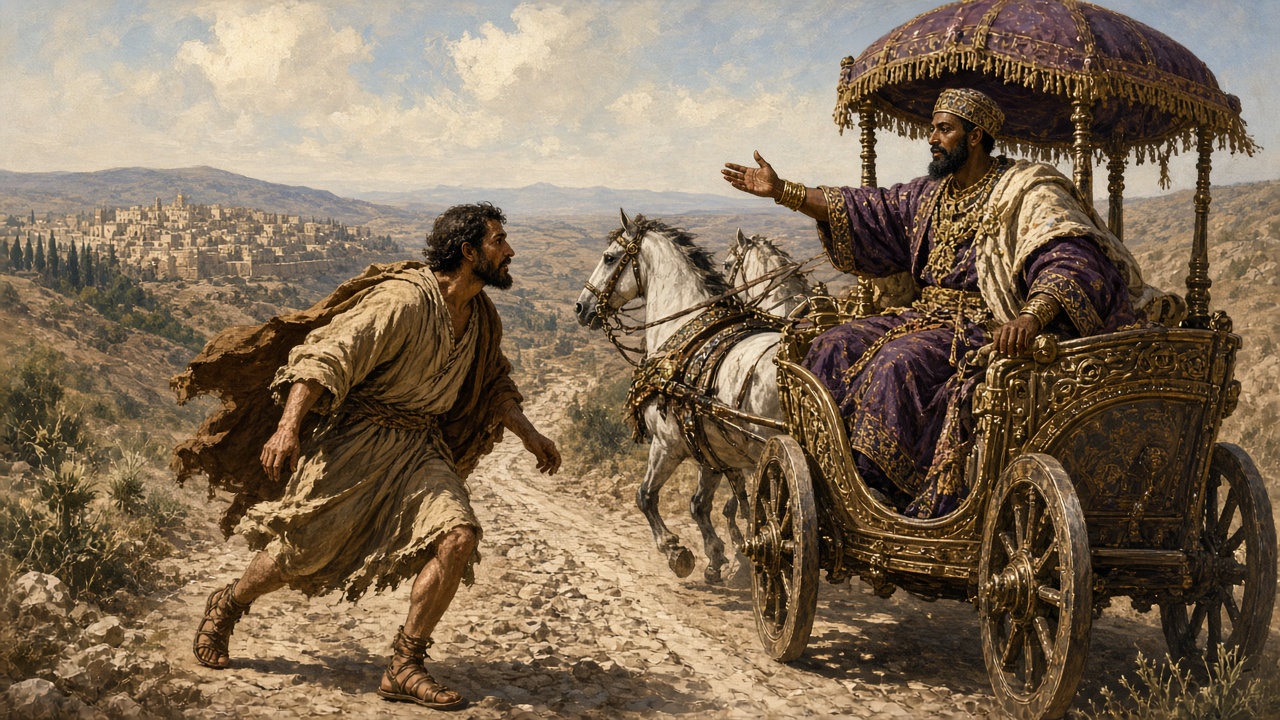
26And a malach Adonoi spoke to Philippos, saying, Get up and go south on the derech going down from Yerushalayim to Gaza. This is desert. 27And having got up, Philippos went. And, hinei, an Ethiopian man, a eunuch, a court official of the Kandake of the Ethiopians! He was over all of her Otzrot (treasury) and had come worshipping to Yerushalayim, 28And he was returning and sitting in his chariot and he was reading Yeshayah HaNavi. 29And the Ruach Hakodesh said to Philippos, Approach and join this chariot. 30And having run, Philippos heard him reading Yeshayah HaNavi, and Philippos said, So do you have binah of what you are reading? 31And he said, How then might I be able, unless someone will guide me? And he invited Philippos to come up and sit with him. 32Now the keta (section) of the Tanakh which he was reading was this: KASEH LATEVACH YUVAL (He was led as a lamb to the slaughter) and as a Seh (Lamb) before the one having sheared it is silent, LO YIFTACH PIV (He does not open his mouth). 33In humiliation his justice was taken away. The descendants of him who will tell? Because he is taken away from HA'ARETZ CHAYYIM. 34And in reply the eunuch said to Philippos, I ask you about whom the Navi (prophet) says this? About himself or about some other person? 35And having opened his mouth, and beginning from this keta (section) of the Kitvei Hakodesh, Philippos began to preach and fier ois (elucidate) Yehoshua/Yeshua to him. 36And as they were going along the derech, they came upon some mayim and the eunuch says, Hinei, mayim! What prevents me from being given Moshiachʼs tevilah of teshuva in the mikveh mayim? [ 37And Philippos said, If you have emunah b'chol levavcha, it is mutar. And he answered, saying, Ani ma'amin ki Rebbe Melech HaMoshiach Yehoshua Ben HaElohim hu.] 38And he commanded the chariot to stop and both went down into the mikveh mayim, both Philippos and the eunuch, and Philippos gave him Moshiachʼs tevilah of teshuva in the mikveh mayim. 39And when they came up from the mikveh mayim, the Ruach Hakodesh of Hashem took Philippos away, and the eunuch did not see him any longer, but was going on his way with lev same'ach. 40But Philippos was found in Ashdod, and passing through, he was preaching the Besuras HaGeulah to all the towns until he came to Caesarea.
¿Sabías que…?
El mensaje se extiende más allá de Jerusalén
- Tras la muerte de Esteban, estalló una gran persecución contra la iglesia en Jerusalén, y todos, excepto los apóstoles, fueron dispersados por Judea y Samaria. Felipe, uno de los siete y más tarde llamado el evangelista, estaba entre ellos; fue primero a Samaria, donde las multitudes atendieron a su mensaje acerca del Cristo.Fuentes: el propio texto bíblico · Phillip the Evangelist
- Antes de que llegara Felipe, Simón había asombrado por mucho tiempo a Samaria con su hechicería, y la gente lo llamaba el poder divino conocido como el Gran Poder. Creyó y fue bautizado, y luego ofreció dinero por el poder de dar el Espíritu Santo mediante la imposición de manos; la palabra simonía, que designa la compra de un cargo espiritual, deriva de su nombre.Fuentes: el propio texto bíblico · Simon the Sorcerer
- Dos caminos unían Jerusalén con Gaza; Felipe fue enviado por el que pasaba por Hebrón y por un distrito poco habitado, llamado desierto. Allí se encontró con un eunuco etíope, tesorero de Candace, reina de los etíopes, que volvía de adorar en Jerusalén y leía al profeta Isaías en su carruaje. Candace era un título que llevaban reinas sucesivas de Meroe, en la Alta Nubia, un rico centro de comercio entre África y el sur de Asia.Fuentes: el propio texto bíblico · Phillip the Evangelist · Candace
Notas escritas con ayuda de IA a partir de fuentes abiertas (Theographic Bible Metadata, CC BY-SA 4.0; Easton’s Bible Dictionary, dominio público) y revisadas antes de publicarse.
Lugares de este capítulo
- Jerusalem · 31.777, 35.234 · versículos 1, 14, 25, 26, 27
- Judea · Hoy: Judea 1 · 31.777, 35.234 · versículo 1
- Samaria · Hoy: Samaria 2 · 32.276, 35.195 · versículos 1, 5, 9, 14, 25
- Gaza · Hoy: Tell Harube · 31.504, 34.464 · versículo 26
- Ethiopia · 16.935, 33.751 · versículo 27
- Ashdod · Hoy: Tel Ashdod · 31.757, 34.658 · versículo 40
- Caesarea · Hoy: Caesarea Maritima · 32.500, 34.892 · versículo 40
Solo aparecen lugares identificados con alta confianza (90 % o más según las fuentes académicas reunidas por OpenBible). Mapa de la época: DARE (Digital Atlas of the Roman Empire), CC BY 4.0; mapa actual: © colaboradores de OpenStreetMap; lugares: OpenBible.info (CC BY 4.0).
Créditos y licencia de esta traducción
The Orthodox Jewish Bible
The Orthodox Jewish Bible - Tanakh and Orthodox Jewish Brit Chadasha - The Holy Bible
copyright © 2002-2011, 2021, 2024 Artists for Israel International
Language: English
Contributor: Artists for Israel International
THE ORTHODOX JEWISH TANAKH
Artists For Israel Intl Inc.
This version also appears with the Orthodox Yiddish Triglot which presents the Hebrew Yiddish script in Latin script and an English word for word translation, available at afii.org/Torah
To donate PayPal.Me
This translation is made available to you under the terms of the
Creative Commons Attribution license 4.0.
You may share and redistribute this Bible translation or extracts from it in any format, provided that:
You include the above copyright and source information.
If you make any changes to the text, you must indicate that you did so in a way that makes it clear that the original licensor is not necessarily endorsing your changes.
Pictures included with Scriptures and other documents on this site are licensed just for use with those Scriptures and documents.
For other uses, please contact the respective copyright owners.
Note that in addition to the rules above, revising and adapting God's Word involves a great responsibility to be true to God's Word. See Revelation 22:18-19.
2026-01-06
Títulos de sección adaptados de la Berean Standard Bible (dominio público); no forman parte del texto bíblico de esta traducción.
Fuente: http://ebible.org/engojb/ · eBible.org