Hechos 7
The Orthodox Jewish Bible · Toca un versículo para ver sus referencias cruzadas.
Stephen’s Address: The Call of Abraham
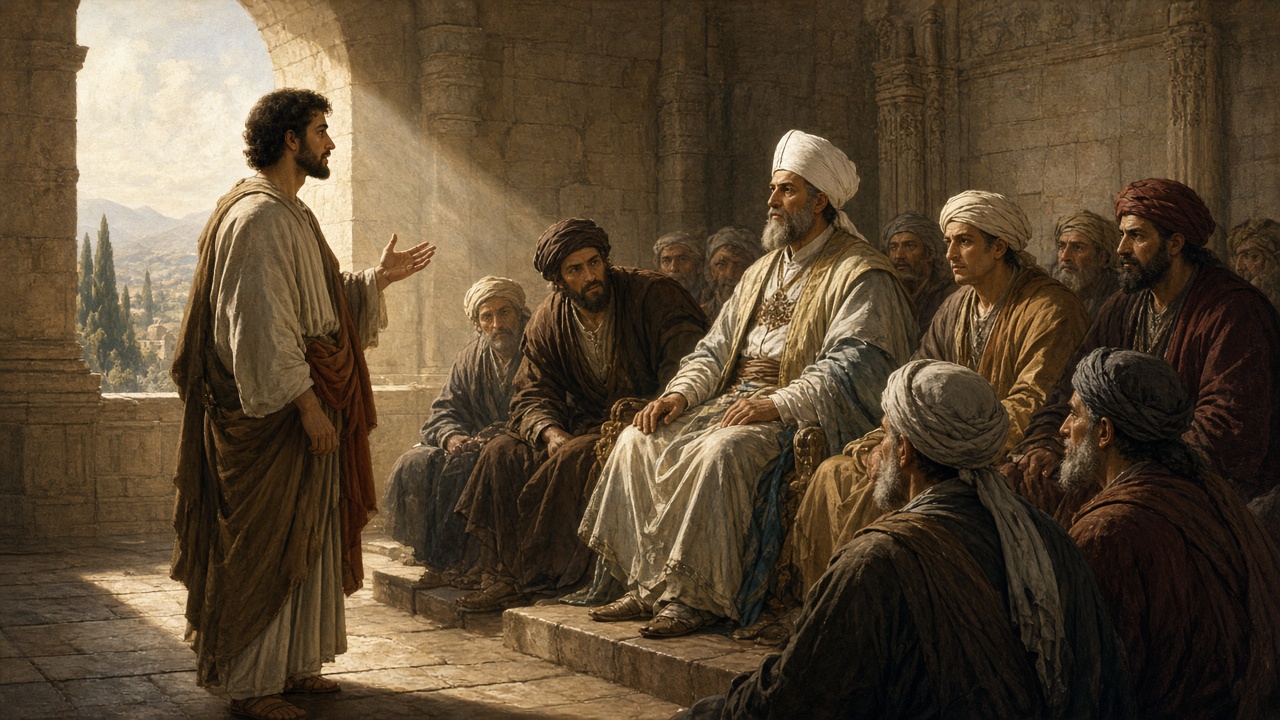
1And the Kohen Gadol said, Are these things so? 2And Stefanos said, Achim and Avot, hear me! Elohei Hakavod appeared to Avraham Avinu while he was in Mesopotamia before he lived in Charan. 3And Hashem said to Avram, Get thee out of thy country, and from thy kindred, and come to the land which I shall show you. 4Then having departed from the land of the Chaldeans, he settled in Charan. And from there, after the mavet of his Av, he was settled by Hashem here in this land in which we now are living. 5And Hashem did not give to him a nachalah (inheritance) in it nor AD MIDRACH KAF REGEL (even enough to put your foot on); and yet, even when he had no ben, the havtachah (promise) of Hashem to him was ES HAARETZ HAZOT E'TEN (This land I will give) to him and to his zera (seed) after him. 6And Hashem spoke thus, that GER YIHIYEH ZAR'ACHA (your seed will be strangers [aliens]) in anotherʼs land and them they will enslave and they will mistreat them ARBA ME'OT SHANAH (four hundred years). 7V'GAM ES HAGOY ASHER YA'AVODU DAN ANOCHI (And whatever nation to which they shall be in bondage I myself will judge, said Hashem,) VACHAREI KHEN YETZU (And after that they will come out) and serve me in this place. 8And he gave to him bris milah. And thus Avraham Avinu became the father of Yitzchak and he did his bris milah on the Yom HaShemini and Yitzchak became the father of Ya'akov and Ya'akov of the Sheneym Asar HaAvot.
Joseph Sold into Egypt
9And the Avot had kinah toward Yosef and sold him into Mitzrayim (Egypt), and Hashem was with him. 10And Hashem delivered Yosef from all his tzoros and gave to him Chen v'Chesed Hashem and chochmah before Pharaoh king of Mitzrayim (Egypt) and he appointed him his grand vizier to rule over Mitzrayim and over his whole bais. 11Now a famine came over all Mitzrayim (Egypt) and Kena'an and tzarah gedolah (great tribulation) and Avoteinu were not finding okhel. 12And when Ya'akov Avinu heard that there was grain in Mitzrayim (Egypt), he sent Avoteinu there pa'am harishonah (the first time). 13And on the second visit Yosef was recognized by his Achim, and Yosefʼs mishpochah became known to Pharaoh. 14And having sent, Yosef summoned Ya'akov his Abba and all his mishpochah, SHIVIM (Seventy) nefashot (souls).
Israel Oppressed in Egypt
15And Ya'akov Avinu went down to Mitzrayim (Egypt) and he died, as did Avoteinu. 16And they were brought back to Shechem and were placed in the kever (tomb) which Avraham bought for a sum of silver from the banim of Chamor in Shechem.
17Now as the time of the havtachah (promise) was drawing near, which Hashem promised to Avraham Avinu, the people grew and were multiplied in Mitzrayim, 18Until over Mitzrayim there appeared a MELECH CHADASH ASHER LO YADA ES YOSEF (a new king who knew not Yosef). 19This king exploited by his shrewdness our nation and mistreated Avoteinu so as to make their ollelim (infants) exposed in order not to keep them alive.
The Birth and Adoption of Moses
20And at this time Moshe Rabbenu was born and he was well pleasing to Hashem; and he was nurtured for shloshah chodashim in the bais of his abba. 21And after he had been exposed, the bat Pharaoh took Moshe Rabbeinu away, and brought him up as her own son. 22And Moshe Rabbenu was instructed in all the chochmah of the Egyptians and in devarim (words) and pe'ulot (deeds) he was given ko'ach.
The Rejection and Flight of Moses
23But when arba'im shanah of his days were completed, it entered into his lev (heart) to visit his Achim of the Bnei Yisroel. 24And having seen one of them being treated unjustly he retaliated and brought yashrus (justice) for the one being oppressed by striking down the Egyptian. 25Now he was assuming that his achim had binah that Hashem by the hand of Moshe was giving Yeshu'at Eloheinu to them, but they did not have binah (understanding). 26And on the next day he came to them as they were fighting and Moshe was trying to reconcile them in shalom, saying, Anashim, you are achim, why are you injuring one another? 27But the one injuring his re'a pushed Moshe aside, saying MI SAMECHA L'ISH SAR V'SHOFET ALENU? (Who made you ruler and judge over us)? 28HALEHARGENI ATAH OMER KA'ASHER HARAGTA yesterday ES HAMITZRI (You do not mean to kill me in the same manner as you killed the Egyptian yesterday?) 29And Moshe Rabbenu fled at this dvar and became a stranger in eretz Midyan, where he became the father of shnei banim.
The Call of Moses
30And at the fulfillment of arba'im shanah a MALACH appeared to him BELABAT EISH MITOCH HASENEH (in flame of fire from within a burning thorn bush) in the desert of the mountain Sinai. 31And Moshe Rabbenu having seen this, was nispoyel (standing in awe) at the chazon and, as he was approaching it to look more closely, there came the kol (voice) of Hashem, 32I am the G-d of your Avot, I am the G-d of Avraham and the G-d of Yitzchak and the G-d of Ya'akov. But Moshe Rabbenu was trembling with pachad and was not daring to look. 33And Hashem said to him, SAL NE'ALECHA ME'AL RAGLECHA (Take off your sandals from your feet) for the place on which you have stood is admat kodesh (holy ground). 34I have seen the ONI AMMI ASHER B'MITZRAYIM (misery of my people in Mitzrayim [Egypt]) and the groaning of them I heard and I came down to deliver them. And now come that I may send you to Mitzrayim (Egypt).
35This Moshe whom they denied, having said, MI SAMECHA L'ISH SAR V'SHOFET? (Who made you a ruler and a judge?), is the one whom G-d sent to be both SAR (ruler) and GO'EL (redeemer) with the help of the malach having appeared to him in the thorn bush. 36This one led them out, effecting moftim and otot in eretz Mitzrayim (Egypt) and in the Yam Suf and in the midbar arba'im shanah. 37This is the Moshe who said to the Bnei Yisroel, NAVI MIKIRBECHA ME'ACHECHA KAMONI YAKIM (A prophet from among you from your brothers like me [ Hashem] will raise up.) 38This is the one having been in the kahal (assembly) in the midbar together with the malach speaking to him at the mountain of Sinai, who was with Avoteinu; he is the one who received torat chayyim to give to us.
The Rebellion of Israel
39And Avoteinu were not willing to have mishma'at (obedience) to Moshe Rabbenu, but they pushed him aside and they turned their levavot back to Mitzrayim (Egypt), 40Having said to Aharon, Make for us g-ds who will go before us; for this Moshe who led us out of the land of Mitzrayim we do not know what happened to him. 41And at that time they made an egel (calf) and brought a sacrifice offering to the elil (idol) and were taking delight in the ma'asim (works) of their hands. 42But Hashem turned away and handed them over to serve the tzeva Shomayim, just as it has been written in the sefer haNevi'im, HAZEVACHIM UMINCHAH HIGASHTEM LI BAMIDBAR ARBA'IM SHANAH, BET YISROEL (It was not to me that you offered victims and sacrifices forty years in the wilderness, was it, O House of Israel?) 43You also took up the ohel of Moloch and the KOKHAV of your g-d Reifan, the tzelamim (idols) which you made to worship them; therefore N'HIGLEITI ETKHEM MEHALAH (I will exile you beyond) Babylon.
The Tabernacle of the Testimony
44Avoteinu had the Mishkan HaEdut in the midbar just as the One who spoke to Moshe [Rabbeinu] directed him to make it according to the TAVNIT (pattern) which he had seen. 45And having received it in their turn, Avoteinu brought it in with Yehoshua (Joshua) upon the dispossessing of the land of the Goyim, which Hashem drove out from the presence of Avoteinu until the yamim of Dovid. 46And Dovid found Chen v'Chesed Hashem before G-d, and asked that he might find a mishkan for Elohei Ya'akov. 47And Sh'lomo (Solomon) built for him a Beis. 48But HaElyon does not dwell in battim made by human hands, just as the Navi (prophet) says, 49HASHOMAYIM KISSI V'HAARETZ HADOM RAGLAI (Heaven is my throne and earth is the footstool for my feet). EI-ZEH BAYIT ASHER TIVNU LI (What kind of House will you build for me?) says Hashem, V'EI ZEH MAKOM MENUCHATI (Or where will my resting place be?) 50Did not my hand ASATAH (make) all these things?
51You AM KESHEH OREF (stiff-necked people), you who are without the “bris milah” of the lev (heart) and of the oznayim (ears), you always resist the Ruach Hakodesh; you are doing like your Avot. 52Which of the Nevi'im (prophets) did your Avot not persecute? And they killed the ones having announced beforehand about the Bias HaMoshiach, the coming of the Tzaddik of whom now you became bogedim and rotzechim (murderers); 53You who received the Torah at the directions of malachim and were not shomer of it.
The Stoning of Stephen
54And hearing these things, they were infuriated in their levavot, and they were grinding their teeth at him. 55But being full of the Ruach Hakodesh and having gazed into Shomayim, Stefanos saw the kavod (glory) of Hashem and Yehoshua standing limin Hashem. 56And Stefanos said, Hinei, I see Shomayim having been opened and the Bar Enosh (Moshiach) standing limin Hashem. 57And having cried out with a kol gadol, they shut their oznayim and they rushed down with one impulse upon Stefanos. 58And having driven Stefanos outside the Ir (City), they were stoning him. And the edim took off their garments at the feet of a bochur named Sha'ul. 59And they went on stoning Stefanos as he called upon Hashem, saying, Adoneinu, receive my neshamah. 60And having fallen down, he cried out in a kol gadol, Adoneinu, may this aveirah not be held against them! And having said this, Stefanos fell asleep. And Rav Sha'ul was giving approval to the murder of Stefanos.
¿Sabías que…?
Esteban relata la historia de Israel
- Esteban abre su discurso con Abraham todavía en Mesopotamia, antes de establecerse en Harán, cuando se le ordenó dejar su tierra y sus parientes. Mesopotamia —en hebreo Aram-naharaim, “Siria de los dos ríos”— era el nombre que griegos y romanos daban a la región entre el Éufrates y el Tigris; en el Antiguo Testamento también se llama Padan-aram, “la llanura de Aram”, y el norte de esa meseta fue el hogar antiguo de los antepasados de los hebreos. El Easton's Bible Dictionary (1897) observa que ese primer llamado no se menciona en el Antiguo Testamento, aunque Génesis 12 lo da a entender, y que Abraham salió de Ur, en Caldea, y recorrió unas 300 millas al norte, hasta Harán.Fuentes: el propio texto bíblico · Mesopotamia · Abraham
- Esteban afirma que los huesos de Jacob y de los padres fueron llevados de vuelta a Siquem y depositados en la tumba que Abraham había comprado a los hijos de Hamor. El Easton's Bible Dictionary (1897) identifica a Hamor como un heveo cuyo nombre significa “asno”, señala que en Hechos 7:16 se le llama Emmor y dice que Jacob le compró el terreno de Siquem en el que después fue sepultado José. El artículo añade que Siquem, hijo de Hamor, fundó la ciudad que llevó su nombre.Fuentes: el propio texto bíblico · Hamor
- Esteban sitúa la zarza ardiente en el desierto, cerca del monte Sinaí, y dice que Moisés recibió allí palabras vivas del ángel que le habló en el monte. El Easton's Bible Dictionary (1897) trata Sinaí —nombre ligado a Sin, un dios lunar— como el mismo distrito montañoso llamado también Horeb. Según el artículo, los hebreos llegaron a esa región al tercer mes después del Éxodo, tras un viaje de unas 150 millas desde el mar Rojo, con todos los recodos del camino, y permanecieron acampados cerca de un año.Fuentes: el propio texto bíblico · Mount Sinai
Notas escritas con ayuda de IA a partir de fuentes abiertas (Theographic Bible Metadata, CC BY-SA 4.0; Easton’s Bible Dictionary, dominio público) y revisadas antes de publicarse.
Lugares de este capítulo
- Haran · Hoy: Harran · 36.864, 39.033 · versículos 2, 4
- Mesopotamia · Hoy: Aram-naharaim · 36.864, 39.033 · versículo 2
- Chaldea · 30.962, 46.104 · versículo 4
- Egypt · 30.129, 31.308 · versículos 9, 10, 11, 12, 14, 15, 17, 18, 34, 36, 39, 40
- Canaan · 32.767, 35.333 · versículo 11
- Shechem · Hoy: Tell Balatah · 32.214, 35.282 · versículo 16
- Nile · Hoy: Nile River · 31.465, 30.367 · versículo 19
- Midian · 28.495, 35.012 · versículo 29
- Babylon · 32.543, 44.422 · versículo 43
Solo aparecen lugares identificados con alta confianza (90 % o más según las fuentes académicas reunidas por OpenBible). Mapa de la época: DARE (Digital Atlas of the Roman Empire), CC BY 4.0; mapa actual: © colaboradores de OpenStreetMap; lugares: OpenBible.info (CC BY 4.0).
Créditos y licencia de esta traducción
The Orthodox Jewish Bible
The Orthodox Jewish Bible - Tanakh and Orthodox Jewish Brit Chadasha - The Holy Bible
copyright © 2002-2011, 2021, 2024 Artists for Israel International
Language: English
Contributor: Artists for Israel International
THE ORTHODOX JEWISH TANAKH
Artists For Israel Intl Inc.
This version also appears with the Orthodox Yiddish Triglot which presents the Hebrew Yiddish script in Latin script and an English word for word translation, available at afii.org/Torah
To donate PayPal.Me
This translation is made available to you under the terms of the
Creative Commons Attribution license 4.0.
You may share and redistribute this Bible translation or extracts from it in any format, provided that:
You include the above copyright and source information.
If you make any changes to the text, you must indicate that you did so in a way that makes it clear that the original licensor is not necessarily endorsing your changes.
Pictures included with Scriptures and other documents on this site are licensed just for use with those Scriptures and documents.
For other uses, please contact the respective copyright owners.
Note that in addition to the rules above, revising and adapting God's Word involves a great responsibility to be true to God's Word. See Revelation 22:18-19.
2026-01-06
Títulos de sección adaptados de la Berean Standard Bible (dominio público); no forman parte del texto bíblico de esta traducción.
Fuente: http://ebible.org/engojb/ · eBible.org