Génesis 8
Open English Bible (U. S. spelling) · Toca un versículo para ver sus referencias cruzadas.
The Ark Rests on Ararat
1Then God remembered Noah and all the beasts and all the animals that were with him in the ark; and God caused a wind to blow over the earth, and the flood subsided, 2the fountains of the deed were stopped and the windows of heaven closed, and the rain from heaven ceased, 3and the waters withdrew more and more from the land for a hundred and fifty days. 4On the seventeenth day of the seventh month, the ark came to rest on the mountains of Ararat. 5The waters continued to go down until, on the first day of the tenth month, the tops of the mountains could be seen.
Noah Sends a Raven and a Dove
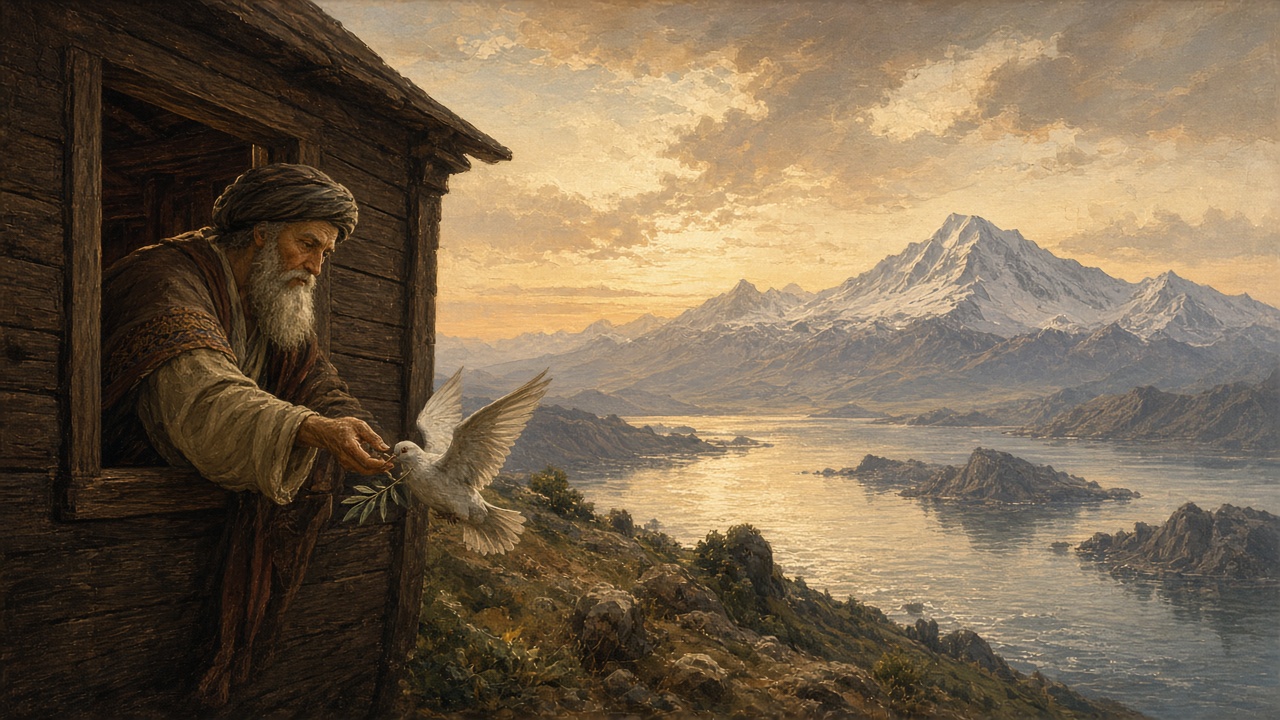
6After forty days Noah opened the window of the ark, 7and sent out a raven; and it kept going to and fro until the waters were dried up from the earth. 8He also sent out a dove to see if the waters had subsided from the surface of the ground; 9but the dove found no rest for her foot, and so returned to him to the ark, for the waters covered the surface of the whole earth. So he reached out his hand and took her and brought her back into the ark.
10Then he waited seven days longer and again sent out the dove from the ark. 11The dove came in to him at dusk and in her mouth was a freshly plucked olive-leaf. So Noah knew that the waters had subsided from the earth. 12He waited seven days more and sent out the dove; but it did not return to him again.
Exiting the Ark
13So it was that in the first day of the first month of Noah’s six hundred and first year, the waters had dried up. Noah removed the covering of the ark and looked, and saw that the surface of the ground was dry. 14It was the twenty-seventh day of the second month.
15God said to Noah, 16“Leave the ark with your wife and sons and their wives. 17Bring out every living creature, every bird, cattle, and creeping thing that creeps on the earth, so that they can spread over the earth, and be fruitful and multiply.” 18So Noah left the ark with his sons and his wife and his son’s wives, 19and every living creature, every creeping thing, every bird came out one kind after another.
Noah Builds an Altar
20Noah built an altar to the Lord and took one of every beast and bird that was fit for sacrifice and offered burnt-offerings on the altar. 21When the Lord smelled the pleasing odour, he said to himself, “I will never again curse the ground because of people because the inclination of their heart is evil from their youth, nor will I again destroy every living thing, as I have done. 22While the earth remains, seedtime and harvest, cold and heat, summer and winter, day and night, will not cease.”
¿Sabías que…?
Las aguas retroceden
- El arca se detuvo sobre los montes de Ararat, nombre que significa “tierra sagrada” o “tierra alta” y designa un país en cuyas montañas el arca reposó después del diluvio. El Easton's Bible Dictionary (1897) sugiere que esos montes eran, probablemente, la cordillera kurda del sur de Armenia, aunque el nombre también se aplica comúnmente a un pico alto y casi inaccesible que se alza desde la llanura del Araxes. En 2 Reyes 19:37 e Isaías 37:38, la Authorized Version traduce el nombre como “Armenia” y la Revised Version como “tierra de Ararat”, mientras que Jeremías 51:27 lo usa para la Armenia central o meridional.Fuentes: Ararat · el propio texto bíblico
- El nombre hebreo de Noé significa “descanso”, y en este capítulo la propia arca llega a reposar mientras bajan las aguas. Era hijo de Lamec y nieto de Matusalén, y padre de Sem, Cam y Jafet. El Easton's Bible Dictionary lo describe como el vínculo entre el mundo antiguo y el nuevo, y como un segundo gran progenitor de la familia humana.Fuentes: Noah · el propio texto bíblico
- Unas notas cronológicas sitúan el Gran Diluvio en 2347 a. C., con una duración de un año; el descenso de las aguas en 2346 a. C., a lo largo de 220 días; y la salida del arca en 2346 a. C., en un solo día. En el propio capítulo, las aguas ya han bajado después de 150 días y el arca reposa el día diecisiete del mes séptimo; el día primero del mes primero del año seiscientos uno de Noé las aguas se han secado, y para el día veintisiete del mes segundo la tierra está completamente seca.Fuentes: The Great Flood · The flood subsides · Leaving the Ark · el propio texto bíblico
Notas escritas con ayuda de IA a partir de fuentes abiertas (Theographic Bible Metadata, CC BY-SA 4.0; Easton’s Bible Dictionary, dominio público) y revisadas antes de publicarse.
Lugares de este capítulo
- Ararat · Hoy: Urartu · 39.703, 44.300 · versículo 4
Solo aparecen lugares identificados con alta confianza (90 % o más según las fuentes académicas reunidas por OpenBible). Mapa de la época: DARE (Digital Atlas of the Roman Empire), CC BY 4.0; mapa actual: © colaboradores de OpenStreetMap; lugares: OpenBible.info (CC BY 4.0).
Créditos y licencia de esta traducción
Open English Bible (U. S. spelling)
The Holy Bible, Open English Bible translation, U. S. spelling edition
Public Domain
Language: English
Translation by: OpenEnglishBible.org
Please see OpenEnglishBible.org/ for information about this translation.
2026-10-02
Títulos de sección adaptados de la Berean Standard Bible (dominio público); no forman parte del texto bíblico de esta traducción.
Fuente: http://ebible.org/engoebus/ · eBible.org