Genesis 8
Open English Bible (U. S. spelling) · Tap a verse to see its cross-references.
The Ark Rests on Ararat
1Then God remembered Noah and all the beasts and all the animals that were with him in the ark; and God caused a wind to blow over the earth, and the flood subsided, 2the fountains of the deed were stopped and the windows of heaven closed, and the rain from heaven ceased, 3and the waters withdrew more and more from the land for a hundred and fifty days. 4On the seventeenth day of the seventh month, the ark came to rest on the mountains of Ararat. 5The waters continued to go down until, on the first day of the tenth month, the tops of the mountains could be seen.
Noah Sends a Raven and a Dove
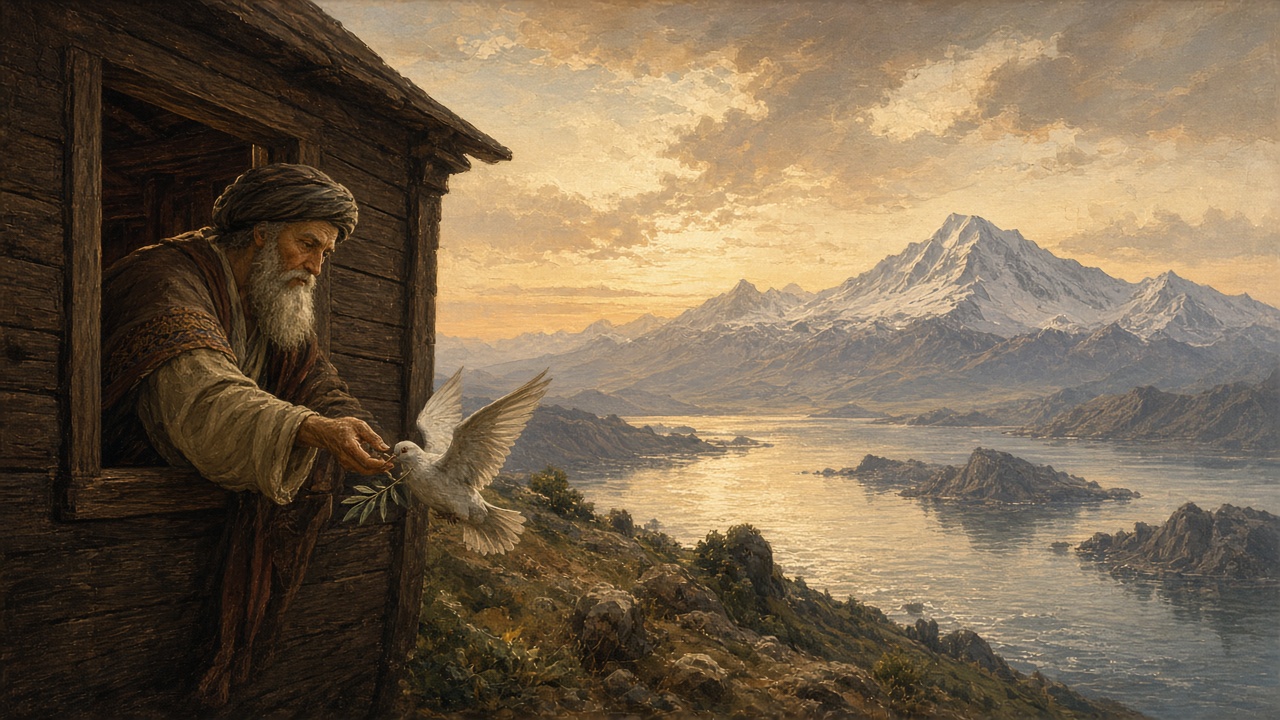
6After forty days Noah opened the window of the ark, 7and sent out a raven; and it kept going to and fro until the waters were dried up from the earth. 8He also sent out a dove to see if the waters had subsided from the surface of the ground; 9but the dove found no rest for her foot, and so returned to him to the ark, for the waters covered the surface of the whole earth. So he reached out his hand and took her and brought her back into the ark.
10Then he waited seven days longer and again sent out the dove from the ark. 11The dove came in to him at dusk and in her mouth was a freshly plucked olive-leaf. So Noah knew that the waters had subsided from the earth. 12He waited seven days more and sent out the dove; but it did not return to him again.
Exiting the Ark
13So it was that in the first day of the first month of Noah’s six hundred and first year, the waters had dried up. Noah removed the covering of the ark and looked, and saw that the surface of the ground was dry. 14It was the twenty-seventh day of the second month.
15God said to Noah, 16“Leave the ark with your wife and sons and their wives. 17Bring out every living creature, every bird, cattle, and creeping thing that creeps on the earth, so that they can spread over the earth, and be fruitful and multiply.” 18So Noah left the ark with his sons and his wife and his son’s wives, 19and every living creature, every creeping thing, every bird came out one kind after another.
Noah Builds an Altar
20Noah built an altar to the Lord and took one of every beast and bird that was fit for sacrifice and offered burnt-offerings on the altar. 21When the Lord smelled the pleasing odour, he said to himself, “I will never again curse the ground because of people because the inclination of their heart is evil from their youth, nor will I again destroy every living thing, as I have done. 22While the earth remains, seedtime and harvest, cold and heat, summer and winter, day and night, will not cease.”
Did you know?
The Waters Recede
- The ark came to rest on the mountains of Ararat, a name meaning “sacred land” or “high land” for a country on whose mountains the ark settled after the flood. Easton's Bible Dictionary (1897) suggests those mountains were probably the Kurdish range of southern Armenia, though the name is also commonly applied to a high, almost inaccessible peak rising from the plain of the Araxes. In 2 Kings 19:37 and Isaiah 37:38 the Authorized Version renders the name “Armenia” and the Revised Version “land of Ararat,” while Jeremiah 51:27 uses it for central or southern Armenia.Sources: Ararat · the Bible text itself
- Noah’s Hebrew name means “rest,” and in this chapter the ark itself comes to rest as the waters go down. He was the son of Lamech and the grandson of Methuselah, and the father of Shem, Ham, and Japheth. Easton's Bible Dictionary describes him as the connecting link between the old world and the new, and as a second great progenitor of the human family.Sources: Noah · the Bible text itself
- Chronological notes place the Great Flood in 2347 BC, lasting one year; the subsiding of the waters in 2346 BC, over 220 days; and the leaving of the ark in 2346 BC, as a single day. In the chapter itself, the waters have gone down after 150 days and the ark rests on the seventeenth day of the seventh month; on the first day of the first month of Noah’s six hundred and first year the waters have dried up, and by the twenty-seventh day of the second month the earth is fully dry.Sources: The Great Flood · The flood subsides · Leaving the Ark · the Bible text itself
Notes written with AI assistance from open sources (Theographic Bible Metadata, CC BY-SA 4.0; Easton’s Bible Dictionary, public domain) and reviewed before publishing.
Places in this chapter
- Ararat · Today: Urartu · 39.703, 44.300 · verse 4
Only places identified with high confidence are shown (90% or more according to the scholarly sources compiled by OpenBible). Period map: DARE (Digital Atlas of the Roman Empire), CC BY 4.0; modern map: © OpenStreetMap contributors; places: OpenBible.info (CC BY 4.0).
Credits and license for this translation
Open English Bible (U. S. spelling)
The Holy Bible, Open English Bible translation, U. S. spelling edition
Public Domain
Language: English
Translation by: OpenEnglishBible.org
Please see OpenEnglishBible.org/ for information about this translation.
2026-10-02
Section headings adapted from the Berean Standard Bible (public domain); they are not part of this translation’s text.
Source: http://ebible.org/engoebus/ · eBible.org