Marcos 3
Nyangumarta English Bible · Toca un versículo para ver sus referencias cruzadas.
JESUS HEALED SOMEONE WITH A SHRIVELLED HAND ON SATURDAY. SOME PEOPLE CRITICISED HIM (3:1-6)
1After that Jesus again entered the meeting house. That day was Saturday. In that house there was a man with a bad hand, it was shrivelled, he could not move the hand. 2There were a few Pharisees there also. They did not like Jesus. They were watching him. They were saying to each other, “Today is Saturday. He might heal the sick person. According to our law that is bad. He should not heal a sick one on Saturday. If he does that we will really criticise him.” In that way those Pharisees were talking to each other. 3Jesus said to that man with the bad hand, “Come here.” 4Then he said to the Pharisees, “Listen! You know about Saturday, our day for not working. That is according to God's word. Yes, according to our law what shall we do to people on Saturday? Shall we do good to them? Shall we do bad to them? Shall we heal them? Shall we hit/kill them? What? You say.” They did not answer him. They were quiet in his presence. They were without pity and were stubborn. Therefore Jesus looked at them with anger. He was also sorry for them. After that he said to the man with the bad hand, “Stretch out your hand.” He stretched it out, it became well. 6Then those Pharisees became angry with him. They went away to talk with some others, what's their name, Herod's people. They joined together, they were discussing among themselves, “How shall we kill Jesus?”
MANY PEOPLE WERE LISTENING TO JESUS NEAR THE WATER (3:7-12)
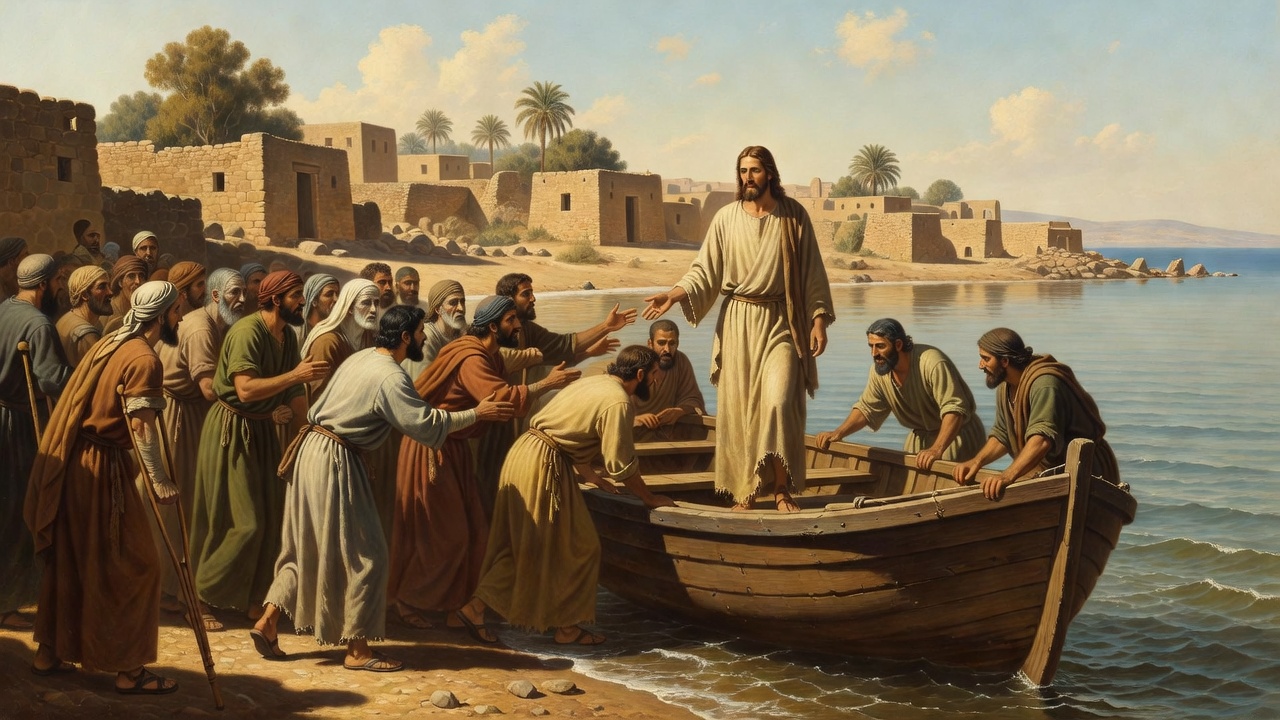
7After that Jesus and his men went to the big water, the waterhole Galilee. Many people followed him. They were coming from that big town, Jerusalem, and from the countries of Judea and Idumea and from the other side of the Jordan river. They heard, “Jesus healed those who were sick.” After that many were coming. 9He healed many who were sick. They were coming very close to touch him. After that Jesus told his men, They might squash me. Get a dinghy for me. I will sit in it to avoid being squashed.” 11Some people were bringing other people to Jesus, they were crazy. Evil spirits were controlling them. As soon as they saw Jesus the evil spirits were throwing the people on the ground in front of Jesus. They were calling out with fear, “Jesus! You are God's child!” He was telling the spirits sternly, “Be quiet!” He was preventing them from naming him, “God's Child”.
¿Sabías que…?
Multitudes, los Doce y la acusación de Satanás
- Varios de los hombres que Jesús designó como los doce habían sido pescadores en Galilea. Simón, a quien llamó Pedro, y su hermano Andrés eran de Betsaida; Santiago y Juan, hijos de Zebedeo, pescaban en sociedad con Pedro. Jesús llamó a esos hermanos Boanerges, “Hijos del Trueno”; el Diccionario Bíblico de Easton (1897) dice que probablemente recibieron ese nombre por su audacia y su energía.Fuentes: Simon Peter · Andrew · James (Son of Zebedee) · el propio texto bíblico
- La gente se agolpaba desde Galilea, Judea, Jerusalén, Idumea, el otro lado del Jordán y la región de Tiro y Sidón, porque había oído lo que Jesús hacía. Tiro y Sidón eran antiguas ciudades fenicias del Mediterráneo; Sidón estaba a unas veinticinco millas al norte de Tiro. Bajo los romanos, Judea era la más meridional de las tres divisiones de Palestina, distinta de Galilea.Fuentes: el propio texto bíblico · Tyre · Sidon · Judea
- Unos escribas que habían bajado de Jerusalén decían que Jesús estaba poseído por Beelzebul y que expulsaba demonios por el príncipe de los demonios. Él respondió preguntando cómo Satanás puede expulsar a Satanás. Satanás significa “adversario” o “acusador”; en el Nuevo Testamento el nombre se usa de manera intercambiable con el diablo, y el Diccionario Bíblico de Easton (1897) también lo llama Beelzebub.Fuentes: el propio texto bíblico · Satan
Notas escritas con ayuda de IA a partir de fuentes abiertas (Theographic Bible Metadata, CC BY-SA 4.0; Easton’s Bible Dictionary, dominio público) y revisadas antes de publicarse.
Lugares de este capítulo
- Galilee · 32.760, 35.527 · versículo 7
- Judea · Hoy: Judea 1 · 31.777, 35.234 · versículo 7
- Idumea · 31.525, 35.102 · versículo 8
- Jerusalem · 31.777, 35.234 · versículos 8, 22
- Jordan · Hoy: Jordan River · 31.761, 35.558 · versículo 8
- Sidon · Hoy: Sandikli archaeological site in Sidon · 33.561, 35.372 · versículo 8
- Tyre · 33.271, 35.196 · versículo 8
Solo aparecen lugares identificados con alta confianza (90 % o más según las fuentes académicas reunidas por OpenBible). Mapa de la época: DARE (Digital Atlas of the Roman Empire), CC BY 4.0; mapa actual: © colaboradores de OpenStreetMap; lugares: OpenBible.info (CC BY 4.0).
Créditos y licencia de esta traducción
Nyangumarta English Bible
Portions of the Holy Bible in English, translated to be a companion to the Nyangumarta Bible
copyright © 1980-2010 Wycliffe Bible Translators, Inc.
Language: English
Bible translation copyright © 1980-2010 Wycliffe Bible Translators, Inc.
Reader Series (book XXC) copyright © 1996 Bible Society Australia. Bible overview (XXA) copyright © 1996 Mission Publications of Australia (PO Box 21, Lawson NSW 2783)
This translation is made available to you under the terms of the
Creative Commons Attribution-Noncommercial-No Derivatives license 4.0.
You may share and redistribute this Bible translation or extracts from it in any format, provided that:
You include the above copyright and source information.
You do not sell this work for a profit.
You do not change any of the words or punctuation of the Scriptures.
Pictures included with Scriptures and other documents on this site are licensed just for use with those Scriptures and documents.
For other uses, please contact the respective copyright owners.
2026-01-06
Fuente: http://ebible.org/engnna/ · eBible.org