Cantares 7
NET Bible · Toca un versículo para ver sus referencias cruzadas.
The Lover to His Beloved:
1How beautiful are your sandaled feet,
O nobleman’s daughter!
The curves of your thighs are like jewels,
the work of the hands of a master craftsman.
2Your navel is a round mixing bowl –
may it never lack mixed wine!
Your belly is a mound of wheat,
encircled by lilies.
3Your two breasts are like two fawns,
twins of a gazelle.
4Your neck is like a tower made of ivory.
Your eyes are the pools in Heshbon
by the gate of Bath-Rabbim.
Your nose is like the tower of Lebanon
overlooking Damascus.
5Your head crowns you like Mount Carmel.
The locks of your hair are like royal tapestries –
the king is held captive in its tresses!
6How beautiful you are! How lovely,
O love, with your delights!
The Palm Tree and the Palm Tree Climber
The Lover to His Beloved:
7Your stature is like a palm tree,
and your breasts are like clusters of grapes.
8I want to climb the palm tree,
and take hold of its fruit stalks.
May your breasts be like the clusters of grapes,
and may the fragrance of your breath be like apricots!
9May your mouth be like the best wine,
flowing smoothly for my beloved,
gliding gently over our lips as we sleep together.
Poetic Refrain: Mutual Possession
The Beloved about Her Lover:
10I am my beloved’s,
and he desires me!
The Journey to the Countryside
The Beloved to Her Lover:
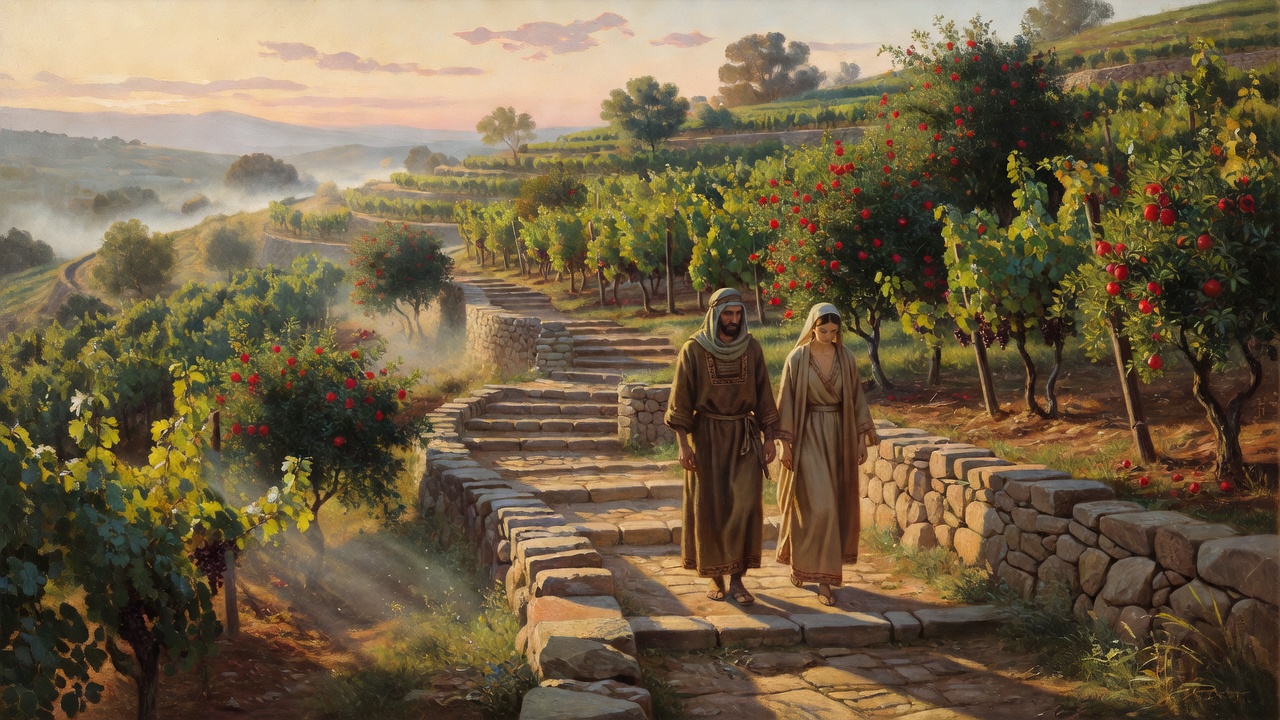
11Come, my beloved, let us go to the countryside;
let us spend the night in the villages.
12Let us rise early to go to the vineyards,
to see if the vines have budded,
to see if their blossoms have opened,
if the pomegranates are in bloom –
there I will give you my love.
13The mandrakes send out their fragrance;
over our door is every delicacy,
both new and old, which I have stored up for you, my lover.
¿Sabías que…?
Poesía de Amor y Paisaje
- El poema describe la belleza de la mujer utilizando destacados puntos geográficos de la región. Sus ojos son comparados con los estanques de Hesbón, cerca de la puerta de Bat-rabim al este del Jordán, mientras que su perfil se asemeja a una torre majestuosa en la cordillera del Líbano que mira hacia Damasco.Fuentes: el propio texto bíblico · Heshbon · Bath-rabbim · Lebanon
- El capítulo concluye con una invitación al campo durante el despertar de la primavera. Los amantes salen a observar los brotes de las vides, la floración de los granados y el aroma de las mandrágoras, reflejando la estrecha relación en la poesía hebrea antigua entre la intimidad romántica y la naturaleza.Fuentes: el propio texto bíblico
Notas escritas con ayuda de IA a partir de fuentes abiertas (Theographic Bible Metadata, CC BY-SA 4.0; Easton’s Bible Dictionary, dominio público) y revisadas antes de publicarse.
Lugares de este capítulo
- Bath-rabbim · Hoy: in Tell Hesban · 31.801, 35.809 · versículo 4
- Damascus · 33.511, 36.306 · versículo 4
- Lebanon · 33.540, 35.584 · versículo 4
- Mount Carmel · 32.672, 35.023 · versículo 5
Solo aparecen lugares identificados con alta confianza (90 % o más según las fuentes académicas reunidas por OpenBible). Mapa de la época: DARE (Digital Atlas of the Roman Empire), CC BY 4.0; mapa actual: © colaboradores de OpenStreetMap; lugares: OpenBible.info (CC BY 4.0).
Créditos y licencia de esta traducción
NET Bible
NET Bible®, New English Translation (NET)
copyright © 1996-2016 Biblical Studies Press, L. L. C.
Please see https://netbible.com/copyright/ for full NET Bible copyright and permissions information. You can also read the NET Bible at http://NETBible.org .
Language: English
Dialect (if applicable): American
Language in English: English
Translation by:
Please see https://netbible.com/copyright/ for full NET Bible copyright and permissions information. You can also read the NET Bible at http://NETBible.org .
The NET Bible (New English Translation) is a completely new translation of the Bible with 58,506 translators’ notes ! It was completed by more than 25 scholars – experts in the original biblical languages – who worked directly from the best currently available Hebrew, Aramaic, and Greek texts. Turn the pages and see the breadth of the translators’ notes, documenting their decisions and choices as they worked.
The translators’ notes make the original languages far more accessible, allowing you to look over the translator’s shoulder at the very process of translation. This level of documentation is a first for a Bible translation, making transparent the textual basis and the rationale for key renderings (including major interpretive options and alternative translations).
This unparalleled level of detail helps connect people to the Bible in the original languages in a way never before possible without years of study of Hebrew, Aramaic, and Greek. It unlocks the riches of the Bible’s truth from entirely new perspectives.
A donation is appreciated. Donate at Bible.org/donations_form so we can continue to provide our material for free for our 16,000+ articles on Bible.org and our world class Bible Study tool at lumina.bible.org .
2026-10-02
Fuente: http://ebible.org/engnet/ · eBible.org