Song of Songs 7
NET Bible · Tap a verse to see its cross-references.
The Lover to His Beloved:
1How beautiful are your sandaled feet,
O nobleman’s daughter!
The curves of your thighs are like jewels,
the work of the hands of a master craftsman.
2Your navel is a round mixing bowl –
may it never lack mixed wine!
Your belly is a mound of wheat,
encircled by lilies.
3Your two breasts are like two fawns,
twins of a gazelle.
4Your neck is like a tower made of ivory.
Your eyes are the pools in Heshbon
by the gate of Bath-Rabbim.
Your nose is like the tower of Lebanon
overlooking Damascus.
5Your head crowns you like Mount Carmel.
The locks of your hair are like royal tapestries –
the king is held captive in its tresses!
6How beautiful you are! How lovely,
O love, with your delights!
The Palm Tree and the Palm Tree Climber
The Lover to His Beloved:
7Your stature is like a palm tree,
and your breasts are like clusters of grapes.
8I want to climb the palm tree,
and take hold of its fruit stalks.
May your breasts be like the clusters of grapes,
and may the fragrance of your breath be like apricots!
9May your mouth be like the best wine,
flowing smoothly for my beloved,
gliding gently over our lips as we sleep together.
Poetic Refrain: Mutual Possession
The Beloved about Her Lover:
10I am my beloved’s,
and he desires me!
The Journey to the Countryside
The Beloved to Her Lover:
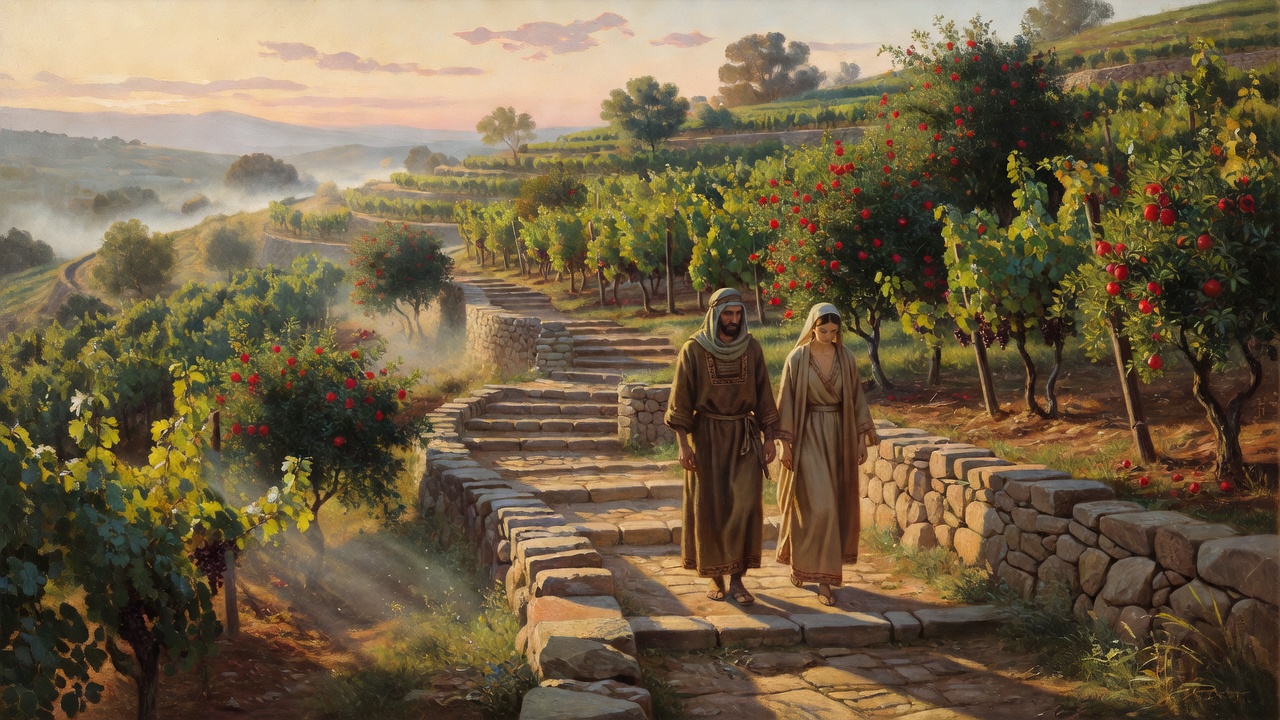
11Come, my beloved, let us go to the countryside;
let us spend the night in the villages.
12Let us rise early to go to the vineyards,
to see if the vines have budded,
to see if their blossoms have opened,
if the pomegranates are in bloom –
there I will give you my love.
13The mandrakes send out their fragrance;
over our door is every delicacy,
both new and old, which I have stored up for you, my lover.
Did you know?
Poetry of Love and Landscape
- The poem describes the woman's beauty using prominent landmarks of the region. Her eyes are compared to the calm pools of Heshbon near the gate of Bath-rabbim east of the Jordan, while her profile is likened to a majestic tower in the mountain range of Lebanon overlooking Damascus.Sources: the Bible text itself · Heshbon · Bath-rabbim · Lebanon
- The chapter concludes with an invitation to the countryside during the renewal of spring. The lovers seek out budding grapevines, blooming pomegranates, and fragrant mandrakes, reflecting the close connection in ancient Hebrew poetry between romantic intimacy and the vitality of the natural world.Sources: the Bible text itself
Notes written with AI assistance from open sources (Theographic Bible Metadata, CC BY-SA 4.0; Easton’s Bible Dictionary, public domain) and reviewed before publishing.
Places in this chapter
- Bath-rabbim · Today: in Tell Hesban · 31.801, 35.809 · verse 4
- Damascus · 33.511, 36.306 · verse 4
- Lebanon · 33.540, 35.584 · verse 4
- Mount Carmel · 32.672, 35.023 · verse 5
Only places identified with high confidence are shown (90% or more according to the scholarly sources compiled by OpenBible). Period map: DARE (Digital Atlas of the Roman Empire), CC BY 4.0; modern map: © OpenStreetMap contributors; places: OpenBible.info (CC BY 4.0).
Credits and license for this translation
NET Bible
NET Bible®, New English Translation (NET)
copyright © 1996-2016 Biblical Studies Press, L. L. C.
Please see https://netbible.com/copyright/ for full NET Bible copyright and permissions information. You can also read the NET Bible at http://NETBible.org .
Language: English
Dialect (if applicable): American
Language in English: English
Translation by:
Please see https://netbible.com/copyright/ for full NET Bible copyright and permissions information. You can also read the NET Bible at http://NETBible.org .
The NET Bible (New English Translation) is a completely new translation of the Bible with 58,506 translators’ notes ! It was completed by more than 25 scholars – experts in the original biblical languages – who worked directly from the best currently available Hebrew, Aramaic, and Greek texts. Turn the pages and see the breadth of the translators’ notes, documenting their decisions and choices as they worked.
The translators’ notes make the original languages far more accessible, allowing you to look over the translator’s shoulder at the very process of translation. This level of documentation is a first for a Bible translation, making transparent the textual basis and the rationale for key renderings (including major interpretive options and alternative translations).
This unparalleled level of detail helps connect people to the Bible in the original languages in a way never before possible without years of study of Hebrew, Aramaic, and Greek. It unlocks the riches of the Bible’s truth from entirely new perspectives.
A donation is appreciated. Donate at Bible.org/donations_form so we can continue to provide our material for free for our 16,000+ articles on Bible.org and our world class Bible Study tool at lumina.bible.org .
2026-10-02
Source: http://ebible.org/engnet/ · eBible.org