2 Samuel 5
NET Bible · Toca un versículo para ver sus referencias cruzadas.
1All the tribes of Israel came to David at Hebron saying, “Look, we are your very flesh and blood! 2In the past, when Saul was our king, you were the real leader in Israel. The Lord said to you, ‘You will shepherd my people Israel; you will rule over Israel.’”
3When all the leaders of Israel came to the king at Hebron, King David made an agreement with them in Hebron before the Lord. They designated David as king over Israel. 4David was thirty years old when he began to reign and he reigned for forty years. 5In Hebron he reigned over Judah for seven years and six months, and in Jerusalem he reigned for thirty-three years over all Israel and Judah.
David Occupies Jerusalem
6Then the king and his men advanced to Jerusalem against the Jebusites who lived in the land. The Jebusites said to David, “You cannot invade this place! Even the blind and the lame will turn you back, saying, ‘David cannot invade this place!’”
7But David captured the fortress of Zion (that is, the city of David). 8David said on that day, “Whoever attacks the Jebusites must approach the ‘lame’ and the ‘blind’ who are David’s enemies by going through the water tunnel.” For this reason it is said, “The blind and the lame cannot enter the palace.”
9So David lived in the fortress and called it the City of David. David built all around it, from the terrace inwards. 10David’s power grew steadily, for the Lord God who commands armies was with him.
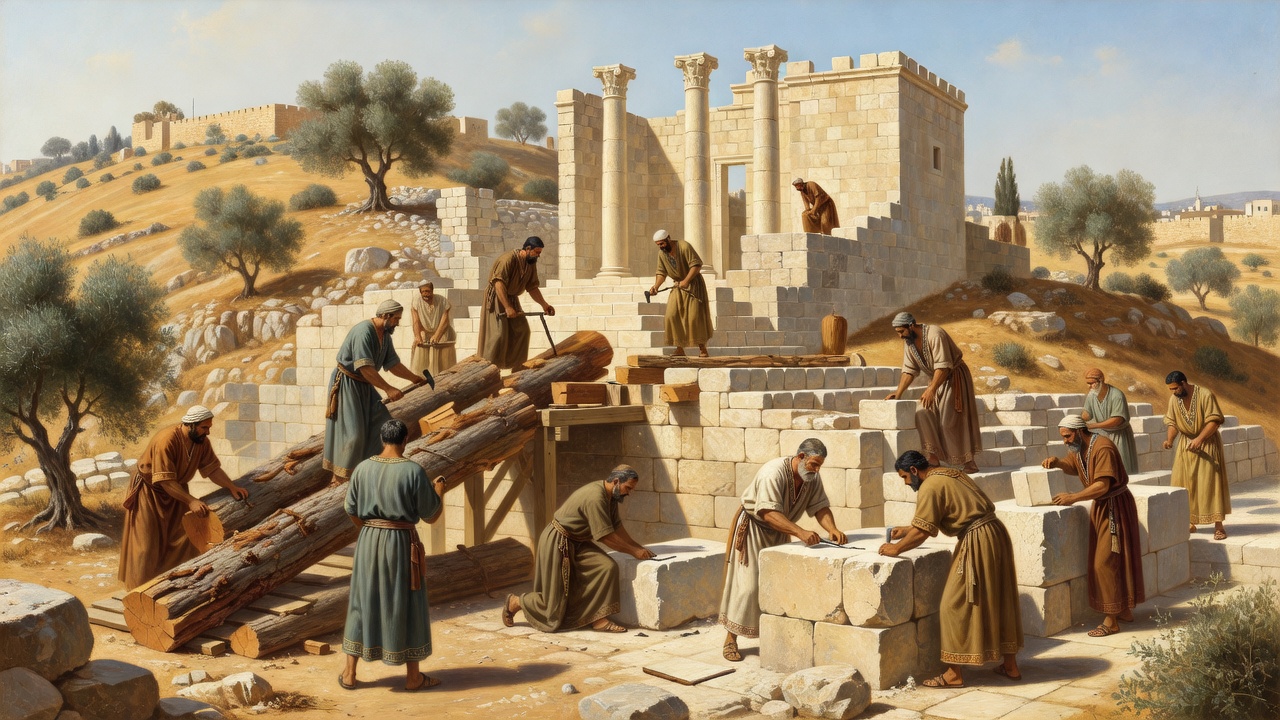
11King Hiram of Tyre sent messengers to David, along with cedar logs, carpenters, and stonemasons. They built a palace for David. 12David realized that the Lord had established him as king over Israel and that he had elevated his kingdom for the sake of his people Israel. 13David married more concubines and wives from Jerusalem after he arrived from Hebron. Even more sons and daughters were born to David. 14These are the names of children born to him in Jerusalem: Shammua, Shobab, Nathan, Solomon, 15Ibhar, Elishua, Nepheg, Japhia, 16Elishama, Eliada, and Eliphelet.
Conflict with the Philistines
17When the Philistines heard that David had been designated king over Israel, they all went up to search for David. When David heard about it, he went down to the fortress. 18Now the Philistines had arrived and spread out in the valley of Rephaim. 19So David asked the Lord, “Should I march up against the Philistines? Will you hand them over to me?” The Lord said to David, “March up, for I will indeed hand the Philistines over to you.”
20So David marched against Baal Perazim and defeated them there. Then he said, “The Lord has burst out against my enemies like water bursts out.” So he called the name of that place Baal Perazim. 21The Philistines abandoned their idols there, and David and his men picked them up.
22The Philistines again came up and spread out in the valley of Rephaim. 23So David asked the Lord what he should do. This time the Lord said to him, “Don’t march straight up. Instead, circle around behind them and come against them opposite the trees. 24When you hear the sound of marching in the tops of the trees, act decisively. For at that moment the Lord is going before you to strike down the army of the Philistines.” 25David did just as the Lord commanded him, and he struck down the Philistines from Gibeon all the way to Gezer.
¿Sabías que…?
David rey sobre todo Israel y la conquista de Jerusalén
- Después de reinar siete años y medio en Hebrón, David unificó a Israel y conquistó la fortaleza montañosa de Sion a los jebuseos. Renombró la fortaleza como la Ciudad de David y expandió sus defensas a partir del Milo, o terrazas de soporte.Fuentes: el propio texto bíblico · Zion · Millo · Hebron
- Hiram, rey de la ciudad costera fenicia de Tiro, estableció una alianza con David enviando madera de cedro, carpinteros y canteros para construir un palacio real en Jerusalén.Fuentes: el propio texto bíblico · Hiram · Tyre
- Situado al suroeste de Jerusalén, el valle de Refaim sirvió como base para las incursiones filisteas en cuanto supieron que David había sido ungido rey sobre todo Israel.Fuentes: el propio texto bíblico · Valley of Rephaim
Notas escritas con ayuda de IA a partir de fuentes abiertas (Theographic Bible Metadata, CC BY-SA 4.0; Easton’s Bible Dictionary, dominio público) y revisadas antes de publicarse.
Lugares de este capítulo
- Hebron · Hoy: Tel Rumeida · 31.525, 35.102 · versículos 1, 3, 5, 13
- Jerusalem · 31.777, 35.234 · versículos 5, 6, 13, 14
- City of David · 31.774, 35.236 · versículos 7, 9
- Zion · Hoy: Jerusalem · 31.777, 35.234 · versículo 7
- Tyre · 33.271, 35.196 · versículo 11
- Valley of Rephaim · 31.763, 35.219 · versículos 18, 22
- Gezer · Hoy: Tel Gezer · 31.859, 34.919 · versículo 25
Solo aparecen lugares identificados con alta confianza (90 % o más según las fuentes académicas reunidas por OpenBible). Mapa de la época: DARE (Digital Atlas of the Roman Empire), CC BY 4.0; mapa actual: © colaboradores de OpenStreetMap; lugares: OpenBible.info (CC BY 4.0).
Créditos y licencia de esta traducción
NET Bible
NET Bible®, New English Translation (NET)
copyright © 1996-2016 Biblical Studies Press, L. L. C.
Please see https://netbible.com/copyright/ for full NET Bible copyright and permissions information. You can also read the NET Bible at http://NETBible.org .
Language: English
Dialect (if applicable): American
Language in English: English
Translation by:
Please see https://netbible.com/copyright/ for full NET Bible copyright and permissions information. You can also read the NET Bible at http://NETBible.org .
The NET Bible (New English Translation) is a completely new translation of the Bible with 58,506 translators’ notes ! It was completed by more than 25 scholars – experts in the original biblical languages – who worked directly from the best currently available Hebrew, Aramaic, and Greek texts. Turn the pages and see the breadth of the translators’ notes, documenting their decisions and choices as they worked.
The translators’ notes make the original languages far more accessible, allowing you to look over the translator’s shoulder at the very process of translation. This level of documentation is a first for a Bible translation, making transparent the textual basis and the rationale for key renderings (including major interpretive options and alternative translations).
This unparalleled level of detail helps connect people to the Bible in the original languages in a way never before possible without years of study of Hebrew, Aramaic, and Greek. It unlocks the riches of the Bible’s truth from entirely new perspectives.
A donation is appreciated. Donate at Bible.org/donations_form so we can continue to provide our material for free for our 16,000+ articles on Bible.org and our world class Bible Study tool at lumina.bible.org .
2026-10-02
Fuente: http://ebible.org/engnet/ · eBible.org