2 Samuel 5
NET Bible · Tap a verse to see its cross-references.
1All the tribes of Israel came to David at Hebron saying, “Look, we are your very flesh and blood! 2In the past, when Saul was our king, you were the real leader in Israel. The Lord said to you, ‘You will shepherd my people Israel; you will rule over Israel.’”
3When all the leaders of Israel came to the king at Hebron, King David made an agreement with them in Hebron before the Lord. They designated David as king over Israel. 4David was thirty years old when he began to reign and he reigned for forty years. 5In Hebron he reigned over Judah for seven years and six months, and in Jerusalem he reigned for thirty-three years over all Israel and Judah.
David Occupies Jerusalem
6Then the king and his men advanced to Jerusalem against the Jebusites who lived in the land. The Jebusites said to David, “You cannot invade this place! Even the blind and the lame will turn you back, saying, ‘David cannot invade this place!’”
7But David captured the fortress of Zion (that is, the city of David). 8David said on that day, “Whoever attacks the Jebusites must approach the ‘lame’ and the ‘blind’ who are David’s enemies by going through the water tunnel.” For this reason it is said, “The blind and the lame cannot enter the palace.”
9So David lived in the fortress and called it the City of David. David built all around it, from the terrace inwards. 10David’s power grew steadily, for the Lord God who commands armies was with him.
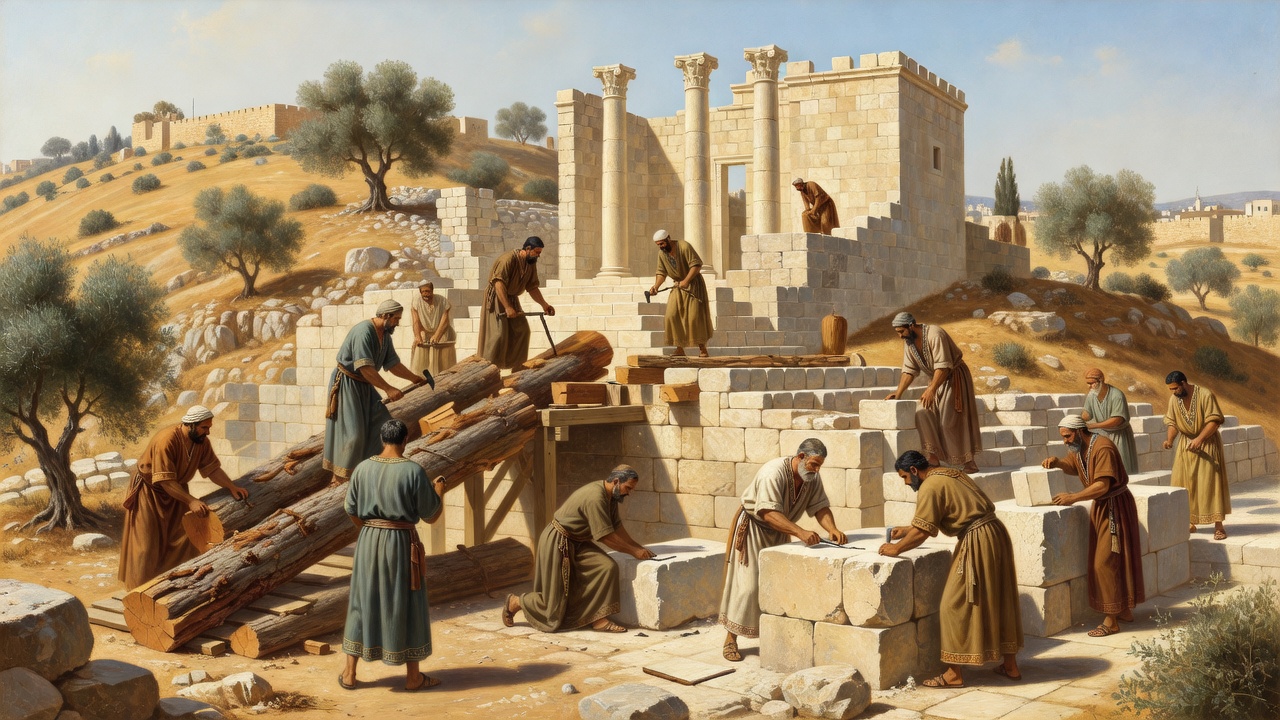
11King Hiram of Tyre sent messengers to David, along with cedar logs, carpenters, and stonemasons. They built a palace for David. 12David realized that the Lord had established him as king over Israel and that he had elevated his kingdom for the sake of his people Israel. 13David married more concubines and wives from Jerusalem after he arrived from Hebron. Even more sons and daughters were born to David. 14These are the names of children born to him in Jerusalem: Shammua, Shobab, Nathan, Solomon, 15Ibhar, Elishua, Nepheg, Japhia, 16Elishama, Eliada, and Eliphelet.
Conflict with the Philistines
17When the Philistines heard that David had been designated king over Israel, they all went up to search for David. When David heard about it, he went down to the fortress. 18Now the Philistines had arrived and spread out in the valley of Rephaim. 19So David asked the Lord, “Should I march up against the Philistines? Will you hand them over to me?” The Lord said to David, “March up, for I will indeed hand the Philistines over to you.”
20So David marched against Baal Perazim and defeated them there. Then he said, “The Lord has burst out against my enemies like water bursts out.” So he called the name of that place Baal Perazim. 21The Philistines abandoned their idols there, and David and his men picked them up.
22The Philistines again came up and spread out in the valley of Rephaim. 23So David asked the Lord what he should do. This time the Lord said to him, “Don’t march straight up. Instead, circle around behind them and come against them opposite the trees. 24When you hear the sound of marching in the tops of the trees, act decisively. For at that moment the Lord is going before you to strike down the army of the Philistines.” 25David did just as the Lord commanded him, and he struck down the Philistines from Gibeon all the way to Gezer.
Did you know?
David King Over All Israel and the Capture of Jerusalem
- After ruling for seven and a half years in Hebron, David unified Israel and captured the mountain stronghold of Zion from the Jebusites. He renamed the fortress the City of David and expanded its defenses around the Millo, or supporting terraces.Sources: the Bible text itself · Zion · Millo · Hebron
- Hiram, king of the Phoenician coastal city of Tyre, established an alliance with David by sending cedar timber, carpenters, and stonemasons to build a royal palace in Jerusalem.Sources: the Bible text itself · Hiram · Tyre
- Located southwest of Jerusalem, the Valley of Rephaim served as the staging ground for Philistine incursions once they learned David had been crowned king over all Israel.Sources: the Bible text itself · Valley of Rephaim
Notes written with AI assistance from open sources (Theographic Bible Metadata, CC BY-SA 4.0; Easton’s Bible Dictionary, public domain) and reviewed before publishing.
Places in this chapter
- Hebron · Today: Tel Rumeida · 31.525, 35.102 · verses 1, 3, 5, 13
- Jerusalem · 31.777, 35.234 · verses 5, 6, 13, 14
- City of David · 31.774, 35.236 · verses 7, 9
- Zion · Today: Jerusalem · 31.777, 35.234 · verse 7
- Tyre · 33.271, 35.196 · verse 11
- Valley of Rephaim · 31.763, 35.219 · verses 18, 22
- Gezer · Today: Tel Gezer · 31.859, 34.919 · verse 25
Only places identified with high confidence are shown (90% or more according to the scholarly sources compiled by OpenBible). Period map: DARE (Digital Atlas of the Roman Empire), CC BY 4.0; modern map: © OpenStreetMap contributors; places: OpenBible.info (CC BY 4.0).
Credits and license for this translation
NET Bible
NET Bible®, New English Translation (NET)
copyright © 1996-2016 Biblical Studies Press, L. L. C.
Please see https://netbible.com/copyright/ for full NET Bible copyright and permissions information. You can also read the NET Bible at http://NETBible.org .
Language: English
Dialect (if applicable): American
Language in English: English
Translation by:
Please see https://netbible.com/copyright/ for full NET Bible copyright and permissions information. You can also read the NET Bible at http://NETBible.org .
The NET Bible (New English Translation) is a completely new translation of the Bible with 58,506 translators’ notes ! It was completed by more than 25 scholars – experts in the original biblical languages – who worked directly from the best currently available Hebrew, Aramaic, and Greek texts. Turn the pages and see the breadth of the translators’ notes, documenting their decisions and choices as they worked.
The translators’ notes make the original languages far more accessible, allowing you to look over the translator’s shoulder at the very process of translation. This level of documentation is a first for a Bible translation, making transparent the textual basis and the rationale for key renderings (including major interpretive options and alternative translations).
This unparalleled level of detail helps connect people to the Bible in the original languages in a way never before possible without years of study of Hebrew, Aramaic, and Greek. It unlocks the riches of the Bible’s truth from entirely new perspectives.
A donation is appreciated. Donate at Bible.org/donations_form so we can continue to provide our material for free for our 16,000+ articles on Bible.org and our world class Bible Study tool at lumina.bible.org .
2026-10-02
Source: http://ebible.org/engnet/ · eBible.org