Marcos 2
Berean Standard Bible · Toca un versículo para ver sus referencias cruzadas.
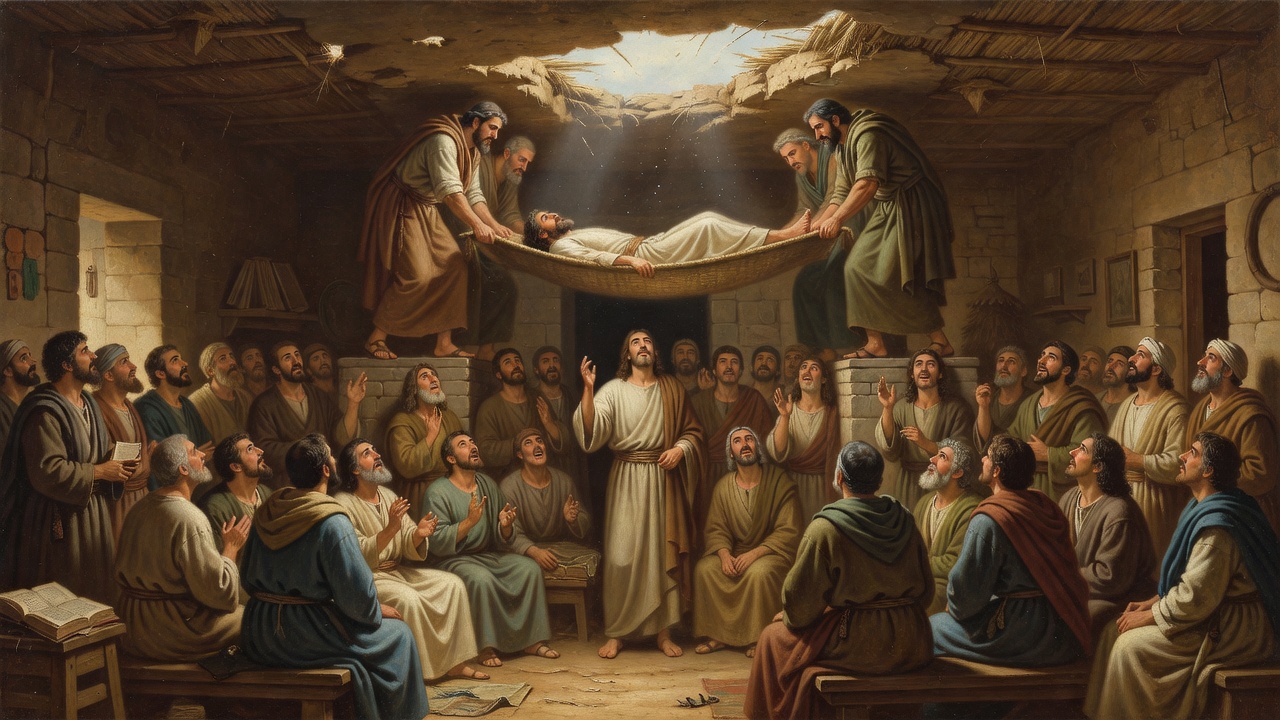
Jesus Heals a Paralytic
1A few days later Jesus went back to Capernaum. And when the people heard that He was home, 2they gathered in such large numbers that there was no more room, not even outside the door, as Jesus spoke the word to them.
3Then a paralytic was brought to Him, carried by four men. 4Since they were unable to get to Jesus through the crowd, they uncovered the roof above Him, made an opening, and lowered the paralytic on his mat.
5When Jesus saw their faith, He said to the paralytic, “Son, your sins are forgiven.”
6But some of the scribes were sitting there and thinking in their hearts, 7“Why does this man speak like this? He is blaspheming! Who can forgive sins but God alone?”
8At once Jesus knew in His spirit that they were thinking this way within themselves. “Why are you thinking these things in your hearts?” He asked. 9“Which is easier: to say to a paralytic, ‘Your sins are forgiven,’ or to say, ‘Get up, pick up your mat, and walk’? 10But so that you may know that the Son of Man has authority on earth to forgive sins...” He said to the paralytic, 11“I tell you, get up, pick up your mat, and go home.”
12And immediately the man got up, picked up his mat, and walked out in front of them all. As a result, they were all astounded and glorified God, saying, “We have never seen anything like this!”
Jesus Calls Levi
13Once again Jesus went out beside the sea. All the people came to Him, and He taught them there.
14As He was walking along, He saw Levi son of Alphaeus sitting at the tax booth. “Follow Me,” He told him, and Levi got up and followed Him.
15While Jesus was dining at Levi’s house, many tax collectors and sinners were eating with Him and His disciples—for there were many who followed Him. 16When the scribes who were Pharisees saw Jesus eating with these people, they asked His disciples, “Why does He eat with tax collectors and sinners?”
17On hearing this, Jesus told them, “It is not the healthy who need a doctor, but the sick. I have not come to call the righteous, but sinners.”
Questions about Fasting
18Now John’s disciples and the Pharisees were often fasting. So people came to Jesus and asked, “Why don’t Your disciples fast like John’s disciples and those of the Pharisees?”
19Jesus replied, “How can the guests of the bridegroom fast while He is with them? As long as He is with them, they cannot fast. 20But the time will come when the bridegroom will be taken from them; then they will fast.
The Patches and the Wineskins
21No one sews a patch of unshrunk cloth on an old garment. If he does, the new piece will pull away from the old, and a worse tear will result.
22And no one pours new wine into old wineskins. If he does, the wine will burst the skins, and both the wine and the wineskins will be ruined. Instead, new wine is poured into new wineskins.”
The Lord of the Sabbath
23One Sabbath Jesus was passing through the grainfields, and His disciples began to pick the heads of grain as they walked along. 24So the Pharisees said to Him, “Look, why are they doing what is unlawful on the Sabbath?”
25Jesus replied, “Have you never read what David did when he and his companions were hungry and in need? 26During the high priesthood of Abiathar, he entered the house of God and ate the consecrated bread, which was lawful only for the priests. And he gave some to his companions as well.”
27Then Jesus declared, “The Sabbath was made for man, not man for the Sabbath. 28Therefore, the Son of Man is Lord even of the Sabbath.”
¿Sabías que…?
Perdón, un recaudador de impuestos y el sábado
- Cafarnaúm, la “ciudad de Nahúm”, era una ciudad de Galilea que no se menciona en el Antiguo Testamento. El diccionario bíblico de Easton (1897) dice que, después de que Jesús fue expulsado de Nazaret, se convirtió en “su propia ciudad”, lo que concuerda con el relato de Marcos de que la gente oyó que estaba en casa y llenó la casa hasta que no quedó lugar ni siquiera fuera de la puerta. Cuatro hombres entonces destaparon el techo, abrieron un hueco y bajaron a un paralítico en su camilla.Fuentes: Capernaum · el propio texto bíblico
- El hombre en el puesto de los impuestos era Leví, hijo de Alfeo, un recaudador de impuestos en Cafarnaúm. El diccionario bíblico de Easton (1897) dice que se le conocía como Leví y tomó el nombre de Mateo —un nombre judío común después del Exilio, que significa “don de Dios”— posiblemente en agradecido recuerdo de su llamamiento. El mismo día, según el diccionario, ofreció un gran banquete de despedida para Jesús y sus discípulos, y probablemente para muchos antiguos compañeros, la reunión que Marcos describe con recaudadores de impuestos y pecadores.Fuentes: Matthew · Alphaeus · el propio texto bíblico
- Cuestionado porque sus discípulos arrancaban espigas en sábado, Jesús habló de David entrando en la casa de Dios y comiendo los panes consagrados, lícitos solo para los sacerdotes, “durante el sumo sacerdocio de Abiatar”, y compartiéndolos con sus compañeros hambrientos. El diccionario bíblico de Easton (1897) identifica a Abiatar como hijo del sumo sacerdote Ahimelec, que escapó cuando su padre y los sacerdotes de Nob fueron muertos, se llevó el efod y se unió a David en la cueva de Adulam.Fuentes: Abiathar · el propio texto bíblico
Notas escritas con ayuda de IA a partir de fuentes abiertas (Theographic Bible Metadata, CC BY-SA 4.0; Easton’s Bible Dictionary, dominio público) y revisadas antes de publicarse.
Créditos y licencia de esta traducción
Berean Standard Bible
The Holy Bible in English: Berean Standard Bible
Public Domain
Language: English
Contributor: BSB Publishing, LLC
2026-10-02
Fuente: http://ebible.org/engbsb/ · eBible.org