Génesis 46
Berean Standard Bible · Toca un versículo para ver sus referencias cruzadas.
Jacob’s Journey to Egypt
1So Israel set out with all that he had, and when he came to Beersheba, he offered sacrifices to the God of his father Isaac. 2And that night God spoke to Israel in a vision: “Jacob, Jacob!” He said.
“Here I am,” replied Jacob.
3“I am God,” He said, “the God of your father. Do not be afraid to go down to Egypt, for I will make you into a great nation there. 4I will go down with you to Egypt, and I will surely bring you back. And Joseph’s own hands will close your eyes.”
5Then Jacob departed from Beersheba, and the sons of Israel took their father Jacob in the wagons Pharaoh had sent to carry him, along with their children and wives. 6They also took the livestock and possessions they had acquired in the land of Canaan, and Jacob and all his offspring went to Egypt.
Those Who Went to Egypt
7Jacob took with him to Egypt his sons and grandsons, and his daughters and granddaughters—all his offspring.
The Children of Leah
8Now these are the names of the sons of Israel (Jacob and his descendants) who went to Egypt: Reuben, Jacob’s firstborn.
9The sons of Reuben: Hanoch, Pallu, Hezron, and Carmi.
10The sons of Simeon: Jemuel, Jamin, Ohad, Jachin, Zohar, and Shaul the son of a Canaanite woman.
11The sons of Levi: Gershon, Kohath, and Merari.
12The sons of Judah: Er, Onan, Shelah, Perez, and Zerah; but Er and Onan died in the land of Canaan.
The sons of Perez: Hezron and Hamul.
13The sons of Issachar: Tola, Puvah, Job, and Shimron.
14The sons of Zebulun: Sered, Elon, and Jahleel.
15These are the sons of Leah born to Jacob in Paddan-aram, in addition to his daughter Dinah. The total number of sons and daughters was thirty-three.
The Children of Zilpah
16The sons of Gad: Ziphion, Haggi, Shuni, Ezbon, Eri, Arodi, and Areli.
17The children of Asher: Imnah, Ishvah, Ishvi, Beriah, and their sister Serah.
The sons of Beriah: Heber and Malchiel.
18These are the sons of Jacob born to Zilpah—whom Laban gave to his daughter Leah—sixteen in all.
The Children of Rachel
19The sons of Jacob’s wife Rachel: Joseph and Benjamin.
20Manasseh and Ephraim were born to Joseph in the land of Egypt by Asenath daughter of Potiphera, priest of On.
21The sons of Benjamin: Bela, Becher, Ashbel, Gera, Naaman, Ehi, Rosh, Muppim, Huppim, and Ard.
22These are the sons of Rachel born to Jacob—fourteen in all.
The Children of Bilhah
23The son of Dan: Hushim.
24The sons of Naphtali: Jahzeel, Guni, Jezer, and Shillem.
25These are the sons of Jacob born to Bilhah, whom Laban gave to his daughter Rachel—seven in all.
26All those belonging to Jacob who came to Egypt—his direct descendants, besides the wives of Jacob’s sons—numbered sixty-six persons. 27And with the two sons who had been born to Joseph in Egypt, the members of Jacob’s family who went to Egypt were seventy in all.
Jacob Arrives in Egypt
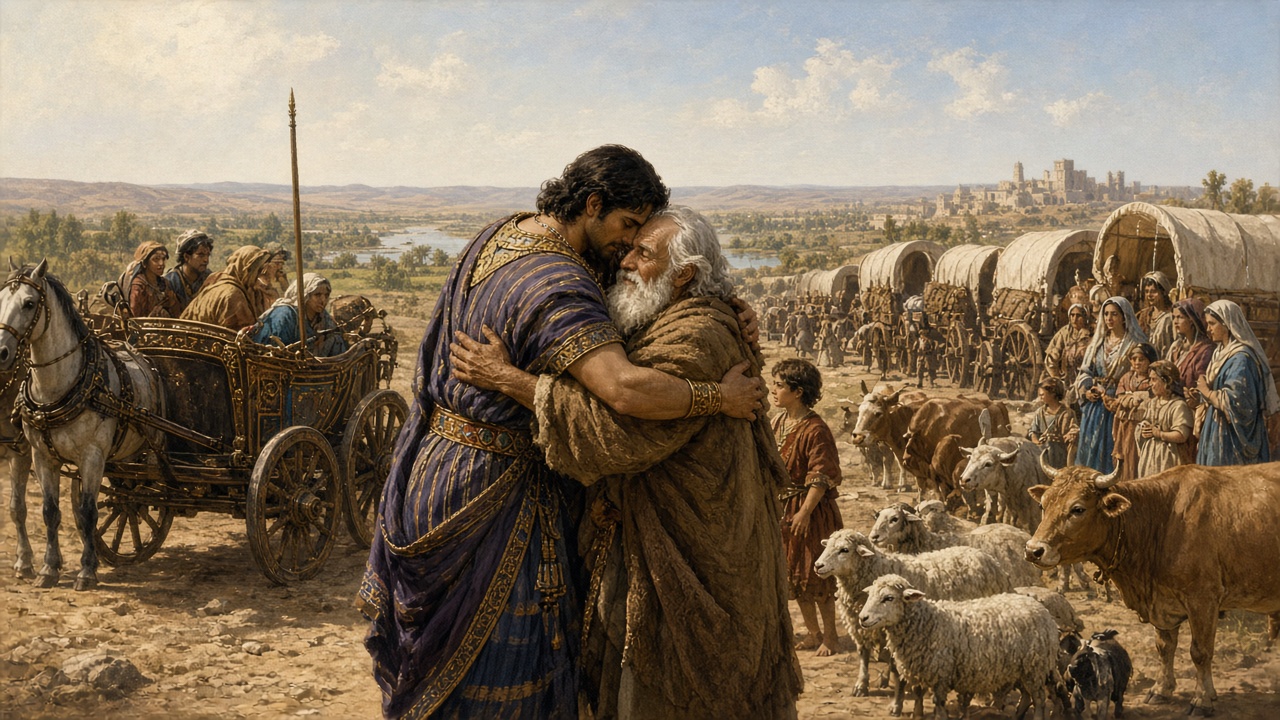
28Now Jacob had sent Judah ahead of him to Joseph to get directions to Goshen. When Jacob’s family arrived in the land of Goshen, 29Joseph prepared his chariot and went there to meet his father Israel. Joseph presented himself to him, embraced him, and wept profusely.
30Then Israel said to Joseph, “Finally I can die, now that I have seen your face and know that you are still alive!”
31Joseph said to his brothers and to his father’s household, “I will go up and inform Pharaoh: ‘My brothers and my father’s household from the land of Canaan have come to me. 32The men are shepherds; they raise livestock, and they have brought their flocks and herds and all that they own.’
33When Pharaoh summons you and asks, ‘What is your occupation?’ 34you are to say, ‘Your servants have raised livestock ever since our youth—both we and our fathers.’ Then you will be allowed to settle in the land of Goshen, since all shepherds are detestable to the Egyptians.”
¿Sabías que…?
Israel desciende a Egipto
- Cuando Israel partió hacia Egipto con todo lo que tenía, se detuvo en Beerseba y ofreció sacrificios al Dios de su padre Isaac. Beerseba, que significa pozo del juramento o pozo de los siete, fue un pozo que Abraham cavó y nombró tras un pacto con Abimelec; cuando Isaac lo reabrió, le dio el mismo nombre. Era un lugar favorito de residencia de ambos patriarcas, y allí, aquella noche, Dios habló a Jacob en una visión y le dijo que no temiera bajar a Egipto, porque allí lo haría una gran nación.Fuentes: el propio texto bíblico · Beersheba
- Jacob envió a Judá por delante hacia José para que le indicara el camino a Gosén, un distrito egipcio al este del Nilo, al parecer cerca de la residencia real, donde la familia permaneció hasta el Éxodo. El Easton's Bible Dictionary (1897) la llama lo mejor de la tierra, hoy un desierto, y también tierra de Ramesés. José dijo a sus hermanos que afirmaran haber criado ganado desde su juventud, para poder establecerse allí, porque los pastores eran detestables para los egipcios; ese diccionario sugiere que el faraón fue probablemente Apopi, el último rey de los hicsos, que acogió a estos pastores asiáticos, mientras los egipcios nativos los aborrecían, aunque algunos argumentan que José llegó más tarde, bajo Tutmosis III, después de la expulsión de los hicsos.Fuentes: el propio texto bíblico · Goshen · Pharaoh (of Joseph)
- El capítulo cuenta sesenta y seis descendientes directos de Jacob que llegaron a Egipto, sin incluir a las esposas de sus hijos, y setenta al incluir a los dos hijos de José ya nacidos en Egipto. Los hijos de Lea y su hija Dina aparecen en esa lista, aunque el Easton's Bible Dictionary (1897) dice que la propia Lea ya había muerto en Canaán antes del viaje y fue sepultada en la cueva de Macpela; Raquel había muerto antes, al dar a luz a Benjamín, y fue sepultada en el camino a Efrata, es decir, Belén. Manasés y Efraín nacieron a José en Egipto de Asenat, hija de Potifera, sacerdote de On, un centro del culto al sol que la Septuaginta y la Vulgata llaman Heliópolis.Fuentes: el propio texto bíblico · Leah · Rachel · On
Notas escritas con ayuda de IA a partir de fuentes abiertas (Theographic Bible Metadata, CC BY-SA 4.0; Easton’s Bible Dictionary, dominio público) y revisadas antes de publicarse.
Lugares de este capítulo
- Egypt · 30.129, 31.308 · versículos 1, 3, 4, 5, 6, 7, 8, 20, 26, 27
- Canaan · 32.767, 35.333 · versículos 6, 12, 31
- Heliopolis · Hoy: Ain Shams · 30.129, 31.308 · versículo 20
- Goshen · Hoy: Goshen 1 · 30.799, 31.834 · versículos 28, 29, 34
Solo aparecen lugares identificados con alta confianza (90 % o más según las fuentes académicas reunidas por OpenBible). Mapa de la época: DARE (Digital Atlas of the Roman Empire), CC BY 4.0; mapa actual: © colaboradores de OpenStreetMap; lugares: OpenBible.info (CC BY 4.0).
Créditos y licencia de esta traducción
Berean Standard Bible
The Holy Bible in English: Berean Standard Bible
Public Domain
Language: English
Contributor: BSB Publishing, LLC
2026-10-02
Fuente: http://ebible.org/engbsb/ · eBible.org