Genesis 46
Berean Standard Bible · Tap a verse to see its cross-references.
Jacob’s Journey to Egypt
1So Israel set out with all that he had, and when he came to Beersheba, he offered sacrifices to the God of his father Isaac. 2And that night God spoke to Israel in a vision: “Jacob, Jacob!” He said.
“Here I am,” replied Jacob.
3“I am God,” He said, “the God of your father. Do not be afraid to go down to Egypt, for I will make you into a great nation there. 4I will go down with you to Egypt, and I will surely bring you back. And Joseph’s own hands will close your eyes.”
5Then Jacob departed from Beersheba, and the sons of Israel took their father Jacob in the wagons Pharaoh had sent to carry him, along with their children and wives. 6They also took the livestock and possessions they had acquired in the land of Canaan, and Jacob and all his offspring went to Egypt.
Those Who Went to Egypt
7Jacob took with him to Egypt his sons and grandsons, and his daughters and granddaughters—all his offspring.
The Children of Leah
8Now these are the names of the sons of Israel (Jacob and his descendants) who went to Egypt: Reuben, Jacob’s firstborn.
9The sons of Reuben: Hanoch, Pallu, Hezron, and Carmi.
10The sons of Simeon: Jemuel, Jamin, Ohad, Jachin, Zohar, and Shaul the son of a Canaanite woman.
11The sons of Levi: Gershon, Kohath, and Merari.
12The sons of Judah: Er, Onan, Shelah, Perez, and Zerah; but Er and Onan died in the land of Canaan.
The sons of Perez: Hezron and Hamul.
13The sons of Issachar: Tola, Puvah, Job, and Shimron.
14The sons of Zebulun: Sered, Elon, and Jahleel.
15These are the sons of Leah born to Jacob in Paddan-aram, in addition to his daughter Dinah. The total number of sons and daughters was thirty-three.
The Children of Zilpah
16The sons of Gad: Ziphion, Haggi, Shuni, Ezbon, Eri, Arodi, and Areli.
17The children of Asher: Imnah, Ishvah, Ishvi, Beriah, and their sister Serah.
The sons of Beriah: Heber and Malchiel.
18These are the sons of Jacob born to Zilpah—whom Laban gave to his daughter Leah—sixteen in all.
The Children of Rachel
19The sons of Jacob’s wife Rachel: Joseph and Benjamin.
20Manasseh and Ephraim were born to Joseph in the land of Egypt by Asenath daughter of Potiphera, priest of On.
21The sons of Benjamin: Bela, Becher, Ashbel, Gera, Naaman, Ehi, Rosh, Muppim, Huppim, and Ard.
22These are the sons of Rachel born to Jacob—fourteen in all.
The Children of Bilhah
23The son of Dan: Hushim.
24The sons of Naphtali: Jahzeel, Guni, Jezer, and Shillem.
25These are the sons of Jacob born to Bilhah, whom Laban gave to his daughter Rachel—seven in all.
26All those belonging to Jacob who came to Egypt—his direct descendants, besides the wives of Jacob’s sons—numbered sixty-six persons. 27And with the two sons who had been born to Joseph in Egypt, the members of Jacob’s family who went to Egypt were seventy in all.
Jacob Arrives in Egypt
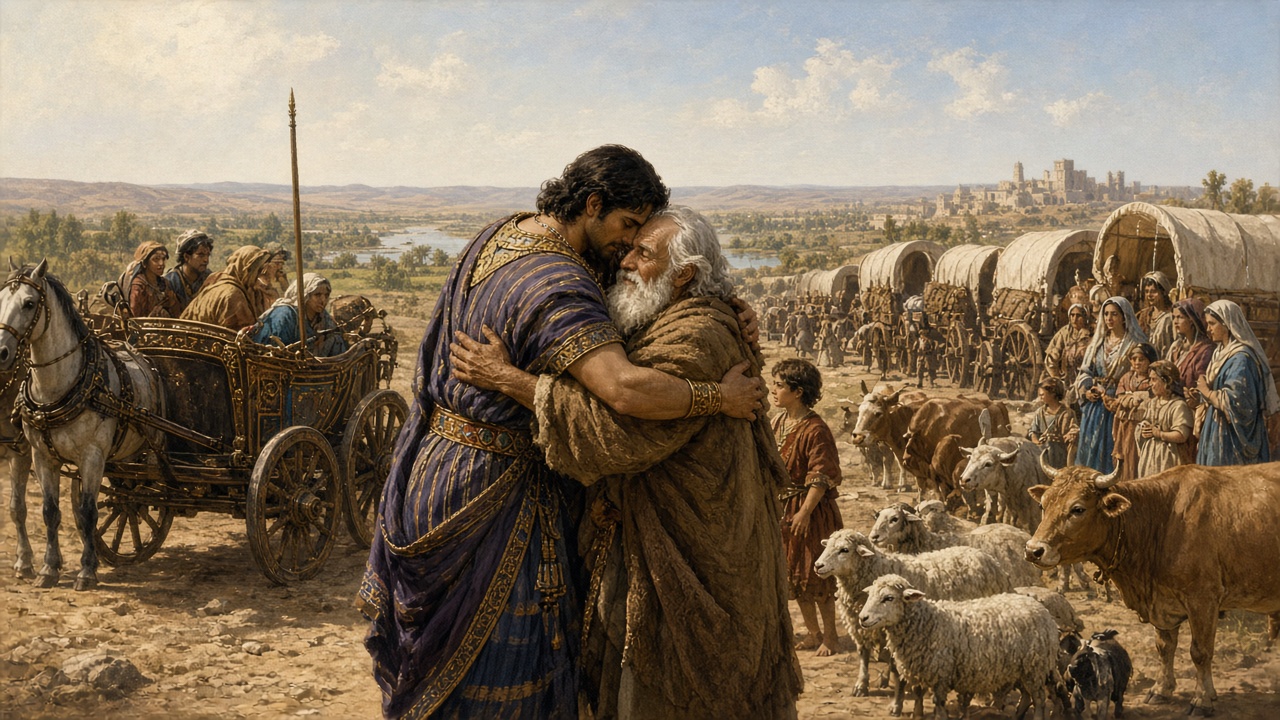
28Now Jacob had sent Judah ahead of him to Joseph to get directions to Goshen. When Jacob’s family arrived in the land of Goshen, 29Joseph prepared his chariot and went there to meet his father Israel. Joseph presented himself to him, embraced him, and wept profusely.
30Then Israel said to Joseph, “Finally I can die, now that I have seen your face and know that you are still alive!”
31Joseph said to his brothers and to his father’s household, “I will go up and inform Pharaoh: ‘My brothers and my father’s household from the land of Canaan have come to me. 32The men are shepherds; they raise livestock, and they have brought their flocks and herds and all that they own.’
33When Pharaoh summons you and asks, ‘What is your occupation?’ 34you are to say, ‘Your servants have raised livestock ever since our youth—both we and our fathers.’ Then you will be allowed to settle in the land of Goshen, since all shepherds are detestable to the Egyptians.”
Did you know?
Israel Goes Down to Egypt
- As Israel set out for Egypt with all that he had, he stopped at Beersheba and offered sacrifices to the God of his father Isaac. Beersheba, meaning well of the oath or well of seven, was a well Abraham dug and named after a compact with Abimelech; when Isaac reopened it, he gave it the same name. It was a favorite dwelling of both patriarchs, and there that night God spoke to Jacob in a vision, telling him not to fear going down to Egypt, for he would make him a great nation there.Sources: the Bible text itself · Beersheba
- Jacob sent Judah ahead to Joseph for directions to Goshen, an Egyptian district east of the Nile, apparently near the royal residence, where the family remained until the Exodus. Easton's Bible Dictionary (1897) calls it the best of the land, now a desert, and also the land of Rameses. Joseph told his brothers to say they had raised livestock from youth, so they might settle there, because shepherds were detestable to the Egyptians; that dictionary suggests Pharaoh was probably Apopi, last of the Hyksos, who welcomed these Asiatic shepherds, while native Egyptians abhorred them, though some argue Joseph arrived later, under Thothmes III, after the Hyksos were expelled.Sources: the Bible text itself · Goshen · Pharaoh (of Joseph)
- The chapter counts sixty-six of Jacob's direct descendants who came to Egypt, not counting the wives of his sons, and seventy when Joseph's two sons already born in Egypt are included. Leah's sons and her daughter Dinah are named in that tally, although Easton's Bible Dictionary (1897) says Leah herself had died in Canaan before the journey and was buried in the cave of Machpelah; Rachel had died earlier giving birth to Benjamin and was buried on the way to Ephrath, that is, Bethlehem. Manasseh and Ephraim were born to Joseph in Egypt by Asenath, daughter of Potiphera, priest of On, a center of sun-worship that the Septuagint and Vulgate call Heliopolis.Sources: the Bible text itself · Leah · Rachel · On
Notes written with AI assistance from open sources (Theographic Bible Metadata, CC BY-SA 4.0; Easton’s Bible Dictionary, public domain) and reviewed before publishing.
Places in this chapter
- Egypt · 30.129, 31.308 · verses 1, 3, 4, 5, 6, 7, 8, 20, 26, 27
- Canaan · 32.767, 35.333 · verses 6, 12, 31
- Heliopolis · Today: Ain Shams · 30.129, 31.308 · verse 20
- Goshen · Today: Goshen 1 · 30.799, 31.834 · verses 28, 29, 34
Only places identified with high confidence are shown (90% or more according to the scholarly sources compiled by OpenBible). Period map: DARE (Digital Atlas of the Roman Empire), CC BY 4.0; modern map: © OpenStreetMap contributors; places: OpenBible.info (CC BY 4.0).
Credits and license for this translation
Berean Standard Bible
The Holy Bible in English: Berean Standard Bible
Public Domain
Language: English
Contributor: BSB Publishing, LLC
2026-10-02
Source: http://ebible.org/engbsb/ · eBible.org