Éxodo 14
Berean Standard Bible · Toca un versículo para ver sus referencias cruzadas.
Pharaoh Pursues the Israelites
1Then the LORD said to Moses, 2“Tell the Israelites to turn back and encamp before Pi-hahiroth, between Migdol and the sea. You are to encamp by the sea, directly opposite Baal-zephon.
3For Pharaoh will say of the Israelites, ‘They are wandering the land in confusion; the wilderness has boxed them in.’ 4And I will harden Pharaoh’s heart so that he will pursue them. But I will gain honor by means of Pharaoh and all his army, and the Egyptians will know that I am the LORD.”
So this is what the Israelites did.
5When the king of Egypt was told that the people had fled, Pharaoh and his officials changed their minds about them and said, “What have we done? We have released Israel from serving us.”
6So Pharaoh prepared his chariot and took his army with him. 7He took 600 of the best chariots, and all the other chariots of Egypt, with officers over all of them.
8And the LORD hardened the heart of Pharaoh king of Egypt so that he pursued the Israelites, who were marching out defiantly. 9The Egyptians—all Pharaoh’s horses and chariots, horsemen and troops—pursued the Israelites and overtook them as they camped by the sea near Pi-hahiroth, opposite Baal-zephon.
10As Pharaoh approached, the Israelites looked up and saw the Egyptians marching after them, and they were terrified and cried out to the LORD. 11They said to Moses, “Was it because there were no graves in Egypt that you brought us into the wilderness to die? What have you done to us by bringing us out of Egypt? 12Did we not say to you in Egypt, ‘Leave us alone so that we may serve the Egyptians’? For it would have been better for us to serve the Egyptians than to die in the wilderness.”
13But Moses told the people, “Do not be afraid. Stand firm and you will see the LORD’s salvation, which He will accomplish for you today; for the Egyptians you see today, you will never see again. 14The LORD will fight for you; you need only to be still.”
Parting the Red Sea
15Then the LORD said to Moses, “Why are you crying out to Me? Tell the Israelites to go forward. 16And as for you, lift up your staff and stretch out your hand over the sea and divide it, so that the Israelites can go through the sea on dry ground. 17And I will harden the hearts of the Egyptians so that they will go in after them. Then I will gain honor by means of Pharaoh and all his army and chariots and horsemen. 18The Egyptians will know that I am the LORD when I am honored through Pharaoh, his chariots, and his horsemen.”
19And the angel of God, who had gone before the camp of Israel, withdrew and went behind them. The pillar of cloud also moved from before them and stood behind them, 20so that it came between the camps of Egypt and Israel. The cloud was there in the darkness, but it lit up the night. So all night long neither camp went near the other.
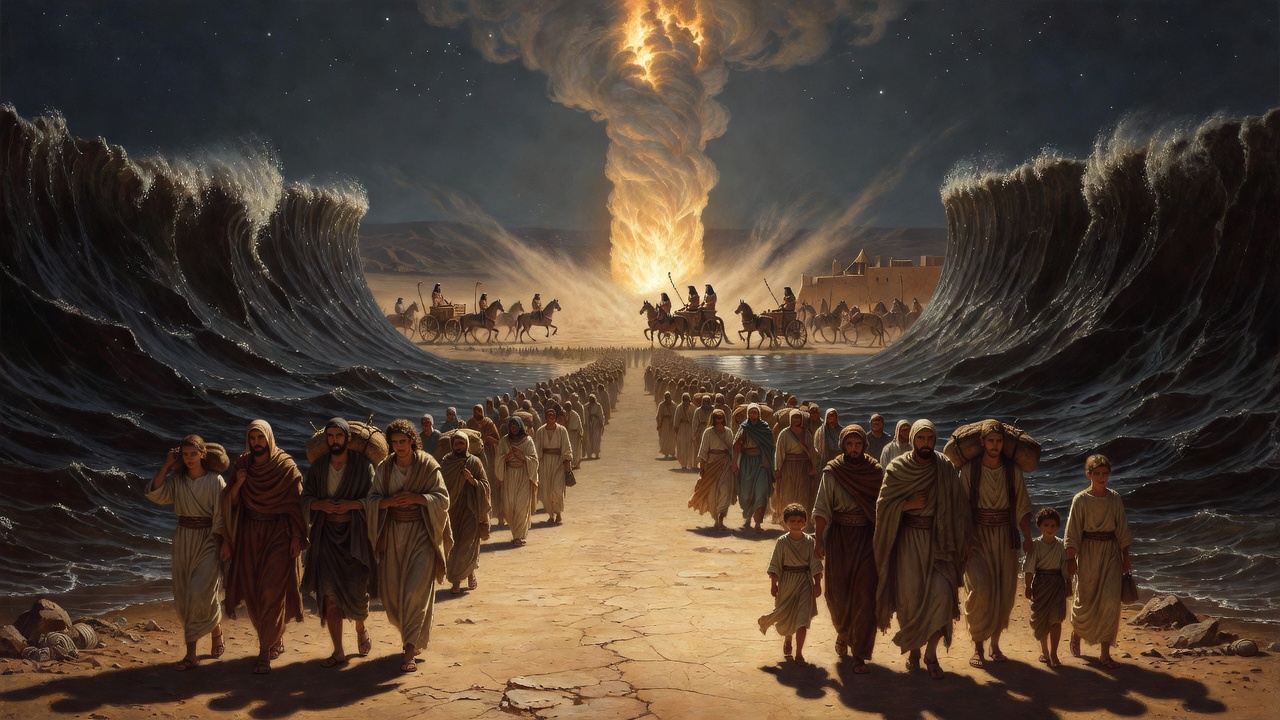
21Then Moses stretched out his hand over the sea, and all that night the LORD drove back the sea with a strong east wind that turned it into dry land. So the waters were divided, 22and the Israelites went through the sea on dry ground, with walls of water on their right and on their left.
23And the Egyptians chased after them—all Pharaoh’s horses, chariots, and horsemen—and followed them into the sea. 24At morning watch, however, the LORD looked down on the army of the Egyptians from the pillar of fire and cloud, and He threw their camp into confusion. 25He caused their chariot wheels to wobble, so that they had difficulty driving. “Let us flee from the Israelites,” said the Egyptians, “for the LORD is fighting for them against Egypt!”
26Then the LORD said to Moses, “Stretch out your hand over the sea, so that the waters may flow back over the Egyptians and their chariots and horsemen.” 27So Moses stretched out his hand over the sea, and at daybreak the sea returned to its normal state. As the Egyptians were retreating, the LORD swept them into the sea. 28The waters flowed back and covered the chariots and horsemen—the entire army of Pharaoh that had chased the Israelites into the sea. Not one of them survived.
29But the Israelites had walked through the sea on dry ground, with walls of water on their right and on their left. 30That day the LORD saved Israel from the hand of the Egyptians, and Israel saw the Egyptians dead on the shore. 31When Israel saw the great power that the LORD had exercised over the Egyptians, the people feared the LORD and believed in Him and in His servant Moses.
¿Sabías que…?
Israel acorralado entre el faraón y el mar
- A Israel se le ordenó volver atrás y acampar frente a Pi-hahirot, entre Migdol y el mar, justo enfrente de Baal-zefón, para que el faraón pensara que el desierto los había acorralado. Pi-hahirot significa lugar donde crecen los juncos, aunque la Septuaginta y el copto leen granja, y Baal-zefón significa Baal del norte.Fuentes: el propio texto bíblico · Pi-hahiroth · Baal-zephon
- El diccionario bíblico de Easton (1897) describe Baal-zefón como una ciudad egipcia a orillas del golfo de Suez, probablemente el actual Jebel Deraj o Kulalah, en la orilla occidental, y señala que Baal-zapuna, de los egipcios, era un lugar de culto. Algunos han identificado Pi-hahirot con Ajrud, una fortaleza entre Etam y Suez. La entrada sobre Pi-hahirot añade que la condición del istmo de Suez en tiempos del Éxodo no se conoce con exactitud, de modo que Pi-hahirot y los otros campamentos de Israel en Egipto no pueden ubicarse con certeza; el istmo se ha formado con depósitos del Nilo.Fuentes: Baal-zephon · Pi-hahiroth
- El diccionario bíblico de Easton (1897) dice que el faraón del Éxodo fue probablemente Menephtah I, el decimocuarto y mayor de los hijos sobrevivientes de Rameses II, y que residía en Zoán, donde tuvieron lugar las entrevistas con Moisés y Aarón registradas en Éxodo. La misma entrada sigue tratando como una cuestión abierta si ese rey fue Seti II o su padre Menephtah, y señala que algunos juzgan que el peso de la evidencia favorece a Seti II.Fuentes: Pharaoh (of the Exodus)
Notas escritas con ayuda de IA a partir de fuentes abiertas (Theographic Bible Metadata, CC BY-SA 4.0; Easton’s Bible Dictionary, dominio público) y revisadas antes de publicarse.
Lugares de este capítulo
Solo aparecen lugares identificados con alta confianza (90 % o más según las fuentes académicas reunidas por OpenBible). Mapa de la época: DARE (Digital Atlas of the Roman Empire), CC BY 4.0; mapa actual: © colaboradores de OpenStreetMap; lugares: OpenBible.info (CC BY 4.0).
Créditos y licencia de esta traducción
Berean Standard Bible
The Holy Bible in English: Berean Standard Bible
Public Domain
Language: English
Contributor: BSB Publishing, LLC
2026-10-02
Fuente: http://ebible.org/engbsb/ · eBible.org