Daniel 1
Berean Standard Bible · Toca un versículo para ver sus referencias cruzadas.
Acerca de este libro
Acerca de Daniel
- Los judíos sitúan el libro de Daniel en los Hagiógrafos, la división llamada Khethubim en hebreo. El propio libro presenta a Daniel como su autor. El Easton's Bible Dictionary (1897) señala que la autenticidad del libro ha sido muy discutida.Fuentes: Easton: Daniel, Book of
- Los capítulos históricos tratan del período del cautiverio. Easton llama a Daniel el historiador de ese tiempo, cuya narración completa el bosquejo de Crónicas: Nabucodonosor llevó a los sobrevivientes a Babilonia, donde sirvieron a él y a sus hijos hasta el reinado del reino de Persia. Una nota sobre Ciro fecha la caída de Babilonia ante su ejército en 538 a. C., la noche del banquete de Belsasar; a Belsasar se le llama el último rey de Babilonia, y la ciudad estaba a orillas del Éufrates.Fuentes: Easton: Daniel, Book of · Cyrus · Belshazzar · Babylon
- El libro consta de dos partes distintas. Los primeros seis capítulos son principalmente históricos, y los seis restantes son principalmente proféticos, y consisten en tres visiones y una comunicación profética más extensa.Fuentes: Easton: Daniel, Book of
- Un rasgo notable es su lengua. Ciertas porciones, Daniel 2:4 y el capítulo 7, están escritas en caldeo, mientras que las porciones en hebreo tienen estrecha afinidad con los libros más tardíos del Antiguo Testamento, en especial Esdras. El autor pasa de una lengua a la otra según lo exige el asunto.Fuentes: Easton: Daniel, Book of
- Nabucodonosor dio a Daniel un nombre caldeo que significa "Beltis protege al rey". A Ananías se le dio el nombre caldeo Sadrac, "mandato de Aku", y a Azarías, de la familia real de Judá, el nombre Abed-nego. Mesac, uno de los tres jóvenes hebreos instruidos con Daniel en Babilonia, fue luego promovido al rango de los magos.Fuentes: Daniel · Shadrach · Azariah · Meshach
Notas escritas con ayuda de IA a partir de fuentes abiertas (Theographic Bible Metadata, CC BY-SA 4.0; Easton’s Bible Dictionary, dominio público) y revisadas antes de publicarse.
Daniel Removed to Babylon
1In the third year of the reign of Jehoiakim king of Judah, Nebuchadnezzar king of Babylon came to Jerusalem and besieged it. 2And the Lord delivered into his hand Jehoiakim king of Judah, along with some of the articles from the house of God. He carried these off to the land of Shinar, to the house of his god, where he put them in the treasury of his god.
3Then the king ordered Ashpenaz, the chief of his court officials, to bring in some Israelites from the royal family and the nobility— 4young men without blemish, handsome, gifted in all wisdom, knowledgeable, quick to understand, and qualified to serve in the king’s palace—and to teach them the language and literature of the Chaldeans.
5The king assigned them daily provisions of the royal food and wine. They were to be trained for three years, after which they were to enter the king’s service.
6Among these young men were some from Judah: Daniel, Hananiah, Mishael, and Azariah. 7The chief official gave them new names: To Daniel he gave the name Belteshazzar; to Hananiah, Shadrach; to Mishael, Meshach; and to Azariah, Abednego.
Daniel’s Faithfulness
8But Daniel made up his mind that he would not defile himself with the king’s food or wine. So he asked the chief official for permission not to defile himself.
9Now God had granted Daniel favor and compassion from the chief official, 10but he said to Daniel, “I fear my lord the king, who has assigned your food and drink. For why should he see your faces looking thinner than those of the other young men your age? You would endanger my head before the king!”
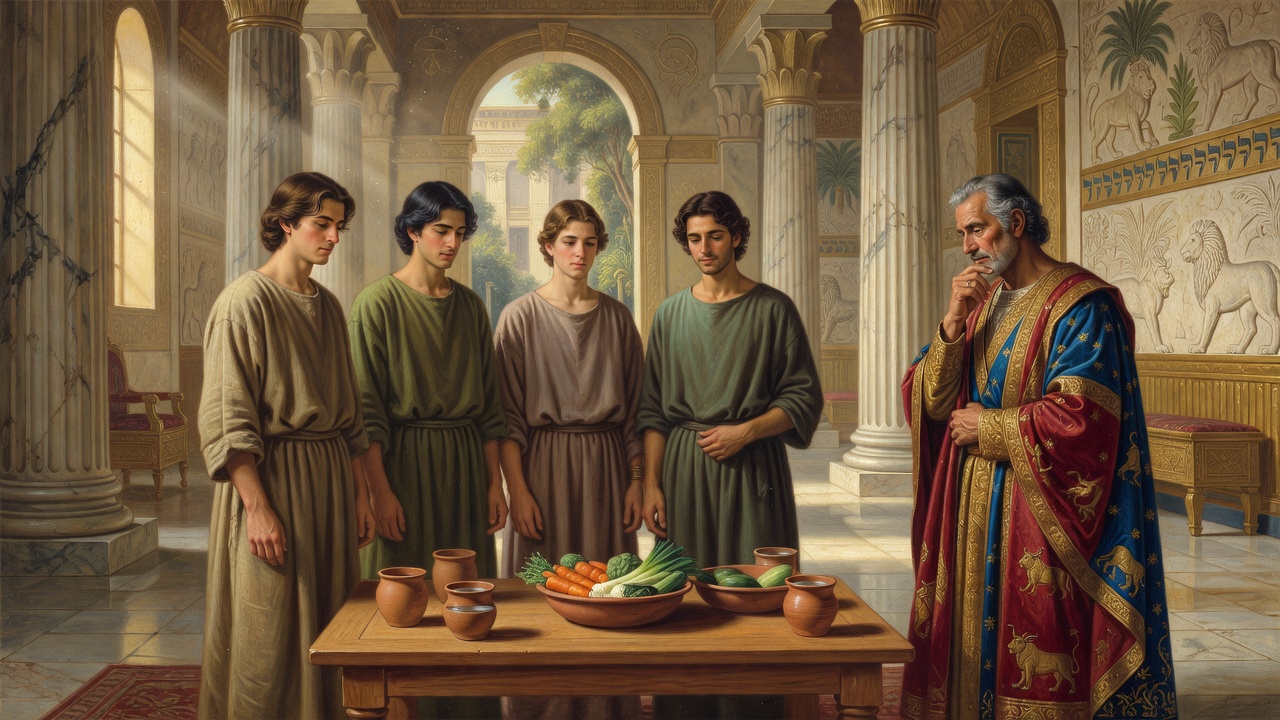
11Then Daniel said to the steward whom the chief official had appointed over Daniel, Hananiah, Mishael, and Azariah, 12“Please test your servants for ten days. Let us be given only vegetables to eat and water to drink. 13Then compare our appearances with those of the young men who are eating the royal food, and deal with your servants according to what you see.”
14So he consented to this and tested them for ten days. 15And at the end of ten days, they looked healthier and better nourished than all the young men who were eating the king’s food. 16So the steward continued to withhold their choice food and the wine they were to drink, and he gave them vegetables instead.
Daniel’s Wisdom
17To these four young men God gave knowledge and understanding in every kind of literature and wisdom. And Daniel had insight into all kinds of visions and dreams.
18Now at the end of the time specified by the king, the chief official presented them to Nebuchadnezzar. 19And the king spoke with them, and among all the young men he found no one equal to Daniel, Hananiah, Mishael, and Azariah. So they entered the king’s service.
20In every matter of wisdom and understanding about which the king consulted them, he found them ten times better than all the magicians and enchanters in his entire kingdom. 21And Daniel remained there until the first year of King Cyrus.
¿Sabías que…?
Fidelidad en la corte babilónica
- Nabucodonosor eligió a jóvenes nobles y capacitados de Judá para recibir tres años de formación en la lengua y la literatura de los caldeos (Dn 1:3–5). Como parte de su integración a la corte, el jefe de oficiales les dio nombres babilónicos: Daniel fue llamado Beltsasar; Ananías, Sadrac; Misael, Mesac; y Azarías, Abed-nego.Fuentes: el propio texto bíblico · Daniel · Shadrach · Azariah
- Para no contaminarse con la comida y el vino de la mesa real, Daniel solicitó una prueba de diez días consumiendo únicamente legumbres y agua (Dn 1:8, 12). El mayordomo encargado de su alimentación aceptó la prueba, y al cabo de los diez días los cuatro jóvenes hebreos lucían más saludables y mejor nutridos que los demás.Fuentes: el propio texto bíblico · Melzar
- El capítulo inicial concluye señalando que Daniel permaneció allí hasta el primer año del rey Ciro (Dn 1:21). Ciro fue el monarca persa que conquistó Babilonia y más tarde emitió el decreto que permitió el regreso de los judíos cautivos.Fuentes: el propio texto bíblico · Cyrus
Notas escritas con ayuda de IA a partir de fuentes abiertas (Theographic Bible Metadata, CC BY-SA 4.0; Easton’s Bible Dictionary, dominio público) y revisadas antes de publicarse.
Lugares de este capítulo
- Babylon · 32.543, 44.422 · versículos 1, 3
- Jerusalem · 31.777, 35.234 · versículo 1
- Shinar · Hoy: Babylonia · 32.543, 44.422 · versículo 2
- Chaldea · 30.962, 46.104 · versículo 4
Solo aparecen lugares identificados con alta confianza (90 % o más según las fuentes académicas reunidas por OpenBible). Mapa de la época: DARE (Digital Atlas of the Roman Empire), CC BY 4.0; mapa actual: © colaboradores de OpenStreetMap; lugares: OpenBible.info (CC BY 4.0).
Créditos y licencia de esta traducción
Berean Standard Bible
The Holy Bible in English: Berean Standard Bible
Public Domain
Language: English
Contributor: BSB Publishing, LLC
2026-10-02
Fuente: http://ebible.org/engbsb/ · eBible.org