Jueces 17
Douay-Rheims 1899 · Toca un versículo para ver sus referencias cruzadas.
Micah’s Idolatry
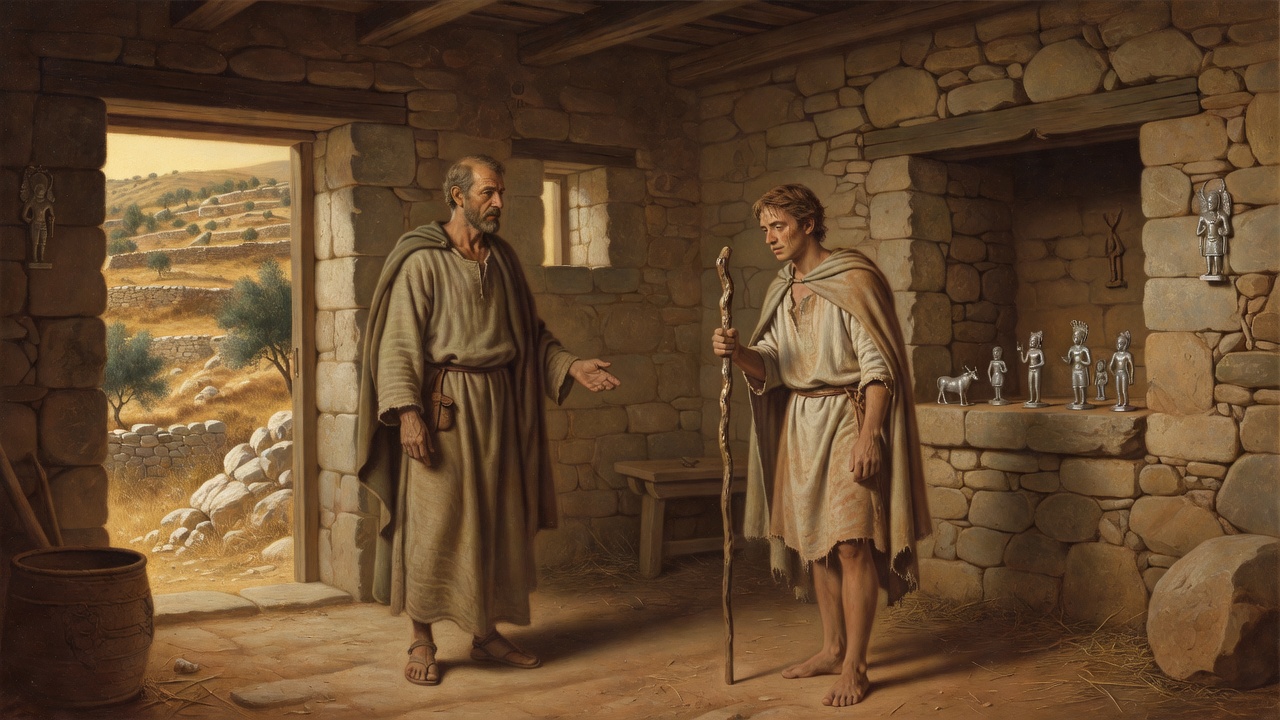
1There was at that time a man of mount Ephraim whose name was Michas, 2Who said to his mother: The eleven hundred pieces of silver, which thou hadst put aside for thyself, and concerning which thou didst swear in my hearing, behold I have, and they are with me. And she said to him: Blessed be my son by the Lord. 3So he restored them to his mother, who said to him: I have consecrated and vowed this silver to the Lord, that my son may receive it at my hand, and make a graven and a molten god, so now I deliver it to thee. 4And he restored them to his mother: and she took two hundred pieces of silver and gave them to the silversmith, to make of them a graven and a molten god, which was in the house of Michas. 5And he separated also therein a little temple for the god, and made an ephod, and theraphim, that is to say, a priestly garment, and idols: and he filled the hand of one of his sons, and he became his priest. 6In those days there was no king in Israel, but every one did that which seemed right to himself. 7There was also another young man of Bethlehem Juda, of the kindred thereof: and he was a Levite, and dwelt there. 8Now he went out from the city of Bethlehem, and desired to sojourn wheresoever he should find it convenient for him. And when he was come to mount Ephraim, as he was on his journey, and had turned aside a little into the house of Michas, 9He was asked by him whence he came. And he answered: I am a Levite of Bethlehem Juda, and I am going to dwell where I can, and where I shall find a place to my advantage. 10And Michas said: Stay with me, and be unto me a father and a priest, and I will give thee every year ten pieces of silver, and a double suit of apparel, and thy victuals. 11He was content, and abode with the man, and was unto him as one of his sons. 12And Michas filled his hand, and had the young man with him, for his priest, saying: 13Now I know God will do me good, since I have a priest of the race of the Levites.
¿Sabías que…?
El santuario doméstico de Micaías
- Micaías, un hombre de la región montañosa de Efraín, estableció un santuario privado con imágenes de plata talladas y fundidas, un efod e ídolos domésticos. Al principio consagró a uno de sus propios hijos como sacerdote antes de contratar a un levita viajero para atender su santuario.Fuentes: el propio texto bíblico · Micah
- La narración señala que en aquellos días no había rey en Israel y cada cual hacía lo que le parecía bien ante sus propios ojos. Este relato ilustra la anarquía y la confusión religiosa del período previo a la monarquía.Fuentes: el propio texto bíblico · Micah
- Un levita errante procedente de Belén de Judá aceptó servir como sacerdote de Micaías a cambio de sustento, ropa y un salario anual de diez siclos de plata.Fuentes: el propio texto bíblico
Notas escritas con ayuda de IA a partir de fuentes abiertas (Theographic Bible Metadata, CC BY-SA 4.0; Easton’s Bible Dictionary, dominio público) y revisadas antes de publicarse.
Lugares de este capítulo
Solo aparecen lugares identificados con alta confianza (90 % o más según las fuentes académicas reunidas por OpenBible). Mapa de la época: DARE (Digital Atlas of the Roman Empire), CC BY 4.0; mapa actual: © colaboradores de OpenStreetMap; lugares: OpenBible.info (CC BY 4.0).
Créditos y licencia de esta traducción
Douay-Rheims 1899
The Holy Bible in English, Douay-Rheims American Edition of 1899, translated from the Latin Vulgate
Public Domain
Language: English
Dialect: archaic American
Translation by: English College, Douai
This Public Domain Bible text is brought to you courtesy of eBible.org.
Help support free Bible access at https://eBible.org/give.php .
2022-11-03
Títulos de sección adaptados de la Berean Standard Bible (dominio público); no forman parte del texto bíblico de esta traducción.
Fuente: http://ebible.org/engDRA/ · eBible.org