Judges 17
Douay-Rheims 1899 · Tap a verse to see its cross-references.
Micah’s Idolatry
1There was at that time a man of mount Ephraim whose name was Michas, 2Who said to his mother: The eleven hundred pieces of silver, which thou hadst put aside for thyself, and concerning which thou didst swear in my hearing, behold I have, and they are with me. And she said to him: Blessed be my son by the Lord. 3So he restored them to his mother, who said to him: I have consecrated and vowed this silver to the Lord, that my son may receive it at my hand, and make a graven and a molten god, so now I deliver it to thee. 4And he restored them to his mother: and she took two hundred pieces of silver and gave them to the silversmith, to make of them a graven and a molten god, which was in the house of Michas. 5And he separated also therein a little temple for the god, and made an ephod, and theraphim, that is to say, a priestly garment, and idols: and he filled the hand of one of his sons, and he became his priest. 6In those days there was no king in Israel, but every one did that which seemed right to himself. 7There was also another young man of Bethlehem Juda, of the kindred thereof: and he was a Levite, and dwelt there. 8Now he went out from the city of Bethlehem, and desired to sojourn wheresoever he should find it convenient for him. And when he was come to mount Ephraim, as he was on his journey, and had turned aside a little into the house of Michas, 9He was asked by him whence he came. And he answered: I am a Levite of Bethlehem Juda, and I am going to dwell where I can, and where I shall find a place to my advantage. 10And Michas said: Stay with me, and be unto me a father and a priest, and I will give thee every year ten pieces of silver, and a double suit of apparel, and thy victuals. 11He was content, and abode with the man, and was unto him as one of his sons. 12And Michas filled his hand, and had the young man with him, for his priest, saying: 13Now I know God will do me good, since I have a priest of the race of the Levites.
Did you know?
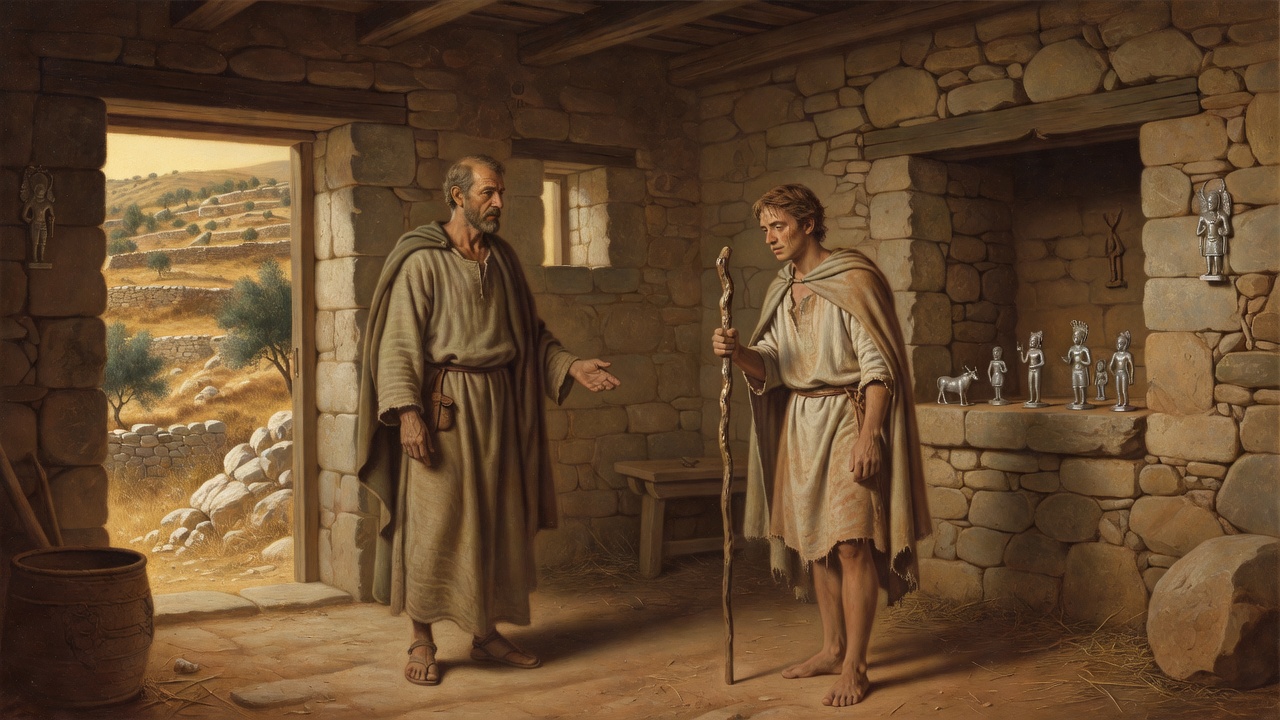
Micah's Domestic Shrine
- Micah, a man from the hill country of Ephraim, set up a private shrine containing carved and cast silver images, an ephod, and household idols. He initially ordained one of his own sons as his priest before hiring a traveling Levite to manage his shrine.Sources: the Bible text itself · Micah
- The narrative notes that there was no king in Israel during those days and everyone did what was right in their own eyes. This account serves to illustrate the lawlessness and religious confusion of the period before the monarchy.Sources: the Bible text itself · Micah
- A wandering Levite from Bethlehem in Judah agreed to serve as Micah's priest in exchange for food, clothing, and an annual wage of ten shekels of silver.Sources: the Bible text itself
Notes written with AI assistance from open sources (Theographic Bible Metadata, CC BY-SA 4.0; Easton’s Bible Dictionary, public domain) and reviewed before publishing.
Places in this chapter
Only places identified with high confidence are shown (90% or more according to the scholarly sources compiled by OpenBible). Period map: DARE (Digital Atlas of the Roman Empire), CC BY 4.0; modern map: © OpenStreetMap contributors; places: OpenBible.info (CC BY 4.0).
Credits and license for this translation
Douay-Rheims 1899
The Holy Bible in English, Douay-Rheims American Edition of 1899, translated from the Latin Vulgate
Public Domain
Language: English
Dialect: archaic American
Translation by: English College, Douai
This Public Domain Bible text is brought to you courtesy of eBible.org.
Help support free Bible access at https://eBible.org/give.php .
2022-11-03
Section headings adapted from the Berean Standard Bible (public domain); they are not part of this translation’s text.
Source: http://ebible.org/engDRA/ · eBible.org