Job 4
LXX2012: Septuagint in British/International English 2012 · Toca un versículo para ver sus referencias cruzadas.
Eliphaz: The Innocent Prosper
1Then Eliphaz the Thaemanite answered and said, 2Have you been often spoken to in distress? but who shall endure the force of your words? 3For whereas you have instructed many, and have strengthened the hands of the weak one, 4and have supported the failing with words, and have imparted courage to feeble knees. 5Yet now that pain has come upon you, and touched you, you are troubled. 6Is not your fear founded in folly, your hope also, and the mischief of your way? 7Remember then who has perished, being pure? or when were the true-hearted utterly destroyed? 8Accordingly as I have seen men ploughing barren places, and they that sow them will reap sorrows for themselves. 9They shall perish by the command of the Lord, and shall be utterly consumed by the breath of his wrath. 10The strength of the lion, and the voice of the lioness, and the exulting cry of serpents are quenched. 11The old lion has perished for lack of food, and the lions' whelps have forsaken one another. 12But if there had been any truth in your words, none of these evils would have befallen you. Shall not my ear receive excellent revelations from him? 13But as when terror falls upon men, with dread and a sound in the night, 14horror and trembling seized me, and caused all my bones greatly to shake. 15And a spirit came before my face; and my hair and flesh quivered. 16I arose and perceived it not: I looked, and there, was no form before my eyes: but I only heard a breath and a voice, saying, 17What, shall a mortal be pure before the Lord? or a man be blameless in regard to his works? 18Whereas he trust not in his servants, and perceives perverseness in his angels. 19But as for them that dwell in houses of clay, of whom we also are formed of the same clay, he smites them like a moth. 20And from the morning to evening they no longer exist: they have perished, because they can’t help themselves. 21For he blows upon them, and they are withered: they have perished for lack of wisdom.
¿Sabías que…?
El Primer Discurso de Elifaz
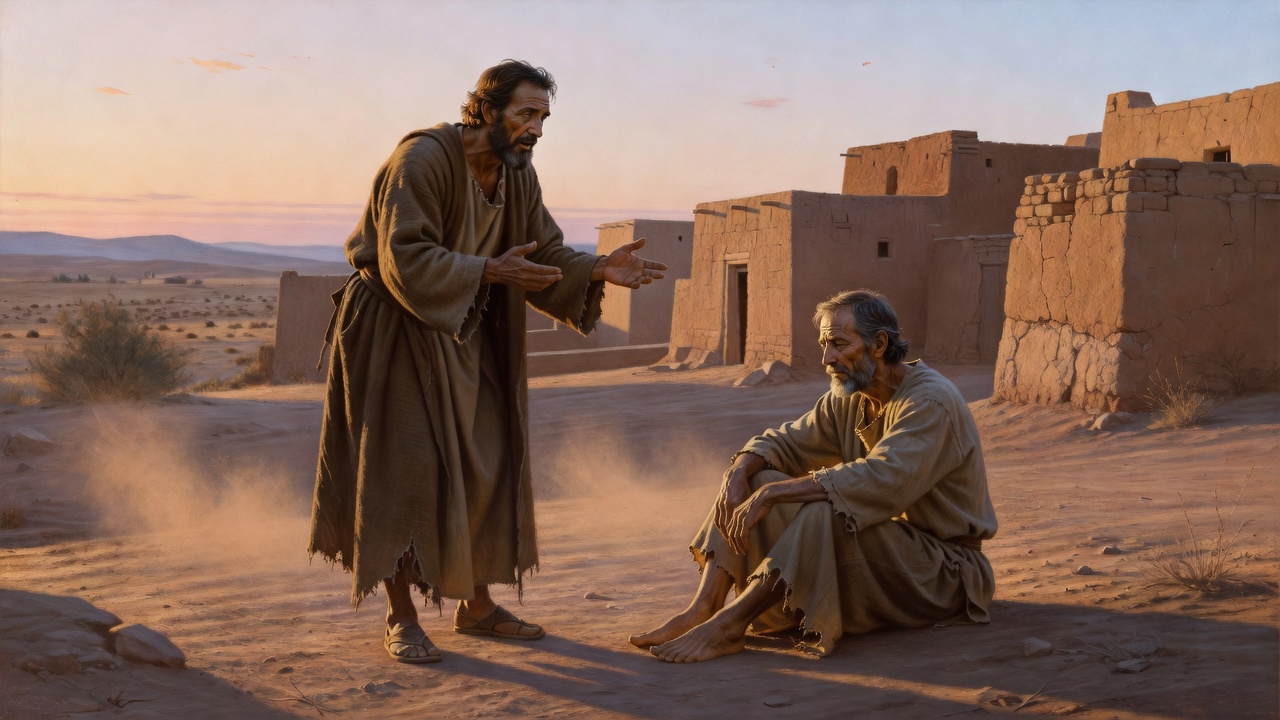
- Elifaz el temanita es el primero de los compañeros de Job en responder, rompiendo el silencio de siete días. Reconoce la reputación pasada de Job de consolar y fortalecer a los afligidos antes de cuestionar por qué Job no puede aplicar esa misma firmeza a su propio sufrimiento.Fuentes: el propio texto bíblico · Eliphaz
- Elifaz introduce el principio tradicional de la retribución, argumentando que los inocentes nunca perecen y que las personas cosechan lo que siembran en la vida.Fuentes: el propio texto bíblico
- Para respaldar su argumento teológico, Elifaz relata una estremecedora visión nocturna en la que un espíritu misterioso apareció ante él en la oscuridad, afirmando que los frágiles mortales que habitan en casas de barro no pueden ser más justos o puros que su Hacedor.Fuentes: el propio texto bíblico
Notas escritas con ayuda de IA a partir de fuentes abiertas (Theographic Bible Metadata, CC BY-SA 4.0; Easton’s Bible Dictionary, dominio público) y revisadas antes de publicarse.
Créditos y licencia de esta traducción
LXX2012: Septuagint in British/International English 2012
The Septuagint with Apocrypha, translated from Greek to English by Sir Lancelot C. L. Brenton and published in 1885, with some language updates (British/International English)
Public Domain
Language: English
Dialect (if applicable): British
Language in English: English
Translation by: Sir Lancelot Charles Lee Breton
LXX2012: Septuagint in English 2012, British/International English Edition
This is a translation of the Old Testament and Apocrypha/Deuterocanon from Hebrew to Greek to 19th Century British English, with some updates of spelling and word usage to contemporary British/International English. The original English translation was done by Sir Lancelot Charles Lee Brenton and published by Samuel Bagster & Sons, Ltd., in London in 1851. It has entered the Public Domain due to the passage of sufficient time. In the process of scanning and typing the text, the original poetry and prose formatting, as well as peripheral material like introductions and notes, have been omitted.
This edition of the Septuagint has some language updates. Brenton's word order and punctuation has been mostly retained, meaning that quotation marks are not used, and sentences within quotes may not start with capital letters, as was standard usage in 1851. Names transliterated from Greek to those transliterated from Hebrew in the common English Bibles often differ. These language updates are dedicated to the Public Domain by the author of those edits, Michael Paul Johnson. Therefore this edition may be freely copied, published, etc.
Before considering making changes to the text of this work, I recommend that you consult with God, because this is really His Book.
If you find errors in the text, please report them so that we can correct them.
Donations to help with the expenses of operating this web site and thus help others have free access to the Word of God may be made to us, but are not required. Please see http://MLJohnson.org/partner/ for more about that.
Títulos de sección adaptados de la Berean Standard Bible (dominio público); no forman parte del texto bíblico de esta traducción.
Fuente: http://ebible.org/eng-uk-lxx2012/ · eBible.org