Job 3
LXX2012: Septuagint in British/International English 2012 · Toca un versículo para ver sus referencias cruzadas.
Job Laments His Birth
1After this Job opened his mouth, and cursed his day, 2saying, 3Let the day perish in which I was born, and that night in which they said, Behold a boy! 4Let that night be darkness, and let not the Lord regard it from above, neither let light come upon it. 5But let darkness and the shadow of death seize it; let blackness come upon it; 6let that day and night be cursed, let darkness carry them away; let it not come into the days of the year, neither let it be numbered with the days of the months. 7But let that night be pain, and let not mirth come upon it, nor joy. 8But let him that curses that day curse it, even he that is ready to attack the great whale. 9Let the stars of that night be darkened; let it remain dark, and not come into light; and let it not see the morning star arise: 10because it shut not up the gates of my mother's womb, for so it would have removed sorrow from my eyes. 11For why died I not in the belly? and why did I not come forth from the womb and die immediately? 12and why did the knees support me? and why did I suck the breasts? 13Now I should have lain down and been quiet, I should have slept and been at rest, 14with kings and councillors of the earth, who gloried in their swords; 15or with rulers, whose gold was abundant, who filled their houses with silver: 16or I should have been as an untimely birth proceeding from his mother's womb, or as infants who never saw light. 17There the ungodly have burnt out the fury of rage; there the wearied in body rest. 18And the men of old time have together ceased to hear the exactor's voice. 19The small and great are there, and the servant that feared his lord. 20For why is light given to those who are in bitterness, and life to those souls which are in griefs? 21who desire death, and obtain it not, digging for it as for treasures; 22and would be very joyful if they should gain it? 23Death is rest to such a man, for God has hedged him in. 24For my groaning comes before my food, and I weep being beset with terror. 25For the terror of which I meditated has come upon me, and that which I had feared has befallen me. 26I was not at peace, nor quiet, nor had I rest; yet wrath came upon me.
¿Sabías que…?
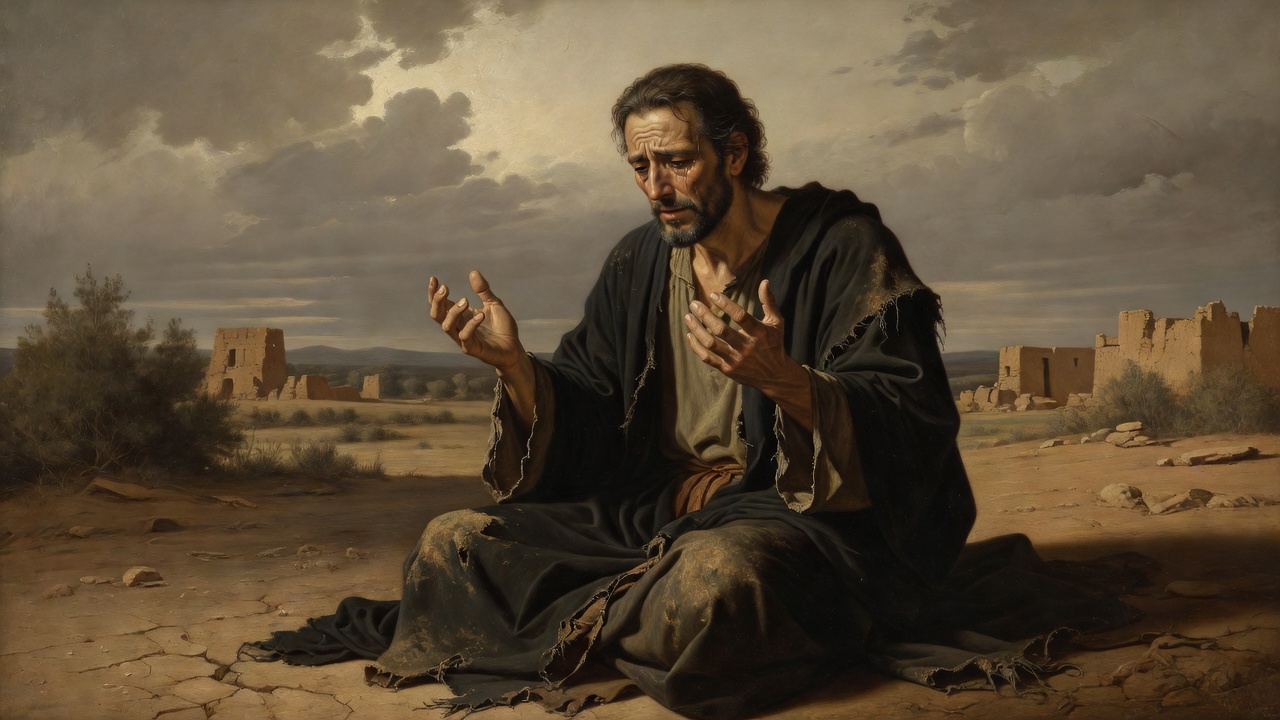
Job Maldice el Día de su Nacimiento
- Tras soportar un intenso sufrimiento, Job rompe su silencio no para maldecir a Dios, sino para maldecir el día de su nacimiento y la noche en que fue concebido, deseando que ese día hubiera sido consumido por la oscuridad absoluta.Fuentes: el propio texto bíblico · Job
- En su lamento poético, Job invoca a los que maldicen el día y están listos para despertar a Leviatán, usando imágenes poéticas de caos cósmico para enfatizar su anhelo de borrar su propia existencia.Fuentes: el propio texto bíblico
- Job describe la tumba como un lugar de descanso e igualdad donde reyes, consejeros, esclavos y cautivos reposan juntos, libres del agotamiento, la opresión y la angustia que afligen a los vivos.Fuentes: el propio texto bíblico
Notas escritas con ayuda de IA a partir de fuentes abiertas (Theographic Bible Metadata, CC BY-SA 4.0; Easton’s Bible Dictionary, dominio público) y revisadas antes de publicarse.
Créditos y licencia de esta traducción
LXX2012: Septuagint in British/International English 2012
The Septuagint with Apocrypha, translated from Greek to English by Sir Lancelot C. L. Brenton and published in 1885, with some language updates (British/International English)
Public Domain
Language: English
Dialect (if applicable): British
Language in English: English
Translation by: Sir Lancelot Charles Lee Breton
LXX2012: Septuagint in English 2012, British/International English Edition
This is a translation of the Old Testament and Apocrypha/Deuterocanon from Hebrew to Greek to 19th Century British English, with some updates of spelling and word usage to contemporary British/International English. The original English translation was done by Sir Lancelot Charles Lee Brenton and published by Samuel Bagster & Sons, Ltd., in London in 1851. It has entered the Public Domain due to the passage of sufficient time. In the process of scanning and typing the text, the original poetry and prose formatting, as well as peripheral material like introductions and notes, have been omitted.
This edition of the Septuagint has some language updates. Brenton's word order and punctuation has been mostly retained, meaning that quotation marks are not used, and sentences within quotes may not start with capital letters, as was standard usage in 1851. Names transliterated from Greek to those transliterated from Hebrew in the common English Bibles often differ. These language updates are dedicated to the Public Domain by the author of those edits, Michael Paul Johnson. Therefore this edition may be freely copied, published, etc.
Before considering making changes to the text of this work, I recommend that you consult with God, because this is really His Book.
If you find errors in the text, please report them so that we can correct them.
Donations to help with the expenses of operating this web site and thus help others have free access to the Word of God may be made to us, but are not required. Please see http://MLJohnson.org/partner/ for more about that.
Títulos de sección adaptados de la Berean Standard Bible (dominio público); no forman parte del texto bíblico de esta traducción.
Fuente: http://ebible.org/eng-uk-lxx2012/ · eBible.org