Génesis 40
LXX2012: Septuagint in British/International English 2012 · Toca un versículo para ver sus referencias cruzadas.
The Cupbearer and the Baker
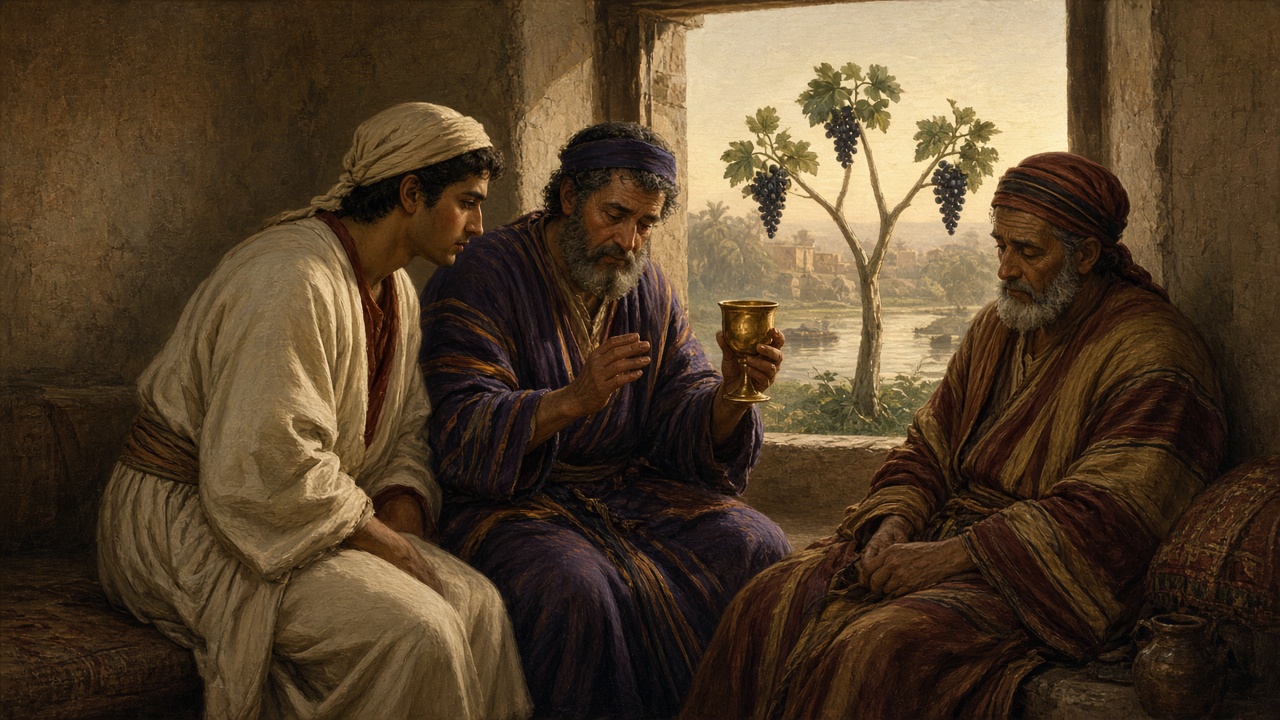
1And it came to pass after these things, that the chief cupbearer of the king of Egypt and the chief baker trespassed against their lord the king of Egypt. 2And Pharao was angry with his two eunuchs, with his chief cupbearer, and with his chief baker. 3And he put them in ward, into the prison, into the place whereinto Joseph had been led. 4And the chief keeper of the prison committed them to Joseph, and he stood by them; and they were some days in the prison. 5And they both had a dream in one night; and the vision of the dream of the chief cupbearer and chief baker, who belonged to the king of Egypt, who were in the prison, was this. 6Joseph went in to them in the morning, and saw them, and they had been troubled. 7And he asked the eunuchs of Pharao who were with him in the prison with his master, saying, Why is it that your countenances are sad today? 8And they said to him, We have seen a dream, and there is no interpreter of it. And Joseph said to them, Is not the interpretation of them through god? tell them than to me. 9And the chief cupbearer related his dream to Joseph, and said, In my dream a vine was before me. 10And in the vine were three stems; and it budding shot forth blossoms; the clusters of grapes were ripe. 11And the cup of Pharao was in my hand; and I took the bunch of grapes, and squeezed it into the cup, and gave the cup into Pharao's hand. 12And Joseph said to him, This is the interpretation of it. The three stems are three days. 13Yet three days and Pharao shall remember your office, and he shall restore you to your place of chief cupbearer, and you shall give the cup of Pharao into his hand, according to your former high place, as you were wont to be cupbearer. 14But remember me of yourself, when it shall be well with you, and you shall deal mercifully with me, and you shall make mention of me to Pharao, and you shall bring me forth out of this dungeon. 15For surely I was stolen away out of the land of the Hebrews, and here I have done nothing, but they have cast me into this pit. 16And the chief baker saw that he interpreted aright; and he said to Joseph, I also saw a dream, and I thought I took up on my head three baskets of mealy food. 17And in the upper basket there was the work of the baker of every kind which Pharao eats; and the fowls of the air ate them out of the basket that was on my head. 18And Joseph answered and said to him, This is the interpretation of it; The three baskets are three days. 19Yet three days, and Pharao shall take away your head from off you, and shall hang you on a tree, and the birds of the sky shall eat your flesh from off you. 20And it came to pass on the third day that it was Pharao's birth-day, and he made a banquet for all his servants, and he remembered the office of the cupbearer and the office of the baker in the midst of his servants. 21And he restored the chief cupbearer to his office, and he gave the cup into Pharao's hand. 22And he hanged the chief baker, as Joseph, interpreted to them. 23Yet did not the chief cupbearer remember Joseph, but forgot him.
¿Sabías que…?
Sueños en la prisión del faraón
- El faraón se enojó con dos oficiales, el jefe de los coperos y el jefe de los panaderos, y los puso en la casa del capitán de la guardia, la misma prisión donde José estaba encerrado. El capitán los encomendó a José, quien pasó a ser su asistente personal.Fuentes: el propio texto bíblico
- En la misma noche, el copero y el panadero soñaron, cada uno con el suyo, y José dijo que las interpretaciones pertenecen a Dios. Él tomó las tres ramas y las tres canastas como tres días: el faraón levantaría la cabeza del copero y lo restauraría, pero le quitaría la cabeza al panadero y lo colgaría de un árbol. Al tercer día, cumpleaños del faraón, el rey ofreció un banquete a sus oficiales, restauró al copero y ahorcó al panadero.Fuentes: el propio texto bíblico
- José pidió al copero que, una vez restaurado, se acordara de él y lo mencionara al faraón. Dijo que había sido secuestrado de la tierra de los hebreos y que no había hecho nada para que lo encerraran en el calabozo. El Easton's Bible Dictionary (1897) identifica al faraón de los días de José probablemente como Apopi, o Apopis, el último de los reyes hicsos; algunos argumentan, en cambio, que José llegó a Egipto más tarde, bajo Thothmes III.Fuentes: el propio texto bíblico · Pharaoh (of Joseph)
Notas escritas con ayuda de IA a partir de fuentes abiertas (Theographic Bible Metadata, CC BY-SA 4.0; Easton’s Bible Dictionary, dominio público) y revisadas antes de publicarse.
Lugares de este capítulo
Solo aparecen lugares identificados con alta confianza (90 % o más según las fuentes académicas reunidas por OpenBible). Mapa de la época: DARE (Digital Atlas of the Roman Empire), CC BY 4.0; mapa actual: © colaboradores de OpenStreetMap; lugares: OpenBible.info (CC BY 4.0).
Créditos y licencia de esta traducción
LXX2012: Septuagint in British/International English 2012
The Septuagint with Apocrypha, translated from Greek to English by Sir Lancelot C. L. Brenton and published in 1885, with some language updates (British/International English)
Public Domain
Language: English
Dialect (if applicable): British
Language in English: English
Translation by: Sir Lancelot Charles Lee Breton
LXX2012: Septuagint in English 2012, British/International English Edition
This is a translation of the Old Testament and Apocrypha/Deuterocanon from Hebrew to Greek to 19th Century British English, with some updates of spelling and word usage to contemporary British/International English. The original English translation was done by Sir Lancelot Charles Lee Brenton and published by Samuel Bagster & Sons, Ltd., in London in 1851. It has entered the Public Domain due to the passage of sufficient time. In the process of scanning and typing the text, the original poetry and prose formatting, as well as peripheral material like introductions and notes, have been omitted.
This edition of the Septuagint has some language updates. Brenton's word order and punctuation has been mostly retained, meaning that quotation marks are not used, and sentences within quotes may not start with capital letters, as was standard usage in 1851. Names transliterated from Greek to those transliterated from Hebrew in the common English Bibles often differ. These language updates are dedicated to the Public Domain by the author of those edits, Michael Paul Johnson. Therefore this edition may be freely copied, published, etc.
Before considering making changes to the text of this work, I recommend that you consult with God, because this is really His Book.
If you find errors in the text, please report them so that we can correct them.
Donations to help with the expenses of operating this web site and thus help others have free access to the Word of God may be made to us, but are not required. Please see http://MLJohnson.org/partner/ for more about that.
Títulos de sección adaptados de la Berean Standard Bible (dominio público); no forman parte del texto bíblico de esta traducción.
Fuente: http://ebible.org/eng-uk-lxx2012/ · eBible.org