Genesis 40
LXX2012: Septuagint in British/International English 2012 · Tap a verse to see its cross-references.
The Cupbearer and the Baker
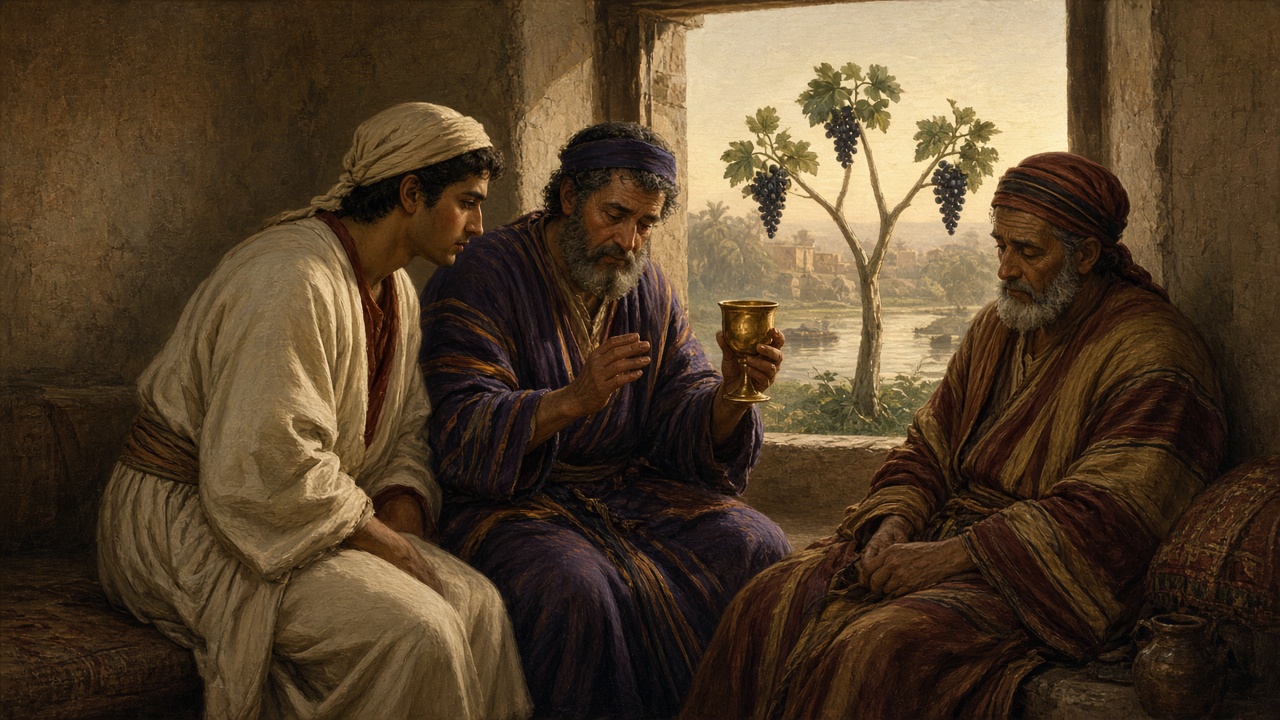
1And it came to pass after these things, that the chief cupbearer of the king of Egypt and the chief baker trespassed against their lord the king of Egypt. 2And Pharao was angry with his two eunuchs, with his chief cupbearer, and with his chief baker. 3And he put them in ward, into the prison, into the place whereinto Joseph had been led. 4And the chief keeper of the prison committed them to Joseph, and he stood by them; and they were some days in the prison. 5And they both had a dream in one night; and the vision of the dream of the chief cupbearer and chief baker, who belonged to the king of Egypt, who were in the prison, was this. 6Joseph went in to them in the morning, and saw them, and they had been troubled. 7And he asked the eunuchs of Pharao who were with him in the prison with his master, saying, Why is it that your countenances are sad today? 8And they said to him, We have seen a dream, and there is no interpreter of it. And Joseph said to them, Is not the interpretation of them through god? tell them than to me. 9And the chief cupbearer related his dream to Joseph, and said, In my dream a vine was before me. 10And in the vine were three stems; and it budding shot forth blossoms; the clusters of grapes were ripe. 11And the cup of Pharao was in my hand; and I took the bunch of grapes, and squeezed it into the cup, and gave the cup into Pharao's hand. 12And Joseph said to him, This is the interpretation of it. The three stems are three days. 13Yet three days and Pharao shall remember your office, and he shall restore you to your place of chief cupbearer, and you shall give the cup of Pharao into his hand, according to your former high place, as you were wont to be cupbearer. 14But remember me of yourself, when it shall be well with you, and you shall deal mercifully with me, and you shall make mention of me to Pharao, and you shall bring me forth out of this dungeon. 15For surely I was stolen away out of the land of the Hebrews, and here I have done nothing, but they have cast me into this pit. 16And the chief baker saw that he interpreted aright; and he said to Joseph, I also saw a dream, and I thought I took up on my head three baskets of mealy food. 17And in the upper basket there was the work of the baker of every kind which Pharao eats; and the fowls of the air ate them out of the basket that was on my head. 18And Joseph answered and said to him, This is the interpretation of it; The three baskets are three days. 19Yet three days, and Pharao shall take away your head from off you, and shall hang you on a tree, and the birds of the sky shall eat your flesh from off you. 20And it came to pass on the third day that it was Pharao's birth-day, and he made a banquet for all his servants, and he remembered the office of the cupbearer and the office of the baker in the midst of his servants. 21And he restored the chief cupbearer to his office, and he gave the cup into Pharao's hand. 22And he hanged the chief baker, as Joseph, interpreted to them. 23Yet did not the chief cupbearer remember Joseph, but forgot him.
Did you know?
Dreams in Pharaoh's Prison
- Pharaoh was angry with two officers, the chief cupbearer and the chief baker, and put them in the house of the captain of the guard, the same prison where Joseph was confined. The captain assigned them to Joseph, who became their personal attendant.Sources: the Bible text itself
- On the same night the cupbearer and the baker each dreamed, and Joseph said that interpretations belong to God. He took the three branches and the three baskets to mean three days: Pharaoh would lift up the cupbearer's head and restore him, but lift off the baker's head and hang him on a tree. On the third day, Pharaoh's birthday, the king held a feast for his officials, restored the cupbearer, and hanged the baker.Sources: the Bible text itself
- Joseph asked the cupbearer to remember him and mention him to Pharaoh after his restoration. He said he had been kidnapped from the land of the Hebrews and had done nothing for which he should have been put in the dungeon. Easton's Bible Dictionary (1897) identifies the Pharaoh of Joseph's days as probably Apopi, or Apopis, the last of the Hyksos kings; some argue instead that Joseph came to Egypt later, under Thothmes III.Sources: the Bible text itself · Pharaoh (of Joseph)
Notes written with AI assistance from open sources (Theographic Bible Metadata, CC BY-SA 4.0; Easton’s Bible Dictionary, public domain) and reviewed before publishing.
Places in this chapter
Only places identified with high confidence are shown (90% or more according to the scholarly sources compiled by OpenBible). Period map: DARE (Digital Atlas of the Roman Empire), CC BY 4.0; modern map: © OpenStreetMap contributors; places: OpenBible.info (CC BY 4.0).
Credits and license for this translation
LXX2012: Septuagint in British/International English 2012
The Septuagint with Apocrypha, translated from Greek to English by Sir Lancelot C. L. Brenton and published in 1885, with some language updates (British/International English)
Public Domain
Language: English
Dialect (if applicable): British
Language in English: English
Translation by: Sir Lancelot Charles Lee Breton
LXX2012: Septuagint in English 2012, British/International English Edition
This is a translation of the Old Testament and Apocrypha/Deuterocanon from Hebrew to Greek to 19th Century British English, with some updates of spelling and word usage to contemporary British/International English. The original English translation was done by Sir Lancelot Charles Lee Brenton and published by Samuel Bagster & Sons, Ltd., in London in 1851. It has entered the Public Domain due to the passage of sufficient time. In the process of scanning and typing the text, the original poetry and prose formatting, as well as peripheral material like introductions and notes, have been omitted.
This edition of the Septuagint has some language updates. Brenton's word order and punctuation has been mostly retained, meaning that quotation marks are not used, and sentences within quotes may not start with capital letters, as was standard usage in 1851. Names transliterated from Greek to those transliterated from Hebrew in the common English Bibles often differ. These language updates are dedicated to the Public Domain by the author of those edits, Michael Paul Johnson. Therefore this edition may be freely copied, published, etc.
Before considering making changes to the text of this work, I recommend that you consult with God, because this is really His Book.
If you find errors in the text, please report them so that we can correct them.
Donations to help with the expenses of operating this web site and thus help others have free access to the Word of God may be made to us, but are not required. Please see http://MLJohnson.org/partner/ for more about that.
Section headings adapted from the Berean Standard Bible (public domain); they are not part of this translation’s text.
Source: http://ebible.org/eng-uk-lxx2012/ · eBible.org