Éxodo 27
LXX2012: Septuagint in British/International English 2012 · Toca un versículo para ver sus referencias cruzadas.
The Bronze Altar
1And you shall make an altar of incorruptible wood, of five cubits in the length, and five cubits in the breadth; the altar shall be square, and the height of it shall be of three cubits. 2And you shall make the horns on the four corners; the horns shall be of the same piece, and you shall overlay them with brass. 3And you shall make a rim for the altar; and its covering and its cups, and its flesh hooks, and its fire-pan, and all its vessels shall you make of brass. 4And you shall make for it a brazen grate with network; and you shall make for the grate four brazen rings under the four sides. 5And you shall put them below under the grate of the altar, and the grate shall extend to the middle of the altar. 6And you shall make for the altar staves of incorruptible wood, and you shall overlay them with brass. 7And you shall put the staves into the rings; and let the staves be on the sides of the altar to carry it. 8You shall make it hollow with boards: according to what was showed you in the mount, so you shall make it.
The Courtyard
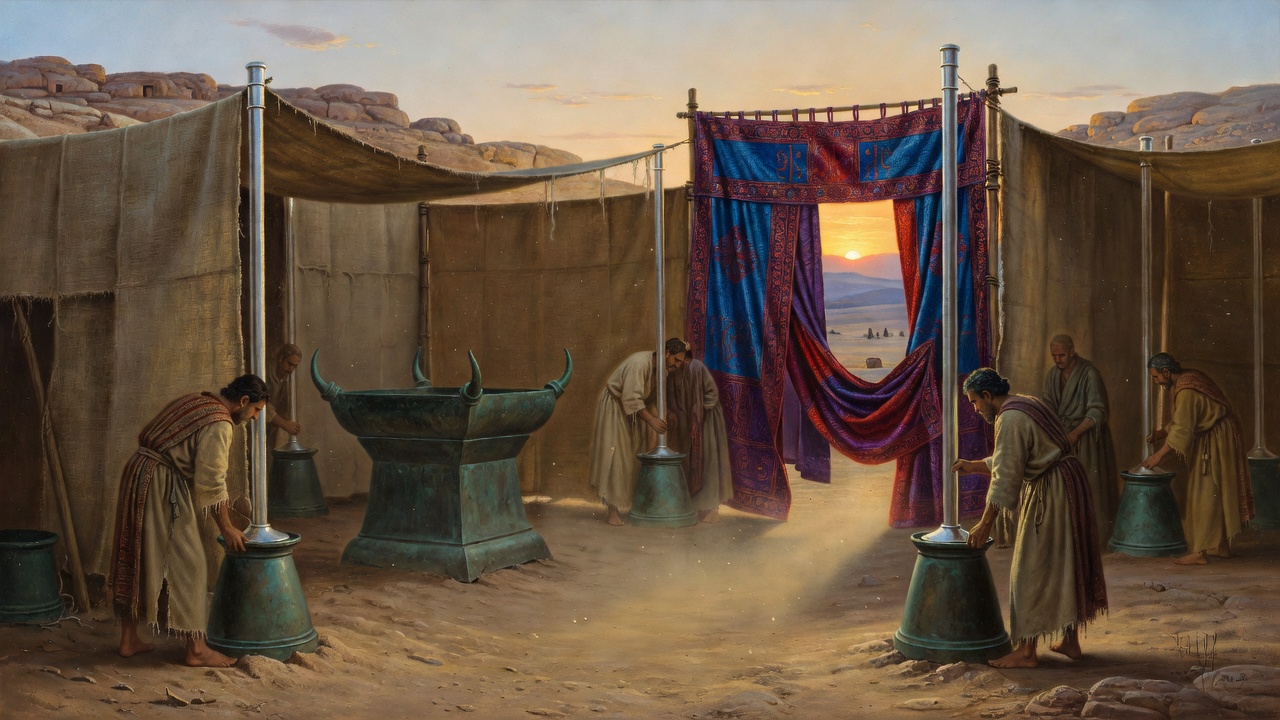
9And you shall make a court for the tabernacle, curtains of the court of fine linen spun on the south side, the length of one hundred cubits for one side. 10And their pillars twenty, and twenty brazen sockets for them, and their rings and their clasps of silver. 11Thus shall there be to the side towards the north curtains of one hundred cubits in length; and their pillars twenty, and their sockets twenty of brass, and the rings and the clasps of the pillars, and their sockets overlaid with silver. 12And in the breadth of the tabernacle towards the west curtains of fifty cubits, their pillars ten and their sockets ten. 13And in the breadth of the tabernacle towards the south, curtains of fifty cubits; their pillars ten, and their sockets ten. 14And the height of the curtains shall be of fifty cubits for the one side of the gate; their pillars three, and their sockets three. 15And for the second side the height of the curtains shall be of fifteen cubits; their pillars three, and their sockets three. 16And a veil for the door of the court, the height of it of twenty cubits of blue linen, and of purple, and spun scarlet, and of fine linen spun with the art of the embroiderer; their pillars four, and their sockets four. 17All the pillars of the court round about overlaid with silver, and their capitals silver and their brass sockets. 18And the length of the court shall be one hundred cubits on each side, and the breadth fifty on each side, and the height five cubits of fine linen spun, and their sockets of brass. 19And all the furniture and all the instruments and the pins of the court shall be of brass.
The Oil for the Lamps
20And do you charge the children of Israel, and let them take for you refined pure olive-oil beaten to burn for light, that a lamp may burn continually 21in the tabernacle of the testimony, without the veil that is before the ark of the covenant, shall Aaron and his sons burn it from evening until morning, before the Lord: it is a perpetual ordinance throughout your generations of the children of Israel.
¿Sabías que…?
El altar de bronce, el atrio y las lámparas
- Este capítulo dispone un altar cuadrado de madera de acacia, de cinco codos de largo, cinco de ancho y tres de alto, con un cuerno en cada una de sus cuatro esquinas, los cuernos de una sola pieza, y el altar recubierto de bronce. Debía construirse hueco, con tablas, con una rejilla de malla de bronce puesta bajo un borde, de modo que la malla quedara a media altura, y con varas de madera de acacia recubiertas de bronce, insertadas en anillos, para que el altar pudiera transportarse. Todos sus utensilios —recipientes para retirar las cenizas, palas, tazones para rociar, tenedores para la carne y braseros— serían de bronce, y el altar debía hacerse tal como se había mostrado en el monte.Fuentes: el propio texto bíblico
- El atrio del tabernáculo debía tener cien codos de largo y cincuenta de ancho, con cortinas de lino fino hilado de cinco codos de alto. Los lados sur y norte, de cien codos cada uno, tendrían veinte postes y veinte bases de bronce, con ganchos y bandas de plata; el lado oeste, de cincuenta codos de ancho, tendría diez postes y diez bases. El lado este, hacia la salida del sol, también tendría cincuenta codos de ancho, con una cortina de entrada de veinte codos, bordada con hilo azul, púrpura y carmesí y lino fino hilado, sobre cuatro postes, y con cortinas de quince codos a cada lado.Fuentes: el propio texto bíblico
- Los israelitas debían traer aceite puro de olivas prensadas para el alumbrado, de modo que las lámparas siguieran ardiendo de continuo. En la Tienda de reunión, fuera del velo que está delante del Testimonio, Aarón y sus hijos debían cuidar las lámparas delante del Señor, desde la tarde hasta la mañana, un estatuto permanente para los israelitas por las generaciones venideras. Aarón, hijo mayor de Amram y Jocabed, nació en Egipto tres años antes que su hermano Moisés y, con Elisabet, hija de Aminadab, de la casa de Judá, con quien se casó, tuvo cuatro hijos: Nadab, Abiú, Eleazar e Itamar.Fuentes: el propio texto bíblico · Aaron
Notas escritas con ayuda de IA a partir de fuentes abiertas (Theographic Bible Metadata, CC BY-SA 4.0; Easton’s Bible Dictionary, dominio público) y revisadas antes de publicarse.
Créditos y licencia de esta traducción
LXX2012: Septuagint in British/International English 2012
The Septuagint with Apocrypha, translated from Greek to English by Sir Lancelot C. L. Brenton and published in 1885, with some language updates (British/International English)
Public Domain
Language: English
Dialect (if applicable): British
Language in English: English
Translation by: Sir Lancelot Charles Lee Breton
LXX2012: Septuagint in English 2012, British/International English Edition
This is a translation of the Old Testament and Apocrypha/Deuterocanon from Hebrew to Greek to 19th Century British English, with some updates of spelling and word usage to contemporary British/International English. The original English translation was done by Sir Lancelot Charles Lee Brenton and published by Samuel Bagster & Sons, Ltd., in London in 1851. It has entered the Public Domain due to the passage of sufficient time. In the process of scanning and typing the text, the original poetry and prose formatting, as well as peripheral material like introductions and notes, have been omitted.
This edition of the Septuagint has some language updates. Brenton's word order and punctuation has been mostly retained, meaning that quotation marks are not used, and sentences within quotes may not start with capital letters, as was standard usage in 1851. Names transliterated from Greek to those transliterated from Hebrew in the common English Bibles often differ. These language updates are dedicated to the Public Domain by the author of those edits, Michael Paul Johnson. Therefore this edition may be freely copied, published, etc.
Before considering making changes to the text of this work, I recommend that you consult with God, because this is really His Book.
If you find errors in the text, please report them so that we can correct them.
Donations to help with the expenses of operating this web site and thus help others have free access to the Word of God may be made to us, but are not required. Please see http://MLJohnson.org/partner/ for more about that.
Títulos de sección adaptados de la Berean Standard Bible (dominio público); no forman parte del texto bíblico de esta traducción.
Fuente: http://ebible.org/eng-uk-lxx2012/ · eBible.org