Exodus 27
LXX2012: Septuagint in British/International English 2012 · Tap a verse to see its cross-references.
The Bronze Altar
1And you shall make an altar of incorruptible wood, of five cubits in the length, and five cubits in the breadth; the altar shall be square, and the height of it shall be of three cubits. 2And you shall make the horns on the four corners; the horns shall be of the same piece, and you shall overlay them with brass. 3And you shall make a rim for the altar; and its covering and its cups, and its flesh hooks, and its fire-pan, and all its vessels shall you make of brass. 4And you shall make for it a brazen grate with network; and you shall make for the grate four brazen rings under the four sides. 5And you shall put them below under the grate of the altar, and the grate shall extend to the middle of the altar. 6And you shall make for the altar staves of incorruptible wood, and you shall overlay them with brass. 7And you shall put the staves into the rings; and let the staves be on the sides of the altar to carry it. 8You shall make it hollow with boards: according to what was showed you in the mount, so you shall make it.
The Courtyard
9And you shall make a court for the tabernacle, curtains of the court of fine linen spun on the south side, the length of one hundred cubits for one side. 10And their pillars twenty, and twenty brazen sockets for them, and their rings and their clasps of silver. 11Thus shall there be to the side towards the north curtains of one hundred cubits in length; and their pillars twenty, and their sockets twenty of brass, and the rings and the clasps of the pillars, and their sockets overlaid with silver. 12And in the breadth of the tabernacle towards the west curtains of fifty cubits, their pillars ten and their sockets ten. 13And in the breadth of the tabernacle towards the south, curtains of fifty cubits; their pillars ten, and their sockets ten. 14And the height of the curtains shall be of fifty cubits for the one side of the gate; their pillars three, and their sockets three. 15And for the second side the height of the curtains shall be of fifteen cubits; their pillars three, and their sockets three. 16And a veil for the door of the court, the height of it of twenty cubits of blue linen, and of purple, and spun scarlet, and of fine linen spun with the art of the embroiderer; their pillars four, and their sockets four. 17All the pillars of the court round about overlaid with silver, and their capitals silver and their brass sockets. 18And the length of the court shall be one hundred cubits on each side, and the breadth fifty on each side, and the height five cubits of fine linen spun, and their sockets of brass. 19And all the furniture and all the instruments and the pins of the court shall be of brass.
The Oil for the Lamps
20And do you charge the children of Israel, and let them take for you refined pure olive-oil beaten to burn for light, that a lamp may burn continually 21in the tabernacle of the testimony, without the veil that is before the ark of the covenant, shall Aaron and his sons burn it from evening until morning, before the Lord: it is a perpetual ordinance throughout your generations of the children of Israel.
Did you know?
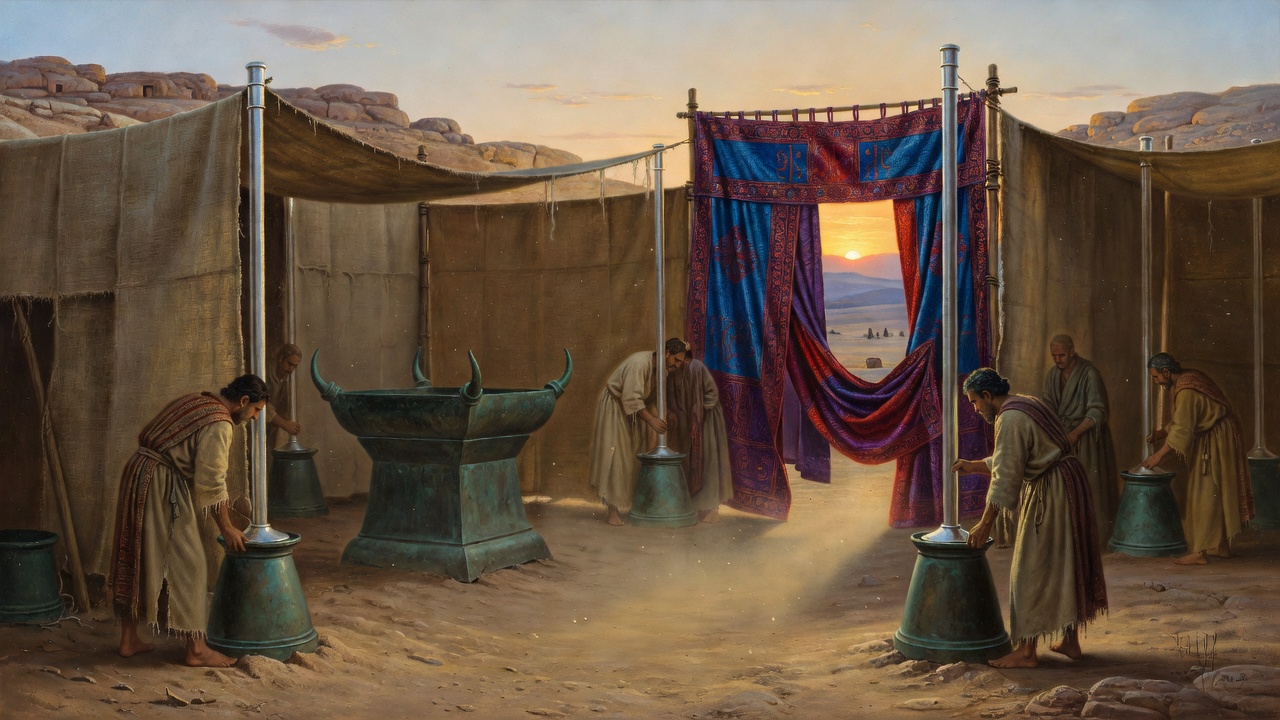
The bronze altar, the courtyard, and the lamps
- This chapter calls for a square altar of acacia wood, five cubits long, five cubits wide, and three cubits high, with a horn on each of its four corners, the horns of one piece, and the altar overlaid with bronze. It was to be built hollow, of boards, with a bronze-mesh grate set beneath a ledge so that the mesh came halfway up, and with poles of acacia wood overlaid with bronze, inserted into rings so the altar could be carried. All its utensils—pots for removing ashes, shovels, sprinkling bowls, meat forks, and firepans—were to be bronze, and the altar was to be made just as shown on the mountain.Sources: the Bible text itself
- The courtyard of the tabernacle was to be a hundred cubits long and fifty cubits wide, with curtains of finely spun linen five cubits high. The south and north sides, each a hundred cubits long, were to have twenty posts and twenty bronze bases, with silver hooks and bands; the west side, fifty cubits wide, was to have ten posts and ten bases. The east side, toward the sunrise, was also fifty cubits wide, with a twenty-cubit gate curtain embroidered with blue, purple, and scarlet yarn and finely spun linen, on four posts, and with curtains of fifteen cubits on either side.Sources: the Bible text itself
- The Israelites were to bring pure oil of pressed olives for the light, so that the lamps would keep burning continually. In the Tent of Meeting, outside the veil in front of the Testimony, Aaron and his sons were to tend the lamps before the LORD from evening until morning, a permanent statute for the Israelites for the generations to come. Aaron, eldest son of Amram and Jochebed, was born in Egypt three years before his brother Moses, and by Elisheba, daughter of Amminadab of the house of Judah, whom he married, he had four sons: Nadab, Abihu, Eleazar, and Ithamar.Sources: the Bible text itself · Aaron
Notes written with AI assistance from open sources (Theographic Bible Metadata, CC BY-SA 4.0; Easton’s Bible Dictionary, public domain) and reviewed before publishing.
Credits and license for this translation
LXX2012: Septuagint in British/International English 2012
The Septuagint with Apocrypha, translated from Greek to English by Sir Lancelot C. L. Brenton and published in 1885, with some language updates (British/International English)
Public Domain
Language: English
Dialect (if applicable): British
Language in English: English
Translation by: Sir Lancelot Charles Lee Breton
LXX2012: Septuagint in English 2012, British/International English Edition
This is a translation of the Old Testament and Apocrypha/Deuterocanon from Hebrew to Greek to 19th Century British English, with some updates of spelling and word usage to contemporary British/International English. The original English translation was done by Sir Lancelot Charles Lee Brenton and published by Samuel Bagster & Sons, Ltd., in London in 1851. It has entered the Public Domain due to the passage of sufficient time. In the process of scanning and typing the text, the original poetry and prose formatting, as well as peripheral material like introductions and notes, have been omitted.
This edition of the Septuagint has some language updates. Brenton's word order and punctuation has been mostly retained, meaning that quotation marks are not used, and sentences within quotes may not start with capital letters, as was standard usage in 1851. Names transliterated from Greek to those transliterated from Hebrew in the common English Bibles often differ. These language updates are dedicated to the Public Domain by the author of those edits, Michael Paul Johnson. Therefore this edition may be freely copied, published, etc.
Before considering making changes to the text of this work, I recommend that you consult with God, because this is really His Book.
If you find errors in the text, please report them so that we can correct them.
Donations to help with the expenses of operating this web site and thus help others have free access to the Word of God may be made to us, but are not required. Please see http://MLJohnson.org/partner/ for more about that.
Section headings adapted from the Berean Standard Bible (public domain); they are not part of this translation’s text.
Source: http://ebible.org/eng-uk-lxx2012/ · eBible.org