Éxodo 13
LXX2012: Septuagint in British/International English 2012 · Toca un versículo para ver sus referencias cruzadas.
The Dedication of the Firstborn
1And the Lord spoke to Moses, saying, 2Sanctify to me every firstborn, first produced, opening every womb amongst the children of Israel both of man and beast: it is mine. 3And Moses said to the people, Remember this day, in which you⌃ came forth out of the land of Egypt, out of the house of bondage, for with a strong hand the Lord brought you forth thence; and leaven shall not be eaten. 4For on this day you⌃ go forth in the month of new corn. 5And it shall come to pass when the Lord your God shall have brought you into the land of the Chananites, and the Chettites, and Amorites, and Evites, and Jebusites, and Gergesites, and Pherezites, which he swore to your fathers to give you, a land flowing with milk and honey, that you shall perform this service in this month. 6Six days you⌃ shall eat unleavened bread, and on the seventh day is a feast to the Lord. 7Seven days shall you⌃ eat unleavened bread; nothing leavened shall be seen with you, neither shall you have leaven in all your borders. 8And you shall tell your son in that day, saying, Therefore the Lord dealt thus with me, as I was going out of Egypt. 9And it shall be to you a sign upon your hand and a memorial before your eyes, that the law of the Lord may be in your mouth, for with a strong hand the Lord God brought you out of Egypt. 10And preserve you⌃ this law according to the times of the seasons, from year to year. 11And it shall come to pass when the Lord your God shall bring you into the land of the Chananites, as he swore to your fathers, and shall give it you, 12that you shall set apart every offspring opening the womb, the males to the Lord, every one that opens the womb out of the herds or amongst your cattle, as many as you shall have: you shall sanctify the males to the Lord. 13Every offspring opening the womb of the ass you shall change for a sheep; and if you will not change it, you shall redeem it: every firstborn of man of your sons shall you redeem. 14And if your son should ask you hereafter, saying, What is this? then you shall say to him, With a strong hand the Lord brought us out of Egypt, out of the house of bondage. 15And when Pharao hardened his heart so as not to send us away, he killed every firstborn in the land of Egypt, both the firstborn of man and the firstborn of beast; therefore do I sacrifice every offspring that opens the womb, the males to the Lord, and every firstborn of my sons I will redeem. 16And it shall be for a sign upon your hand, and immovable before your eyes, for with a strong hand the Lord brought you out of Egypt.
The Pillars of Cloud and Fire
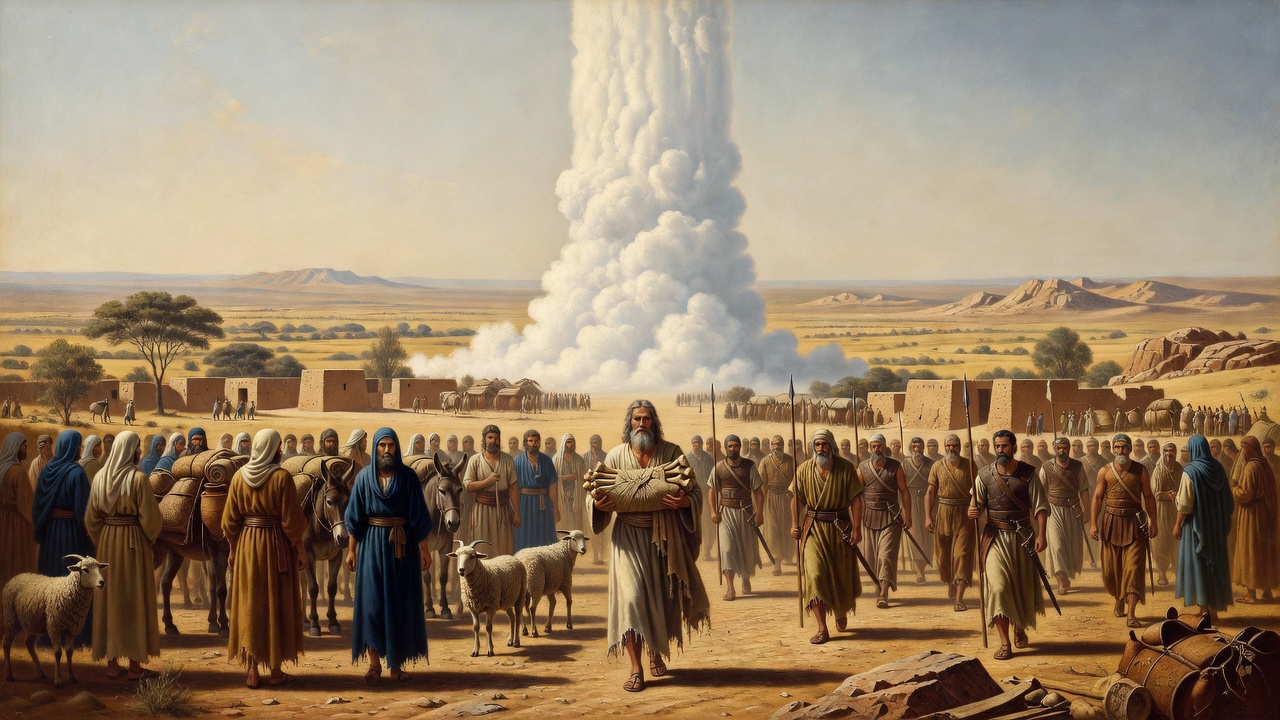
17And when Pharao sent forth the people, God led them not by the way of the land of the Phylistines, because it was near; for God said, Lest at any time the people repent when they see war, and return to Egypt. 18And God led the people round by the way to the wilderness, to the Red Sea: and in the fifth generation the children of Israel went up out of the land of Egypt. 19And Moses took the bones of Joseph with him, for he had solemnly adjured the children of Israel, saying, God will surely visit you, and you⌃ shall carry up my bones hence with you. 20And the children of Israel departed from Socchoth, and encamped in Othom by the wilderness. 21And God led them, in the day by a pillar of cloud, to show them the way, and in the night by a pillar of fire. 22And the pillar of cloud failed not by day, nor the pillar of fire by night, before all the people.
¿Sabías que…?
Los primogénitos y la salida de Egipto
- Dios no los guió por el camino más corto, por la tierra de los filisteos, no fuera que la guerra los hiciera volver a Egipto, sino por el desierto hacia el mar Rojo, que separa Asia de África. Salieron de Sucot, el primer campamento después de dejar Ramesés y también el nombre civil de Pitón, e hicieron su tercer campamento en Etam, al borde del desierto. Etam es quizá otro nombre de Khetam, o “fortaleza”, en el muro de Shur, que iba del Mediterráneo al golfo de Suez, y el campamento estaba probablemente un poco al oeste de la actual Ismailía.Fuentes: el propio texto bíblico · Succoth · Etham · Red Sea
- Moisés llevó consigo los huesos de José, porque José había hecho jurar a los hijos de Israel que, cuando Dios los atendiera, debían llevar sus huesos de aquel lugar. José era el mayor de los dos hijos de Jacob con Raquel.Fuentes: el propio texto bíblico · Joseph (son of Jacob)
- El SEÑOR dijo a Moisés que consagrara a todo primogénito varón; el primogénito de todo vientre entre los israelitas, tanto de personas como de animales, le pertenecía. Todo asno primogénito debía ser rescatado con un cordero, o de lo contrario se le quebraría el cuello, y todo hijo primogénito debía ser rescatado. Cuando un hijo preguntara qué significaba esto, debían decirle que Faraón se había negado obstinadamente a dejarlos ir, de modo que el SEÑOR mató a todos los primogénitos de Egipto, de personas y de animales, y los sacó de la casa de esclavitud.Fuentes: el propio texto bíblico
Notas escritas con ayuda de IA a partir de fuentes abiertas (Theographic Bible Metadata, CC BY-SA 4.0; Easton’s Bible Dictionary, dominio público) y revisadas antes de publicarse.
Lugares de este capítulo
Solo aparecen lugares identificados con alta confianza (90 % o más según las fuentes académicas reunidas por OpenBible). Mapa de la época: DARE (Digital Atlas of the Roman Empire), CC BY 4.0; mapa actual: © colaboradores de OpenStreetMap; lugares: OpenBible.info (CC BY 4.0).
Créditos y licencia de esta traducción
LXX2012: Septuagint in British/International English 2012
The Septuagint with Apocrypha, translated from Greek to English by Sir Lancelot C. L. Brenton and published in 1885, with some language updates (British/International English)
Public Domain
Language: English
Dialect (if applicable): British
Language in English: English
Translation by: Sir Lancelot Charles Lee Breton
LXX2012: Septuagint in English 2012, British/International English Edition
This is a translation of the Old Testament and Apocrypha/Deuterocanon from Hebrew to Greek to 19th Century British English, with some updates of spelling and word usage to contemporary British/International English. The original English translation was done by Sir Lancelot Charles Lee Brenton and published by Samuel Bagster & Sons, Ltd., in London in 1851. It has entered the Public Domain due to the passage of sufficient time. In the process of scanning and typing the text, the original poetry and prose formatting, as well as peripheral material like introductions and notes, have been omitted.
This edition of the Septuagint has some language updates. Brenton's word order and punctuation has been mostly retained, meaning that quotation marks are not used, and sentences within quotes may not start with capital letters, as was standard usage in 1851. Names transliterated from Greek to those transliterated from Hebrew in the common English Bibles often differ. These language updates are dedicated to the Public Domain by the author of those edits, Michael Paul Johnson. Therefore this edition may be freely copied, published, etc.
Before considering making changes to the text of this work, I recommend that you consult with God, because this is really His Book.
If you find errors in the text, please report them so that we can correct them.
Donations to help with the expenses of operating this web site and thus help others have free access to the Word of God may be made to us, but are not required. Please see http://MLJohnson.org/partner/ for more about that.
Títulos de sección adaptados de la Berean Standard Bible (dominio público); no forman parte del texto bíblico de esta traducción.
Fuente: http://ebible.org/eng-uk-lxx2012/ · eBible.org