Exodus 13
LXX2012: Septuagint in British/International English 2012 · Tap a verse to see its cross-references.
The Dedication of the Firstborn
1And the Lord spoke to Moses, saying, 2Sanctify to me every firstborn, first produced, opening every womb amongst the children of Israel both of man and beast: it is mine. 3And Moses said to the people, Remember this day, in which you⌃ came forth out of the land of Egypt, out of the house of bondage, for with a strong hand the Lord brought you forth thence; and leaven shall not be eaten. 4For on this day you⌃ go forth in the month of new corn. 5And it shall come to pass when the Lord your God shall have brought you into the land of the Chananites, and the Chettites, and Amorites, and Evites, and Jebusites, and Gergesites, and Pherezites, which he swore to your fathers to give you, a land flowing with milk and honey, that you shall perform this service in this month. 6Six days you⌃ shall eat unleavened bread, and on the seventh day is a feast to the Lord. 7Seven days shall you⌃ eat unleavened bread; nothing leavened shall be seen with you, neither shall you have leaven in all your borders. 8And you shall tell your son in that day, saying, Therefore the Lord dealt thus with me, as I was going out of Egypt. 9And it shall be to you a sign upon your hand and a memorial before your eyes, that the law of the Lord may be in your mouth, for with a strong hand the Lord God brought you out of Egypt. 10And preserve you⌃ this law according to the times of the seasons, from year to year. 11And it shall come to pass when the Lord your God shall bring you into the land of the Chananites, as he swore to your fathers, and shall give it you, 12that you shall set apart every offspring opening the womb, the males to the Lord, every one that opens the womb out of the herds or amongst your cattle, as many as you shall have: you shall sanctify the males to the Lord. 13Every offspring opening the womb of the ass you shall change for a sheep; and if you will not change it, you shall redeem it: every firstborn of man of your sons shall you redeem. 14And if your son should ask you hereafter, saying, What is this? then you shall say to him, With a strong hand the Lord brought us out of Egypt, out of the house of bondage. 15And when Pharao hardened his heart so as not to send us away, he killed every firstborn in the land of Egypt, both the firstborn of man and the firstborn of beast; therefore do I sacrifice every offspring that opens the womb, the males to the Lord, and every firstborn of my sons I will redeem. 16And it shall be for a sign upon your hand, and immovable before your eyes, for with a strong hand the Lord brought you out of Egypt.
The Pillars of Cloud and Fire
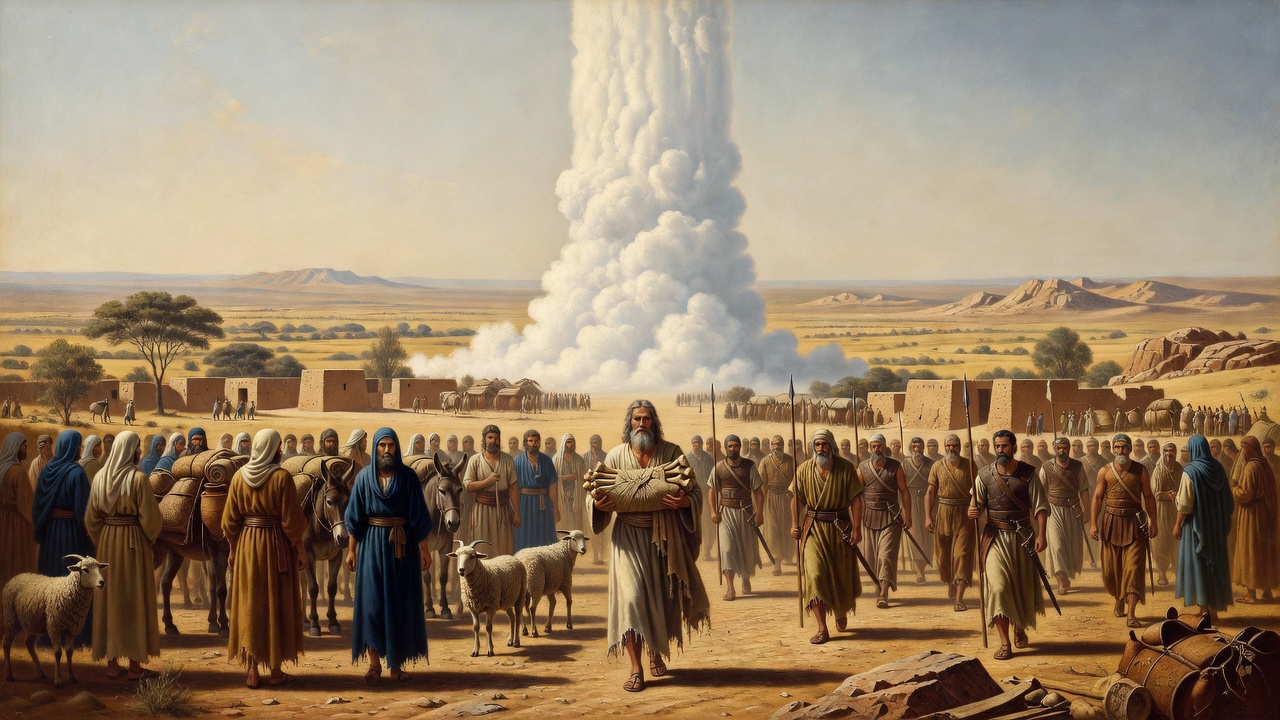
17And when Pharao sent forth the people, God led them not by the way of the land of the Phylistines, because it was near; for God said, Lest at any time the people repent when they see war, and return to Egypt. 18And God led the people round by the way to the wilderness, to the Red Sea: and in the fifth generation the children of Israel went up out of the land of Egypt. 19And Moses took the bones of Joseph with him, for he had solemnly adjured the children of Israel, saying, God will surely visit you, and you⌃ shall carry up my bones hence with you. 20And the children of Israel departed from Socchoth, and encamped in Othom by the wilderness. 21And God led them, in the day by a pillar of cloud, to show them the way, and in the night by a pillar of fire. 22And the pillar of cloud failed not by day, nor the pillar of fire by night, before all the people.
Did you know?
The Firstborn and the Departure from Egypt
- God did not lead them by the shorter road through the land of the Philistines, lest war make them return to Egypt, but by the wilderness toward the Red Sea, which separates Asia from Africa. They set out from Succoth, the first encampment after leaving Ramesses and also the civil name of Pithom, and made their third camp at Etham, on the edge of the wilderness. Etham is perhaps another name for Khetam, or “fortress,” on the wall of Shur, which ran from the Mediterranean to the Gulf of Suez, and the camp was probably a little west of modern Ismailia.Sources: the Bible text itself · Succoth · Etham · Red Sea
- Moses took the bones of Joseph with him, because Joseph had made the sons of Israel swear that, when God attended to them, they must carry his bones from that place. Joseph was the elder of the two sons of Jacob by Rachel.Sources: the Bible text itself · Joseph (son of Jacob)
- The LORD told Moses to consecrate every firstborn male; the firstborn from every womb among the Israelites, both of people and of animals, belonged to him. Every firstborn donkey was to be redeemed with a lamb, or else have its neck broken, and every firstborn son was to be redeemed. When a son asked what this meant, he was to be told that Pharaoh had stubbornly refused to let them go, so the LORD killed every firstborn in Egypt, of people and of animals, and brought them out of the house of slavery.Sources: the Bible text itself
Notes written with AI assistance from open sources (Theographic Bible Metadata, CC BY-SA 4.0; Easton’s Bible Dictionary, public domain) and reviewed before publishing.
Places in this chapter
Only places identified with high confidence are shown (90% or more according to the scholarly sources compiled by OpenBible). Period map: DARE (Digital Atlas of the Roman Empire), CC BY 4.0; modern map: © OpenStreetMap contributors; places: OpenBible.info (CC BY 4.0).
Credits and license for this translation
LXX2012: Septuagint in British/International English 2012
The Septuagint with Apocrypha, translated from Greek to English by Sir Lancelot C. L. Brenton and published in 1885, with some language updates (British/International English)
Public Domain
Language: English
Dialect (if applicable): British
Language in English: English
Translation by: Sir Lancelot Charles Lee Breton
LXX2012: Septuagint in English 2012, British/International English Edition
This is a translation of the Old Testament and Apocrypha/Deuterocanon from Hebrew to Greek to 19th Century British English, with some updates of spelling and word usage to contemporary British/International English. The original English translation was done by Sir Lancelot Charles Lee Brenton and published by Samuel Bagster & Sons, Ltd., in London in 1851. It has entered the Public Domain due to the passage of sufficient time. In the process of scanning and typing the text, the original poetry and prose formatting, as well as peripheral material like introductions and notes, have been omitted.
This edition of the Septuagint has some language updates. Brenton's word order and punctuation has been mostly retained, meaning that quotation marks are not used, and sentences within quotes may not start with capital letters, as was standard usage in 1851. Names transliterated from Greek to those transliterated from Hebrew in the common English Bibles often differ. These language updates are dedicated to the Public Domain by the author of those edits, Michael Paul Johnson. Therefore this edition may be freely copied, published, etc.
Before considering making changes to the text of this work, I recommend that you consult with God, because this is really His Book.
If you find errors in the text, please report them so that we can correct them.
Donations to help with the expenses of operating this web site and thus help others have free access to the Word of God may be made to us, but are not required. Please see http://MLJohnson.org/partner/ for more about that.
Section headings adapted from the Berean Standard Bible (public domain); they are not part of this translation’s text.
Source: http://ebible.org/eng-uk-lxx2012/ · eBible.org