Números 1
Translation for Translators · Toca un versículo para ver sus referencias cruzadas.
Acerca de este libro
Acerca de Números
- Números es el cuarto libro del Pentateuco. En hebreo se llama be-midbar, “en el desierto”; la Septuaginta griega lo llamó Números, el nombre que sigue siendo usual, porque registra un censo en el desierto de Sinaí y otro posterior en la llanura de Moab.Fuentes: Easton: Numbers, Book of
- El Easton's Bible Dictionary (1897) presenta Números, como los demás libros del Pentateuco, como escrito por Moisés. La historia que contiene va del segundo mes del segundo año después del Éxodo al comienzo del undécimo mes del cuadragésimo año, unos treinta y ocho años y diez meses.Fuentes: Easton: Numbers, Book of
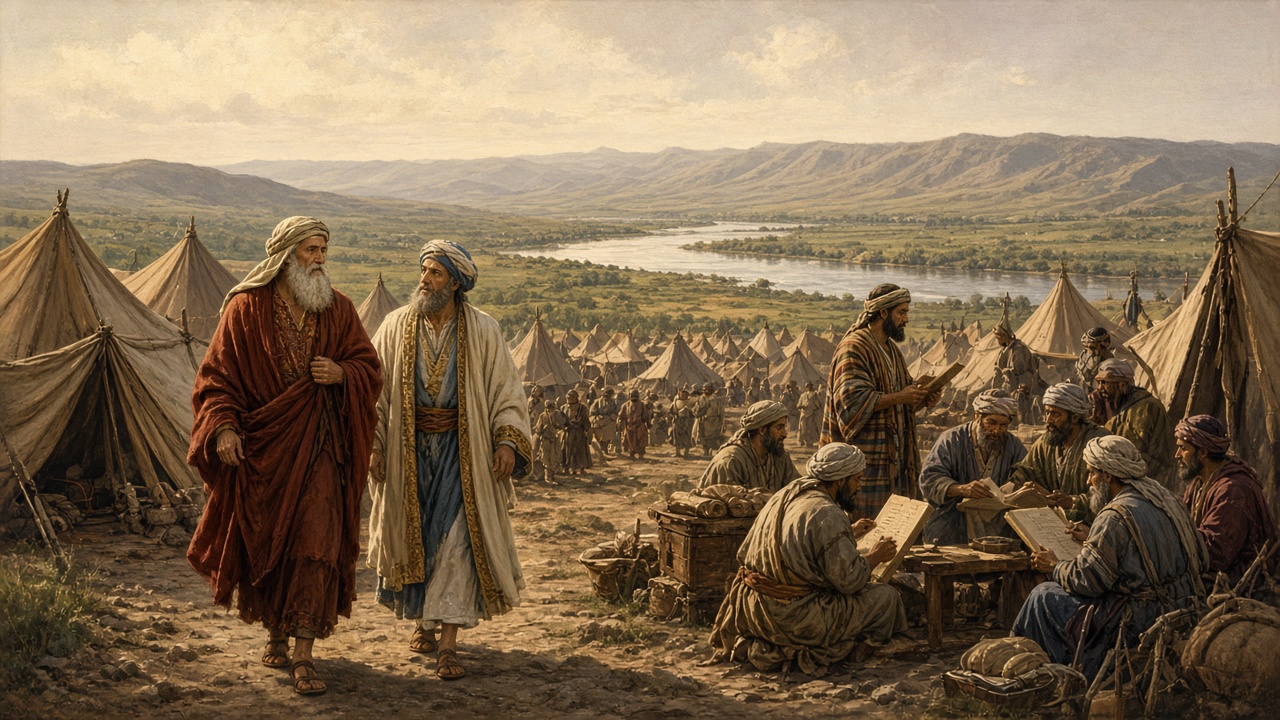
- La narración comienza en Sinaí, la región montañosa a la que Israel llegó en el tercer mes después del Éxodo y donde acampó cerca de un año, y sigue su ruta y sus campamentos por el desierto. Termina en las llanuras de Moab, al este del Jordán y del mar Muerto, frente a Jericó, su último campamento antes de entrar en Canaán, el país al oeste del Jordán. Easton describe esos años como un tiempo de peregrinación en el que aquella generación murió en el desierto, y señala que el pueblo era entonces menos numeroso que cuando salió de Egipto.Fuentes: Easton: Numbers, Book of · Sinai · Moab · Canaan
- Easton divide el libro en tres partes: el censo en Sinaí y los preparativos para reanudar la marcha, incluido el voto de nazareo (1–10:10); el viaje de Sinaí a Moab, el envío de los espías y el informe que trajeron, y las murmuraciones del pueblo, ocho veces, por las penurias del camino (10:11–21:20); y los sucesos en la llanura de Moab antes de cruzar el Jordán (21:21–36).Fuentes: Easton: Numbers, Book of
- Mientras Israel estaba acampado en las llanuras de Moab, Balac, hijo de Zipor y rey de Moab, por temor a ellos, mandó buscar a Petor, en Mesopotamia, a Balaam, hijo de Beor, para maldecirlos; la narración dice que Balaam no pudo hacerlo. Números 21:14 cita también “el libro de las guerras del Señor”, una obra que Easton dice que es incierta, quizá un escrito de Israel hoy perdido o un registro amorreo de las victorias de su rey Sehón.Fuentes: Easton: Numbers, Book of · Balaam · Balak
Notas escritas con ayuda de IA a partir de fuentes abiertas (Theographic Bible Metadata, CC BY-SA 4.0; Easton’s Bible Dictionary, dominio público) y revisadas antes de publicarse.
The men of Israel were counted
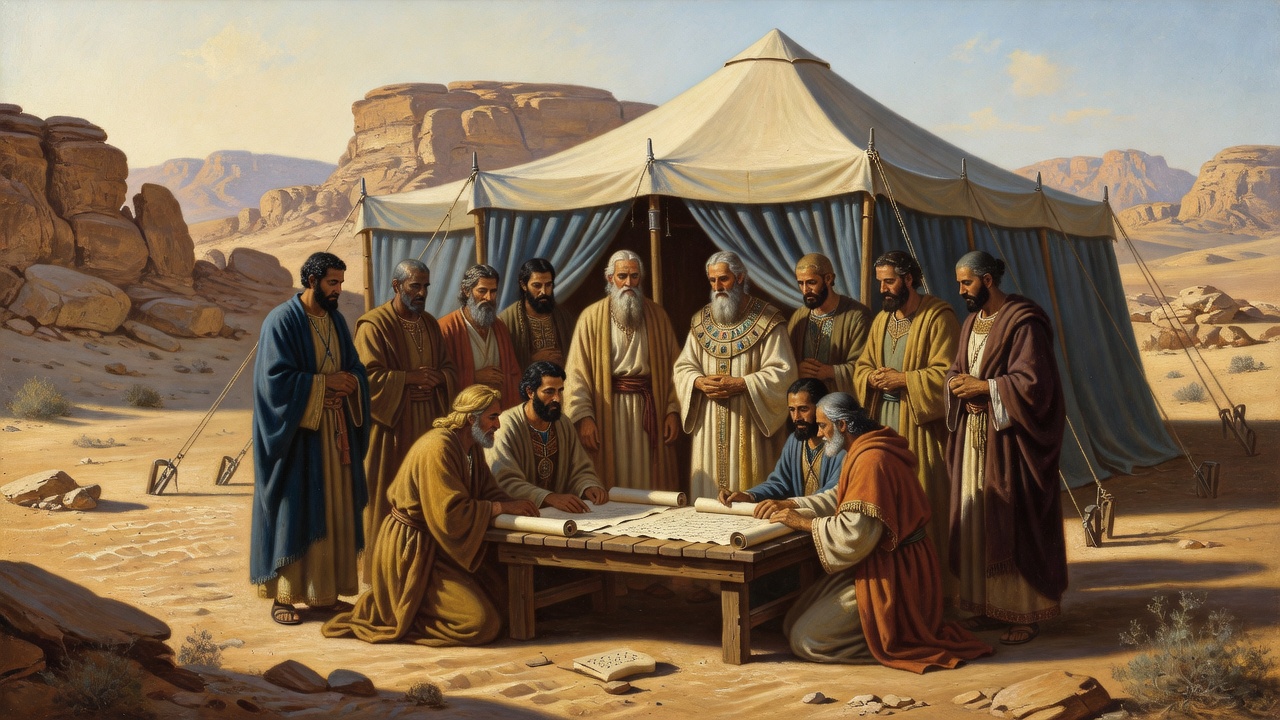
1In April of the year after the Israeli people left Egypt, Yahweh spoke to Moses/me while he/I was in the Sacred Tent, in the Sinai Desert. Yahweh said to him/me, 2“I want you and Aaron to determine how many Israeli men are able to fight in battles. Write down the names of all the men who are at least 20 years old, and write down the names of their clans and families. 4I have chosen one man from each of the tribes to help you to do this. Each one will be a leader of his clan.
5Their names are:
Elizur, the son of Shedeur, from the tribe of Reuben;
Shelumiel, the son of Zurishaddai, from the tribe of Simeon;
Nahshon, the son of Amminadab, from the tribe of Judah;
Nethanel, the son of Zuar, from the tribe of Issachar;
Eliab, the son of Helon, from the tribe of Zebulun;
Elishama, the son of Ammihud, from the tribe of Joseph’s son Ephraim;
Gamaliel, the son of Pedahzur, from the tribe of Joseph’s son Manasseh;
Abidan, the son of Gideoni, from the tribe of Benjamin;
Ahiezer, the son of Ammishaddai, from the tribe of Dan;
Pagiel, the son of Ocran, from the tribe of Asher;
Eliasaph, the son of Deuel, from the tribe of Gad;
Ahira, the son of Enan, from the tribe of Naphtali.”
16Those were the men whom Yahweh chose from the people. They were leaders of their tribes. They were the chief men of the clans of the Israeli people.
17Aaron and Moses/I summoned all these leaders, 18and they gathered all of the people together on that same day. They listed/wrote down the names of all the men who were at least 20 years old, and with their names they wrote the names of their clans and their family groups 19just as Moses/I had commanded. They wrote the names while ◄the Israelis/we► were there in the Sinai Desert.
20This is a list of the number of men who were at least 20 years old and able to fight in battles, and the names of their tribes:
There were 46,500 men from the tribe of Reuben (who was Jacob’s oldest son);
there were 59,300 men from the tribe of Simeon;
there were 45,560 men from the tribe of Gad;
there were 74,600 men from the tribe of Judah;
there were 54,400 men from the tribe of Issachar;
there were 57,400 men from the tribe of Zebulun;
there were 40,500 men from the tribe of Ephraim;
there were 32,200 men from the tribe of Manasseh;
there were 35,400 men from the tribe of Benjamin;
there were 62,700 men from the tribe of Dan;
there were 41,500 men from the tribe of Asher;
there were 53,400 men from the tribe of Naphtali.
44That was the number of men from each tribe that Aaron and Moses/I and the twelve leaders of the tribes of Israel listed, along with the names of their clans. 46The total was 603,550 men.
47But this number did not include the names of the men of the tribe of Levi, 48because Yahweh had said to Moses/me, 49“When you ◄count/write the names of► the men of the tribes of Israel, do not count the men in the tribe of Levi. 50Appoint the male descendants of Levi to take care of the Sacred Tent and the chest inside it that contains the tablets on which are written the Ten Commandments. They must also take care of the other things that are inside the tent. When you travel, they are the ones who must carry the tent and all the things that are inside it, and they must take care of it and set up their tents around it. 51Whenever it is time for all of you to move to another location, the descendants of Levi are the ones who must dismantle the tent. And when it is time to stop traveling, they are the ones who must set up the Sacred Tent again. Any other person who goes near the Sacred Tent to do this work must be executed. 52The people of each Israeli tribe must set up their tents in their own area, and they must set up a flag/banner that represents their tribe. 53But the male descendants of Levi must set up their tents around the Sacred Tent, in order to protect the other Israeli people from being punished [MTY] by Yahweh for coming close to the Sacred Tent. The descendants of Levi are the ones who must stand around the Sacred Tent to guard it.”
54So the Israeli people did everything just like Yahweh had commanded Moses/me.
¿Sabías que…?
El censo en el desierto de Sinaí
- El censo se ordenó en el desierto de Sinaí el primer día del segundo mes del segundo año después de que los israelitas salieron de Egipto. Se contó a cada varón de veinte años o más apto para el servicio militar, sumando un total de 603.550 hombres.Fuentes: el propio texto bíblico · Sinai
- Moisés y Aarón llevaron a cabo el registro junto con doce líderes tribales designados. José estuvo representado por dos divisiones tribales distintas con los nombres de sus hijos, Efraín y Manasés.Fuentes: el propio texto bíblico · Ephraim · Manasseh (son of Joseph)
- La tribu de Leví quedó totalmente excluida del censo militar. En su lugar, los levitas fueron asignados exclusivamente a cuidar, transportar, levantar y custodiar el tabernáculo del Testimonio y todos sus utensilios.Fuentes: el propio texto bíblico
Notas escritas con ayuda de IA a partir de fuentes abiertas (Theographic Bible Metadata, CC BY-SA 4.0; Easton’s Bible Dictionary, dominio público) y revisadas antes de publicarse.
Lugares de este capítulo
- Egypt · 30.129, 31.308 · versículo 1
- Wilderness of Sinai · Hoy: about 50 km around Jebel Musa · 28.540, 33.973 · versículos 1, 19
Solo aparecen lugares identificados con alta confianza (90 % o más según las fuentes académicas reunidas por OpenBible). Mapa de la época: DARE (Digital Atlas of the Roman Empire), CC BY 4.0; mapa actual: © colaboradores de OpenStreetMap; lugares: OpenBible.info (CC BY 4.0).
Créditos y licencia de esta traducción
Translation for Translators
A Bible Translation for Bible Translators which makes implied information explicit in the text as an aid to the translator who may need that information to correctly translate into a particular language.
Copyright © 2008-2017 Ellis W. Deibler, Jr.
Language: English
Dialect: American
This translation is made available to you under the terms of the
Creative Commons Attribution Share-Alike license 4.0.
You have permission to share and redistribute this Bible translation in any format and to make reasonable revisions and adaptations of this translation, provided that:
You include the above copyright and source information.
If you make any changes to the text, you must indicate that you did so in a way that makes it clear that the original licensor is not necessarily endorsing your changes.
If you redistribute this text, you must distribute your contributions under the same license as the original.
Pictures included with Scriptures and other documents on this site are licensed just for use with those Scriptures and documents.
For other uses, please contact the respective copyright owners.
Note that in addition to the rules above, revising and adapting God's Word involves a great responsibility to be true to God's Word. See Revelation 22:18-19.
2026-10-02
Fuente: http://ebible.org/eng-t4t/ · eBible.org