Numbers 1
Translation for Translators · Tap a verse to see its cross-references.
About this book
About Numbers
- Numbers is the fourth book of the Pentateuch. In Hebrew it is called be-midbar, “in the wilderness”; the Greek Septuagint called it Numbers, the name still usual, because it records a census in the wilderness of Sinai and a later census on the plain of Moab.Sources: Easton: Numbers, Book of
- Easton's Bible Dictionary (1897) presents Numbers, like the other books of the Pentateuch, as written by Moses. The history it contains runs from the second month of the second year after the Exodus to the beginning of the eleventh month of the fortieth year, about thirty-eight years and ten months.Sources: Easton: Numbers, Book of
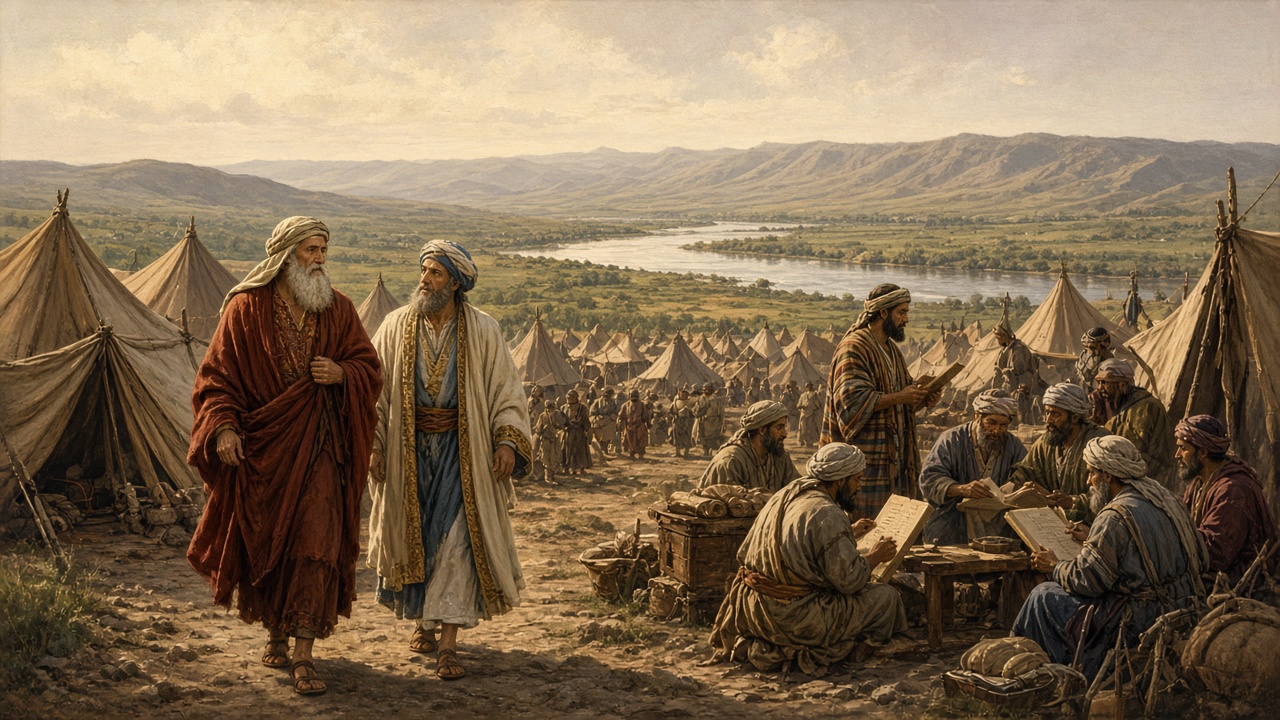
- The narrative begins at Sinai, the mountain district Israel reached in the third month after the Exodus and where they camped for about a year, and follows their route and encampments through the wilderness. It ends on the plains of Moab, east of the Jordan and the Dead Sea, opposite Jericho, their last camp before entering Canaan, the country west of the Jordan. Easton describes those years as a time of wandering in which that generation died in the wilderness, and notes that the people were fewer then than when they left Egypt.Sources: Easton: Numbers, Book of · Sinai · Moab · Canaan
- Easton divides the book into three parts: the census at Sinai and preparations to resume the march, including the Nazirite vow (1–10:10); the journey from Sinai to Moab, the sending of the spies and the report they brought back, and the people’s murmurings, eight times, at the hardships of the way (10:11–21:20); and the events on the plain of Moab before the crossing of the Jordan (21:21–36).Sources: Easton: Numbers, Book of
- While Israel was camped on the plains of Moab, Balak, son of Zippor and king of Moab, fearing them, sent to Pethor in Mesopotamia for Balaam, son of Beor, to curse them; the narrative says Balaam was unable to do so. Numbers 21:14 also cites “the book of the wars of the Lord,” a work that Easton says is uncertain, perhaps a lost writing of Israel or an Amorite record of the victories of their king Sihon.Sources: Easton: Numbers, Book of · Balaam · Balak
Notes written with AI assistance from open sources (Theographic Bible Metadata, CC BY-SA 4.0; Easton’s Bible Dictionary, public domain) and reviewed before publishing.
The men of Israel were counted
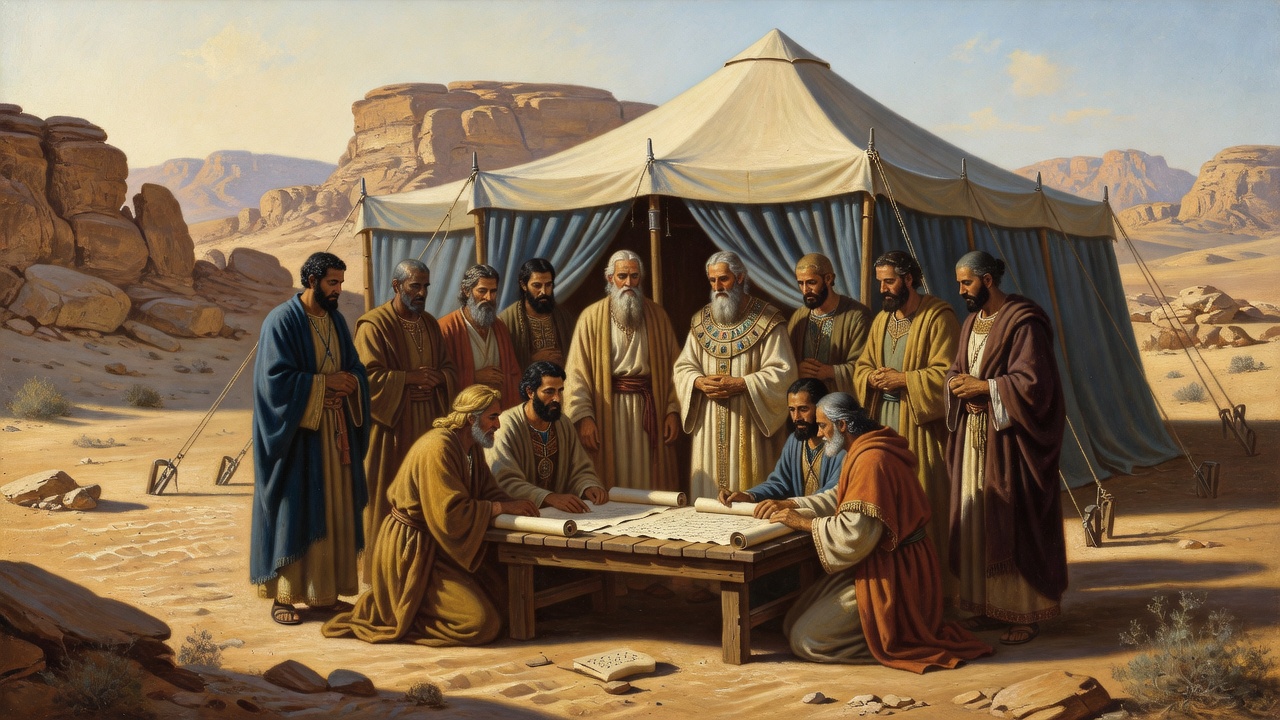
1In April of the year after the Israeli people left Egypt, Yahweh spoke to Moses/me while he/I was in the Sacred Tent, in the Sinai Desert. Yahweh said to him/me, 2“I want you and Aaron to determine how many Israeli men are able to fight in battles. Write down the names of all the men who are at least 20 years old, and write down the names of their clans and families. 4I have chosen one man from each of the tribes to help you to do this. Each one will be a leader of his clan.
5Their names are:
Elizur, the son of Shedeur, from the tribe of Reuben;
Shelumiel, the son of Zurishaddai, from the tribe of Simeon;
Nahshon, the son of Amminadab, from the tribe of Judah;
Nethanel, the son of Zuar, from the tribe of Issachar;
Eliab, the son of Helon, from the tribe of Zebulun;
Elishama, the son of Ammihud, from the tribe of Joseph’s son Ephraim;
Gamaliel, the son of Pedahzur, from the tribe of Joseph’s son Manasseh;
Abidan, the son of Gideoni, from the tribe of Benjamin;
Ahiezer, the son of Ammishaddai, from the tribe of Dan;
Pagiel, the son of Ocran, from the tribe of Asher;
Eliasaph, the son of Deuel, from the tribe of Gad;
Ahira, the son of Enan, from the tribe of Naphtali.”
16Those were the men whom Yahweh chose from the people. They were leaders of their tribes. They were the chief men of the clans of the Israeli people.
17Aaron and Moses/I summoned all these leaders, 18and they gathered all of the people together on that same day. They listed/wrote down the names of all the men who were at least 20 years old, and with their names they wrote the names of their clans and their family groups 19just as Moses/I had commanded. They wrote the names while ◄the Israelis/we► were there in the Sinai Desert.
20This is a list of the number of men who were at least 20 years old and able to fight in battles, and the names of their tribes:
There were 46,500 men from the tribe of Reuben (who was Jacob’s oldest son);
there were 59,300 men from the tribe of Simeon;
there were 45,560 men from the tribe of Gad;
there were 74,600 men from the tribe of Judah;
there were 54,400 men from the tribe of Issachar;
there were 57,400 men from the tribe of Zebulun;
there were 40,500 men from the tribe of Ephraim;
there were 32,200 men from the tribe of Manasseh;
there were 35,400 men from the tribe of Benjamin;
there were 62,700 men from the tribe of Dan;
there were 41,500 men from the tribe of Asher;
there were 53,400 men from the tribe of Naphtali.
44That was the number of men from each tribe that Aaron and Moses/I and the twelve leaders of the tribes of Israel listed, along with the names of their clans. 46The total was 603,550 men.
47But this number did not include the names of the men of the tribe of Levi, 48because Yahweh had said to Moses/me, 49“When you ◄count/write the names of► the men of the tribes of Israel, do not count the men in the tribe of Levi. 50Appoint the male descendants of Levi to take care of the Sacred Tent and the chest inside it that contains the tablets on which are written the Ten Commandments. They must also take care of the other things that are inside the tent. When you travel, they are the ones who must carry the tent and all the things that are inside it, and they must take care of it and set up their tents around it. 51Whenever it is time for all of you to move to another location, the descendants of Levi are the ones who must dismantle the tent. And when it is time to stop traveling, they are the ones who must set up the Sacred Tent again. Any other person who goes near the Sacred Tent to do this work must be executed. 52The people of each Israeli tribe must set up their tents in their own area, and they must set up a flag/banner that represents their tribe. 53But the male descendants of Levi must set up their tents around the Sacred Tent, in order to protect the other Israeli people from being punished [MTY] by Yahweh for coming close to the Sacred Tent. The descendants of Levi are the ones who must stand around the Sacred Tent to guard it.”
54So the Israeli people did everything just like Yahweh had commanded Moses/me.
Did you know?
The Census in the Wilderness of Sinai
- The census was ordered in the Wilderness of Sinai on the first day of the second month in the second year after the Israelites departed Egypt. It counted every male aged twenty or older who was able to serve in the army, arriving at a total of 603,550 fighting men.Sources: the Bible text itself · Sinai
- Moses and Aaron conducted the registration alongside twelve appointed tribal leaders. Joseph was represented as two distinct tribal divisions named after his sons, Ephraim and Manasseh.Sources: the Bible text itself · Ephraim · Manasseh (son of Joseph)
- The tribe of Levi was entirely exempted from the military count. Instead, the Levites were assigned exclusively to care for, transport, assemble, and guard the tabernacle of the Testimony and its furnishings.Sources: the Bible text itself
Notes written with AI assistance from open sources (Theographic Bible Metadata, CC BY-SA 4.0; Easton’s Bible Dictionary, public domain) and reviewed before publishing.
Places in this chapter
- Egypt · 30.129, 31.308 · verse 1
- Wilderness of Sinai · Today: about 50 km around Jebel Musa · 28.540, 33.973 · verses 1, 19
Only places identified with high confidence are shown (90% or more according to the scholarly sources compiled by OpenBible). Period map: DARE (Digital Atlas of the Roman Empire), CC BY 4.0; modern map: © OpenStreetMap contributors; places: OpenBible.info (CC BY 4.0).
Credits and license for this translation
Translation for Translators
A Bible Translation for Bible Translators which makes implied information explicit in the text as an aid to the translator who may need that information to correctly translate into a particular language.
Copyright © 2008-2017 Ellis W. Deibler, Jr.
Language: English
Dialect: American
This translation is made available to you under the terms of the
Creative Commons Attribution Share-Alike license 4.0.
You have permission to share and redistribute this Bible translation in any format and to make reasonable revisions and adaptations of this translation, provided that:
You include the above copyright and source information.
If you make any changes to the text, you must indicate that you did so in a way that makes it clear that the original licensor is not necessarily endorsing your changes.
If you redistribute this text, you must distribute your contributions under the same license as the original.
Pictures included with Scriptures and other documents on this site are licensed just for use with those Scriptures and documents.
For other uses, please contact the respective copyright owners.
Note that in addition to the rules above, revising and adapting God's Word involves a great responsibility to be true to God's Word. See Revelation 22:18-19.
2026-10-02
Source: http://ebible.org/eng-t4t/ · eBible.org