1 Reyes 1
Ekajuk Scriptures Bible Portions · Toca un versículo para ver sus referencias cruzadas.

Acerca de este libro
Sobre 1 Reyes
- El Easton's Bible Dictionary (1897) considera incierta la autoría de los libros de Reyes. Una tradición según la cual Jeremías los escribió queda, a juicio de Easton, respaldada por pasajes casi idénticos a partes de Jeremías y por sucesos que Jeremías conocía personalmente; sin embargo, Easton estima más probable que Esdras, después del cautiverio, compilara los libros a partir de documentos anteriores, quizá escritos por David, Salomón, Natán, Gad e Iddo. Easton sitúa la composición entre el 561 a. C., cuando Evil-merodac liberó a Joaquín del cautiverio, y el 538 a. C., el decreto de Ciro.Fuentes: Easton: Kings, The Books of
- Easton afirma que estos libros contienen los anales del reino desde la subida de Salomón al trono hasta que Nabucodonosor y los babilonios lo sometieron, un período que estima en unos 453 años. 1 Reyes comienza mientras David está muriendo: Adonías, su cuarto hijo, que había pasado a ser el heredero presunto del trono tras la muerte de Amnón y Absalón, se hace proclamar rey, pero Natán y Betsabé persuaden a David de que entronice a Salomón de inmediato. Salomón, hijo de David y Betsabé, cuya historia se registra en 1 Reyes 1-11, llegó al trono, sugiere Easton, hacia los dieciséis o dieciocho años.Fuentes: Easton: Kings, The Books of · Adonijah · Solomon
- En las Escrituras hebreas, los dos libros de Reyes formaban originalmente un solo libro; la Septuaginta fue la primera en dividirlos y, con la Vulgata, los numera como el tercer y el cuarto libros de Reyes, siendo los libros de Samuel el primero y el segundo. Easton observa que Crónicas da mayor relieve al oficio sacerdotal o levítico, mientras que Reyes da mayor relieve al oficio real, y que en la división de las Escrituras en tres partes hecha por los judíos estos libros se cuentan entre los Profetas. La narración remite a fuentes anteriores: el libro de los hechos de Salomón y las crónicas de los reyes de Judá y de Israel.Fuentes: Easton: Kings, The Books of
- Tras la muerte de Salomón, las diez tribus se rebelaron e invitaron a Jeroboam, hijo de Nebat, a ser su rey; Easton lo llama el primer rey de esas tribus y sitúa su reinado entre 976 y 945 a. C. Había huido a Egipto bajo la protección de Sisac I y luego trasladó su residencia de Siquem, su primera capital, a Tirsa, que siguió siendo la residencia principal de los reyes de Israel hasta que Omri compró a Semer el monte de Shomeron por dos talentos de plata y edificó Samaria. La narración posterior incluye a Acab, hijo de Omri y séptimo rey de Israel, cuya esposa era Jezabel: al culto del becerro introducido por Jeroboam añadió el culto de Baal, y fue severamente amonestado por el profeta Elías.Fuentes: Jeroboam · Tirzah · Samaria · Ahab
Notas escritas con ayuda de IA a partir de fuentes abiertas (Theographic Bible Metadata, CC BY-SA 4.0; Easton’s Bible Dictionary, dominio público) y revisadas antes de publicarse.
Ngare Nyi Devid Ma Kul
1Ngare nyi Devid ma sahb kˈkul, jol afi bo konng-e egbvgbv ebbik ebbik, á joom tiki bel elfuubu. 2Alokeltum ebe kehm-e tongo re, <<Nong wahr seb mongunga nnenkal, no bahke jo loko ntul, fere jo kpur-e. Á bahke ma noongo go egea nkpe, eji nso ntul ewahre bahke bele elfuubu.>>
3Owo bo kehm yannge seb nnobo noba mmonse nkal go Isreel kpee, kehm song nyehn Abisagi, nne ejahbe Sunam, kehm-e koko ba ka ntul. 4Mmonse nkal jolo nne ano; á jo kpuru ntul, jo lok-e, wo ntul tikem noongo a ne.
Adonija Sebe Re Á Ko Eti Etul
5Ngare nyia, Adonija, ye ji bo jo lung nnyehn re Hagiti, kehm mehle elne wahre, kehm bungu re, <<M bahke jolo ntul.>> Ano wo á kehm toobo amvtv akuungu a anyꞌnya, a ane atahl abal ane awubu ba bahke jo gbo-e mbang. 6<<Jol nde we-e ka nyˈnyam, fere bahb-e re, <<Jenji wahnge a kpꞌlimi eljini nia?>> Adonija jolo nne ano, ye wo bo jele kunu Absalom.>>
7Adonija kpa njahm a Joab ji mmona Jeruya, a Abiata ji nlimajom, bo kun-e abo go njahm 8Wo Jadok ji nlimajom, Benaya mmona Jehoiada, Natan ji nnyehnamahr, Simeyi a Reyi, a akahme kahme ane ba jo baabe Devid taamem semme elbo a ntoobo nyi Adonija. 9Adonija kehm koko ejoro, adahmagbudu a ajoko joko abon efong song lim ajom go Eltal ni Joheleti kohlo En Rogel. Á tiingi abonanyehn kpee, ba li abon ntul, a aneblum ba Juda kpee ba kpo lim eltum etahk ntul, 10wo á tiingem Natan ji nnyehnamahr, afi Benaya, afi akahme kahme ane ba jo baabe ntul, afi Solomon ji mmonannyehn.
11Owo Natan kehm bahbe Batiseba ji nnyehn Solomon re, <<Á ka wuk re Adonija, ji mmona Hagiti, ebjol ntul, jol nsoo ntula Devid kahnema? 12Anv nong me n tub-a elle, ana á bahke tahre elkpin ena, a ni Solomon mmon ewa. 13Song go ekpˈkpa goji Ntula Devid, song tong-e re, <<Nsoo ntul, á tirem tong me nlokeltum ewa re, <<Etingitingi Solomon mmon ewa wo bahke jolo ntul toon-ma?, ye wo bahke jehke go egame eti etula? ˈNꞌnan wahnge Adonija ma fere jol ntul?>> 14Ana a kpi mbungu mbungu a ntul, m bahke bake ba kpir-a o, ba tong ntul re, ji a kpꞌbungu lohko li ano.>>
15Ano wo Betiseba mehle song nyehn ntul no ma sahb kˈkul go ege ekpꞌkpa, eji Abisagi nnea Sunem jo kpur-e. 16Betiseba kehm gongo noongo go ndi, go esamahr ntul.
Ntul kehm-e bahbe re, <<Jenji á kpꞌsebe?>>
17Á kehm faange ntul re, <<Ntul ewame, wofono antahng wo tiri tong-m me nlokeltum ewa go mbing nyi Jehova Esowo eba re, <<Solomon mmon ewa wo bahke jolo ntul toon-m, ye wo bahke jehke go egame eti etul.>> 18Wo anv, Adonija wo ma jol ntul, nga wo ntul ewame, wo ka kahn bade. 19Adonija eblim ajom, ko ajoko joko abon efong gbalee, a adahmagbudu, ejoro, fere tiingi abon ntul, Abiata ji nlimajom a Joab ji ntubesia nsoja, wo Solomon nlokeltum ewa, á we-e tiingem. 20Nsoo ntul ewame, amahr nya anebe Isreel kpee kpi wo seenge, re bo kahn go ega nne no bahke jehke go eti etul ji nso ntul toon-e. 21A tohko lim ano, ana bo kpꞌkpake babnso ewahne kak elahm a babnde ebo, me a Solomon mmon ewame, bo bahk-r jabbe ana abi ane.>>
22Ana á kpi mbungu mbungu a ntul, nyehn Natan ji nnyehnamahr ma ba lohng. 23Bo kehm tongo ntul re, <<Natan ji nnyehamahr li a.>> Á kehm tahme go esamahr ntul, kehm song gong esamahr ebe go ndi.
24Natan kehm bungu tong ntul re, <<Nsoo ntul ewame, wobbung re, Adonija wo bahke jolo ntul no bahke jehke toon-aa? ye wo bahke jehke go ega eti etula? 25Lela yeblohng song lim ajom, ko ajoko joko abon efong gbalee, efong, a ejoro. Yebtiingi abon ntul, fere tiingi atubesi asoja, a Abiata ji nlimanjom. Anv, bo baa go kpꞌlehke fere wꞌwo a ne, fere kpꞌbungu re, <<Nong elkpin ena lab, ntula Adonija!>> 26Wo me, nlokeltum ewa, a Jadok nlimanjom, a Benaya mmon no Jehoida, go Solomon nlokeltum ewa, á wahr tiingem. 27Ejum ji a ji nso ntul ewame ma lim, á sebem re wahr alokeltum eba kahn nne no bahke jehke go eti etul ji nso ntul ewahre toon-ea?>>
Devid bobo Solomon Etul
28Owo ntula Devid kehm bungu re, <<Lung Betiseba kam.>>Ejum ji nso ntul ewame ma lim ji a, á sebem re Ano wo á lohngo ba yiimi go esamahr ntul.
29Owo ntul kehm koko nwongo re, <<Go etingitingi ana Jehova li go elkpin, ye ji ma-m tahre go ajoobo atongtong anyehng anyehng, 30m bahke lohko lim lela go etingitingi ji n ko nwongo tong-a go esamahr bi Jehova Esowo bi Isreel. Solomon mmon ewa bahke jehke etul toon-m, á bahke jehke go egame eti etul, go egama enyo.>> Owo Betiseba kehm gongo esamahr ebe go ndi, fere noongo tanne go esamahr ntul, kehm bungu re, <<Nong nsoo ewame, ntula Devid bel nlabe elkpin!>>
31Owo Betiseba kehm gongo esamahr ebe go ndi, fere noongo tanne go esamahr ntul, kehm bungu re, <<Nong nsoo ewame, ntula Devid bel nlabe elkpin!>>
32Ntula Devid kehm bungu re, <<Lung Jadok ji nlimanjom, Natan ji nnyehnamahr, a Benaya mmona Jehoida kam.>> Eji bo ba no go esamahr bi ntul, 33á kehm tongo bo re, "Roden nlokeltuma ntul wahn song, fere rod Solomon mmon ewame kunu go egame enyꞌnya ji kahbe akpade, song a ne go Gihon. 34Nong Jadok ji nlimajom abola Natan ji nnyehnamahr, bo wohng-e akehng go edi jio, bob-r etul bi Isreel. Wor ntang, fere rabe re, <<Ntula Solomon, elkpin ena laboo!>> 35Owo ḿ bahke tahme a ne, á song ji go egame eti etul, jo fili edi go egame enyo. M me-e yehke re á jol nfiladi go Isreel a Juda.>
36Benaya mmona Jehoida kehm faange ntul re, <<Nong jol ano! Nong Jehova, Esowo bi nso ntul ewame bung yiimi tˈtahne. 37Ana Jehova jolo a nsoo ntul ewame, nong á tob jol a Solomon, lim etul ebe gbal sehnge eti etul ji nso ntula David!
38Ano wo Jadok ji nlimajom, Natan nnyehnamahr, go Benaya mmona Jehoida, anebe Kereti a anebe Peleti, bo mehle tahm, song rod Solomon kunu go enyꞌnya ji ntula Devid ji kahbe akpade, fere tv-e ko-e song rehng go Gihon. 39Jadok ji nlimajom kehm rodo ntang nyi akehng wob atahng go mmobkpatahk no li saang ba kak Solomon akehng go esi. Owo bo kehm woro ntang, fvfo ane kpee kehm rabe re, <<Ntula Solomon, elkpin ena laboo!>> 40Ane kpee kehm mehle tahm jo toon-e, jo wor agbehle, jo bel eyebatahng gbalee, ndi jo gbꞌgbehke go ewahl ji jo lim.
41Adonija, a ajenne kpee nya jolo a ne wuku ewahl eji bo yahke li elkak ebo mal. Ana bo kpꞌwuku atang nya bo kpꞌworo, Joab kehm bahbe re, <<Elkohn ewahl ajii li go atahng ejahbe me?>> 42Jol ana á kpi mbungu mbungu, Jonatan mmona Abiata ji nlimajom ebba lohng. Adonija kehm bungu re, <<Ba yel. Nnooba nne ana wo tiki kpi nnoobo etib.>> 43Jonatan kehm faange re, <<Eꞌeeo! nsoo ntul ewahre Devid ebbob Solomon ntul. 44Ntul me-e tum a Jadok ji nlimajom, Natan nnyehnamahr, Benaya mmon no Jehoida, anebe Kereti, anebe Peleti, fvfo bo me-e rod kunu go enyꞌnya ji ntul ji kahbe akpade, 45fvfo Jadok ji nlimajom a Natan nnyehnamahr me-e bob etul go Gihon. Go wo bo lohngo no ba, ba yel go nfam, a ewahl ewahl ana bo ba no. Ewok ji o ji á kpꞌwuku. 46Go nsol kpee, Solomon ebji go nji etul enye ana ntul. 47Fvfo, ane ba kpo lim eltum a ntul, ebba kak nsoo ntula Devid nnyo re, <<Nong Esowo eba lim mbing nyi Solomon ga gbal sehnge nyꞌnya, nji etul enye bel ellub sehnge nyꞌnya!> Ntul gbo kohk esi eje go edilnong kak Esowo, 48fere bung re, <Eltehke jol ka Jehova Esowo bi Isreel, ye ji ma wahng re me nyehn nne no bahke jehke toon-m go eti etul lela.> >> 49Eji bo wuku jia, ajenne kpee nya ba goji Adonija mehle a elfahle, fere be raade no nne tahm mbang enye. 50Wo Adonija go elfahle ni á jo fahl Solomon, mehle tahm song tub ejahm go atang nya jolo go egudu njom. 51Bo kehm tongo Solomon re, <<Adonija kpꞌfahle ntula Solomon, yebsong tub ejahm go atang nya egudu njom. Á bungu re, <<Nong ntula Solomon tir tong-m lela re, á nehm wul me nlokeltum ewe.>>>
52Solomon kehm faange re, <<Á lꞌtib elne ana nne no bo bahk-e ma bum etingitingi, jol ellv esi ene anehng anehng nehm gbo go ndi; wo lꞌjol re abꞌbi bahke jolo go ege atahng, á bahke kpoko.>> 53Owo Ntula Solomon kehm tumu ane, bo song radd-e go egudu njom ba a ne. Owo Adonija kehm bake, ba gbo kohk esi go ndi kpunu Ntula Solomon, owo Solomon kehm bungu tong-e re, <<Song ega etahk.>>
¿Sabías que…?
La sucesión al trono de David
- Siendo el hijo mayor sobreviviente de David tras la muerte de Amnón y Absalón, Adonías reclamó la sucesión real respaldado por el comandante militar Joab y el sacerdote Abiatar. Sin embargo, David eligió a su hijo menor Salomón, quien contaba con el apoyo del profeta Natán, el sacerdote Sadoc y Benaía.Fuentes: Adonijah · Solomon · el propio texto bíblico
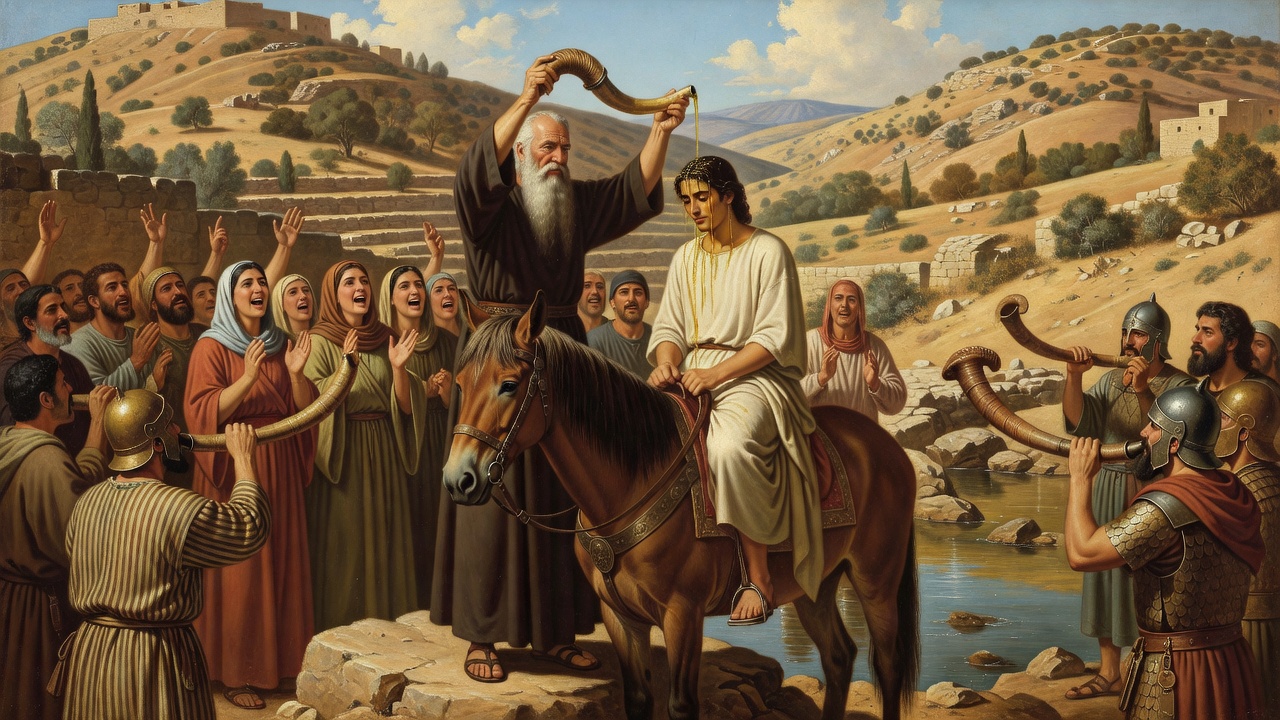
- Montar en la propia mula del rey constituía una proclamación pública decisiva de autoridad real. Por orden expresa de David, Salomón fue llevado al manantial de Gijón, donde Sadoc lo ungió como rey con aceite sagrado del tabernáculo en medio del sonido de cuernos y la aclamación popular.Fuentes: Gihon · Zadok · el propio texto bíblico
- Al enterarse de la coronación pública de Salomón, Adonías huyó aterrorizado y buscó asilo sujetándose a los cuernos del altar de los sacrificios. Salomón le otorgó clemencia condicional, perdonándole la vida siempre que demostrara ser un hombre digno.Fuentes: Adonijah · el propio texto bíblico
Notas escritas con ayuda de IA a partir de fuentes abiertas (Theographic Bible Metadata, CC BY-SA 4.0; Easton’s Bible Dictionary, dominio público) y revisadas antes de publicarse.
Lugares de este capítulo
- Shunem · Hoy: Sulam · 32.606, 35.334 · versículo 3
- Serpent’s Stone · Hoy: within 100 m of Bir Ayub · 31.767, 35.236 · versículo 9
- Gihon · Hoy: Gihon Spring · 31.773, 35.236 · versículos 33, 38, 44, 45
- Jerusalem · 31.777, 35.234 · versículo 40
Solo aparecen lugares identificados con alta confianza (90 % o más según las fuentes académicas reunidas por OpenBible). Mapa de la época: DARE (Digital Atlas of the Roman Empire), CC BY 4.0; mapa actual: © colaboradores de OpenStreetMap; lugares: OpenBible.info (CC BY 4.0).
Créditos y licencia de esta traducción
Ekajuk Scriptures Bible Portions
Ekajuk: Ekajuk Scriptures Bible Portions (Bible)
copyright © 2024 Luke Initiative for Scripture Translation and The Seed Company
Language: Ekajuk
Contributor: Luke Initiative for Scripture Translation
This translation is made available to you under the terms of the
Creative Commons Attribution Share-Alike license 4.0.
You have permission to share and redistribute this Bible translation in any format and to make reasonable revisions and adaptations of this translation, provided that:
You include the above copyright and source information.
If you make any changes to the text, you must indicate that you did so in a way that makes it clear that the original licensor is not necessarily endorsing your changes.
If you redistribute this text, you must distribute your contributions under the same license as the original.
Pictures included with Scriptures and other documents on this site are licensed just for use with those Scriptures and documents.
For other uses, please contact the respective copyright owners.
Note that in addition to the rules above, revising and adapting God's Word involves a great responsibility to be true to God's Word. See Revelation 22:18-19.
2025-07-02
Fuente: http://ebible.org/eka/ · eBible.org