Mateo 7
Beibel: okanisi tongo · Toca un versículo para ver sus referencias cruzadas.
Wi á mu kuutu taawan
1“Ná kuutu, kaagi taawan, da taawan ná o kuutu, kaagi yu tu. 2Bika na a fasi fa yu e kuutu, kaagi taawan, na so taawan o kuutu, kaagi yu baka. Anga a seefi maiki di yu e teke maiki taawan, anga en den o teke maiki yu baka. 3Bika saide meke, u e si a pikin mbalububa a ini a ain fu wan taawan, ma a gaan gobo di de a ini iseefi ain, dati i nái si? 4Da fa i sa taigi i baala taki: ‘Baala! Kon mi puu a pikin mbalu a ini yu ain gi yu.’ Ma wan gaan gobo de a ini iseefi ain? 5U bidiigiman u! Puu a gaan gobo a ini iseefi ain fosi, da i sa si kiin fu puu a pikin mbalu di de a ini i baala ain gi en!”
6Namo Masaa Jesesi piki den taki: “U á teke a apaiti sani fu Masaa Gadu, iti gi den dagu anga den agu. Bika te u iti den gi dagu anga den agu, da den ná o si en fu wan sani. Da kande den o teke en, da den waka ne en tapu, masimasi en enke lawlaw sani. Da te fu kaba, da den daai kon nyan yu seefi pisipisi kii.”
Fa Masaa Gadu e yee u begi
7We, ne Masaa Jesesi taigi den taki: “U begi, da u o kisi. U suku, da u o fende. U koko, da doo o opo gi u. 8Bika sama di e begi, e kisi. Da sama di e suku, e fende. Soseefi sama di e koko, da doo e opo gi den. 9We, sama di de ya, te i manpikin begi yu wan beele, yu o teke wan siton gi en? 10Te a akisi yu wan fisi, yu o teke wan sineki langa gi en? Nono! 11We, efu u, anga ala fa u abi takuu ati seefi, toku u sabi gi u pikin bun sani so, da fa u pakisei, fu u Tata a tapu? A ná o gi sama di e begi en sani, bun sani, no?
12“We, a fasi fa i wani meke sama libi anga yu, na letiso i mu libi anga sama tu. Disi na a hii mama fu den weiti di Mosesi, anga ala taa taa fositen apaiti takiman fu Masaa Gadu be sikiifi.”
Den tu sowtu pasi
13Soseefi a taki go doo taki: “U doo pasa, go a ini, na a sumaa doo mofu! Bika a baala doo mofu na fu pasa go miti a baala pasi di e go kai a didibii faya. Somen sama de, di e waka na a baala pasi ya, pasa go a ini. 14Ma a doo di e tyai sama go na a libi fu tego sumaa. Da a pasi fu waka go miti a doo de nyoni, da a taanga fu waka. Somen sama á de di e waka ne en.”
Fa fu sabi apaiti takiman // fu Masaa Gadu
15Namo Masaa Jesesi wasikoi den sama taki: “U mu koni anga leiman di e lei taki, den na apaiti takiman fu Masaa Gadu. Den sa koli yu kisi. Bika den e kon a yu tapu enke bunbun saka manii sama. Ma luku bun anga den! Den abi takuu ati enke takuu meti di e kisi taa meti nyan kii. 16A takuu libi fu den e puu a takuu ati di den abi kon a doo, fu si. Bika i si pe bunbun sii fu nyan komoto a maka bon kaba? 17Kweti! Na bun ati bon namo sa poi meke bunbun sii fu nyan. Ma takuu ati bon na sii di á bun fu nyan a o meke. 18Takuu ati bon dati á poi meke bunbun sii fu nyan. Da a kon, bun ati bon á poi meke sii di á bun fu nyan tu. 19Da di takuu ati bon nái meke bun sii kaba, da na fu koti go iti a ini faya, fu boon. 20Ala san mi taki de e soi, fa fu luku sama libi, meke u sa sabi den falisi takiman.”
A dei di ala sani o kon a kiin
21Namo Masaa Jesesi taki go doo taki: “U denki taki na ala sama di e kai mi, ‘Masaa! Masaa!’ o go doo a Nyun Tii fu Masaa Gadu Kondee a tapu anda. Kweti! A ná ala sama di e kai mi, ‘Masaa! Masaa!’ o doo anda. Ma na sama di e libi enke fa mi Tata wani, o doo a tapu anda. 22Na a dei di Masaa Gadu o kai ala sama kon a kuutu, da u o yee bali. Taawan o go e bali taki: ‘Oho! Masaa! A ná wi be teke yu nen e tyai a bosikopu fu Masaa Gadu go taigi sama, no? Masaa! A ná wi be e yaki takuu jeje puu a sama tapu anga yu nen, no? Oho! Masaa, a ná wi be e du somen foondoo sani anga yu nen, no?’ 23Ma, da mi o piki den taki: ‘U gwe komoto a mi fesi ya! U takuu ati sama u! Bika mi á sabi u enke sama di be e libi enke fa mi wani.’ ”
Tu sowtu fasi fu sete a libi
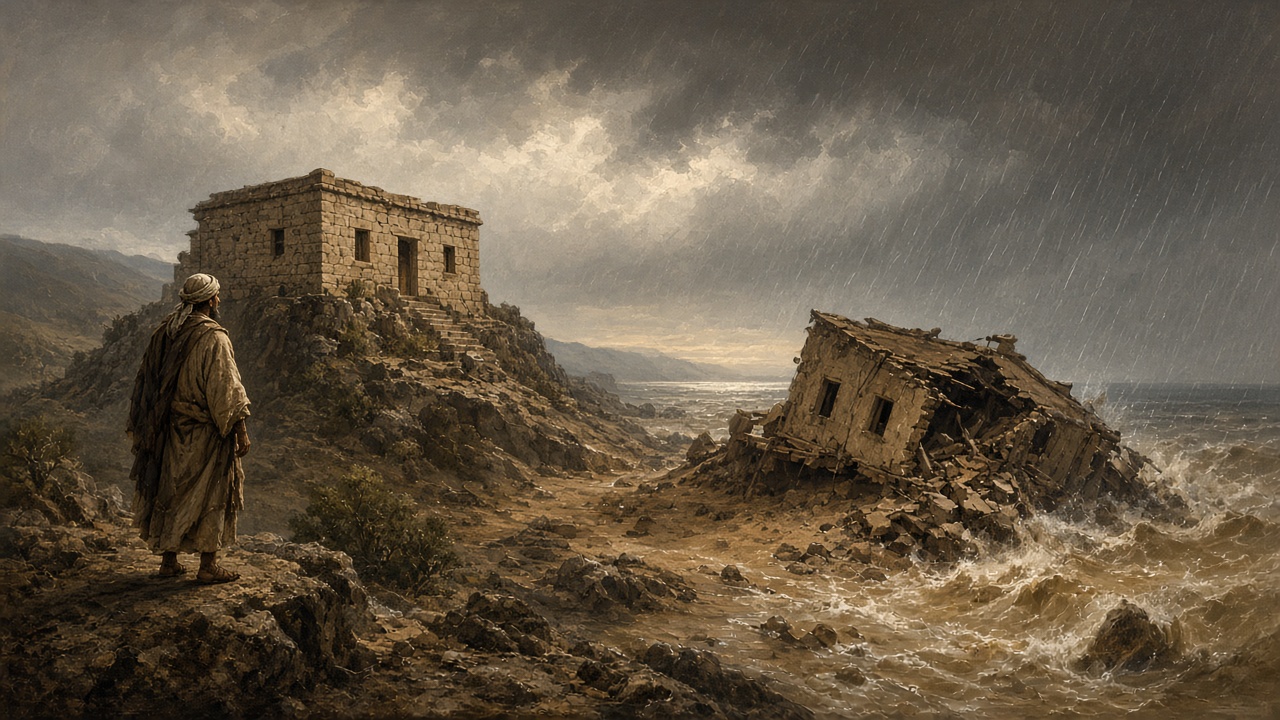
24Soseefi Masaa Jesesi taki go doo taki: “Sama di e teke mi taki de enke wan gaan koniman. Bika a koni, da a sabi luku bunbun peesi fu sete en osu. 25A sete a fondamenti fi en osu kinkin, fasi a ini wan bunbun taanga doti. Namo gaan alen kai dyullu, ne wataa fuu kon doo na a osu. Soseefi, gaan winta wai huu kon naki a osu. Ma anga ala dati, toku a osu á bunduka kai. Ma a taampu kinkin ete. Bika a fondamenti be sete a ini taanga doti. 26Ma sama di á wani teke mi taki dati tan enke gaan donman di don. Bika a gei sama di don, fu sabi luku bunbun peesi, fu sete en osu. A gaan donman ya go sete a fondamenti fi en osu wisiwasi fasi a ini fukufuku doti. 27Namo gaan alen kai dyullu, ne wataa fuu kon doo na a osu. Soseefi gaan winta wai huu kon naki a osu. Ne a osu bunduka guwaa dyulu a wataa. Bika a be sete a fukufuku doti ini.”
Masaa Jesesi leli nái gei taa sama leli
28Da a hii fasi fa Masaa Jesesi e gi a leli fu Masaa Gadu ya be foondoo den sama, te ná sipowtu. 29Bika den leliman fu Dyuweiti be e leli den sani wan hii taa fasi. Ma Masaa Jesesi dati be e leli den, enke wan sama di sa sidon taki a Masaa Gadu peesi.
¿Sabías que…?
El juicio, el camino angosto y un fundamento firme
- El registro del acontecimiento fecha el inicio del Sermón del Monte en el año 28 d. C. y su duración en un día. Este capítulo termina con las multitudes asombradas de la enseñanza de Jesús, porque él enseñaba como quien tiene autoridad, y no como sus escribas.Fuentes: Sermon on the Mount · el propio texto bíblico
- Jesús advierte que el juicio que alguien pronuncia, y la medida que esa persona usa, se volverán contra ella. Describe a alguien que nota la paja en el ojo de su hermano, pero no advierte la viga en el propio, y dice que la viga debe quitarse primero.Fuentes: el propio texto bíblico
- El capítulo llama esencia de la Ley y los Profetas hacer a los demás lo que uno querría que le hicieran. Contrasta una puerta ancha y un camino espacioso que lleva a la destrucción, por el que entran muchos, con una puerta pequeña y un camino angosto que lleva a la vida, que pocos hallan, y compara oír estas palabras y ponerlas en práctica con una casa edificada sobre la roca y no sobre la arena.Fuentes: el propio texto bíblico
Notas escritas con ayuda de IA a partir de fuentes abiertas (Theographic Bible Metadata, CC BY-SA 4.0; Easton’s Bible Dictionary, dominio público) y revisadas antes de publicarse.
Créditos y licencia de esta traducción
Beibel: okanisi tongo
New Testament in Eastern Maroon Creole (NS:djk:Eastern Maroon Creole)
copyright © 2009 Wycliffe Bible Translators, Inc.
Language: Eastern Maroon Creole
Translation by: Wycliffe Bible Translators, Inc.
Eastern Maroon Creole
djk
Suriname
Copyright Information
© 2009, Wycliffe Bible Translators, Inc. All rights reserved.
This translation text is made available to you under the
terms of the Creative Commons License: Attribution-Noncommercial-No Derivative Works.
( http://creativecommons.org/licenses/by-nc-nd/3.0/ )
In addition, you have permission to port the text to different file formats, as long as you
do not change any of the text or punctuation of the Bible.
You may share, copy, distribute, transmit, and extract portions
or quotations from this work, provided that you include the above copyright
information:
You must give Attribution to the work.
You do not sell this work for a profit.
You do not make any derivative works that change any of the actual words or punctuation of the Scriptures.
Permissions beyond the scope of this license may be
available if you contact
us with your request.
The New Testament
in Eastern Maroon Creole
© 2009, Wycliffe Bible Translators, Inc. All rights reserved.
This translation is made available to you under the terms of the
Creative Commons Attribution-Noncommercial-No Derivatives license 4.0.
You may share and redistribute this Bible translation or extracts from it in any format, provided that:
You include the above copyright and source information.
You do not sell this work for a profit.
You do not change any of the words or punctuation of the Scriptures.
Pictures included with Scriptures and other documents on this site are licensed just for use with those Scriptures and documents.
For other uses, please contact the respective copyright owners.
2014-04-22
Fuente: http://ebible.org/djkNT/ · eBible.org