Génesis 45
Nǫ̀htsı̨̨ Nı̨̨htł'è · Toca un versículo para ver sus referencias cruzadas.
Joseph amìı hǫt'ee sìı edı̨ı̨de gık'èhoezǫǫ̀ agǫ̀ǫ̀là
1Judah hadıì xàyaı̨htı t'à Joseph edecheekeè hazǫǫ̀ gınadąą̀ wegha dìì agòjà. Eyıt'à edecheekeè gots'ǫ̀ whezeh, “Hazǫǫ̀ sets'ǫǫ̀ xàahdè!” gòhdı. Hazǫǫ̀ xàgeède tł'axǫǫ̀ Joseph amìı hǫt'ee sìı edı̨ı̨de gık'èhoezǫǫ̀ agǫ̀ǫ̀là. 2Wegha dìì t'à sıì hòtł'ò ı̨ı̨tsè t'à Egypt got'ı̨į̀ gıìkw'o, eyıts'ǫ dǫ k'àowocho Faraoh wekǫ̀ gocho nàgedèe sìı gıghǫ ıìkw'o.
3Joseph edı̨ı̨de ts'ǫ̀ hadı, “Sı̨ Joseph aht'e! Asį̀į̀ setà ı̨łaà eda?” gòhdı. Hanìkò wı̨ı̨de gıch'àèhyeh t'à t'asagıìhdı ha dìì.
4Eyıt'à Joseph edı̨ı̨de gots'ǫ̀ hadı, “Segà nìahdè,” gòhdı. Wegà nègı̨ı̨de ekò hagòhdı, “Naxıchı Joseph aht'e, Egypt nèk'e ts'ǫ̀ naxıghǫ nàedì ı̨lèe sìı eyı aht'e! 5Hanìkò weghǫ dahjı̨-le, naxıghǫnàseèdì t'à edets'ǫ̀ ààhch'e-le. Nǫ̀htsı̨ dǫ łǫ edaxàgole gha naxınakweè seèhɂà hǫt'e. 6Dıì xè nàke xo gots'ǫ dèè k'e t'asìı wı̨ı̨zìı dehshe-le, eyıts'ǫ ı̨daà sı̨làı xo gots'ǫ̀ t'asìı dehshe-le t'à dǫ dèè k'e eghàlageeda ha nıìle. 7Hanìkò Nǫ̀htsı̨ sìı dıı nèk'e naxıts'ǫ dǫ gǫ̀hłı̨ ha nıwǫ, eyıts'ǫ enıìyah nechàa t'à edaxànaxele ha nıwǫ t'à naxınakweè seèhɂà hǫt'e.
8“Eyıt'à naxı̨ jǫ ts'ǫ̀ asèahłà nıìle, Nǫ̀htsı̨ jǫ ts'ǫ̀ seèhɂà hǫt'e. K'àowocho Faraoh wegha k'eyaetıı-dǫǫ̀ ehłı̨į̀ asį̀į̀là. Wecheekeè hazǫǫ̀ eyıts'ǫ wenèè hazǫǫ̀ gha denahk'e k'àowo ehłı̨į̀ asį̀į̀là hǫt'e. 9Įwhąą̀ setà ts'ǫ̀ anaahde, dıı hawèahdı, ‘Neza Joseph nets'ǫ̀ dıı hadı: Nǫ̀htsı̨ Egypt nèk'e gha k'àowo sèhtsı̨. Įwhąą̀ sets'àątła. 10Goshen nèk'e segà nıwà-lea nàądè ha. Nı̨, neza, eyıts'ǫ neza gıza xè, nets'ǫ sahzǫ̀ą, ejıe, eyıts'ǫ t'asìı hazǫǫ̀ nets'ǫ xè jǫ ts'ǫ̀ aąde. 11Įłaà sı̨làı xo ts'ǫ̀ bò whìle ha ne t'à, weghǫ shèts'ezhee negha whelaà ahłe ha. Sets'ǫ̀ aahjà-le nı̨dè nı̨, nèot'ı̨, eyıts'ǫ nets'ǫ tıts'aàdìı hazǫǫ̀ bò dę t'asagede ha,’ setà hawèahdı nǫǫ̀.
12“Naxı̨ eyıts'ǫ sechı Benjamın sı naxıdaà t'à seghàahda hǫt'e, xàè sı̨ Joseph naxıts'ǫ̀ gohdee sìı eyı aht'e. 13Jǫ Egypt nèk'e dànì sexè enıìyah hòɂǫǫ, eyıts'ǫ t'asìı hazǫǫ̀ ghàahdaa sìı ghǫ setà xè goahdo. Eyıt'à setà ı̨whąą̀ jǫ nèweahchı,” gòhdı.
14Joseph hadı tł'axǫǫ̀ edechı Benjamın edeyàdo xè etse, wechı Benjamın ededı̨ sı edeyàdo xè etse. 15Joseph edı̨ı̨de hazǫǫ̀ goı̨ts'į̀ xè goghǫ etse. Eyı tł'axǫǫ̀ wı̨ı̨de hazǫǫ̀ gıxè godo.
16Joseph wı̨ı̨de weghǫ nègı̨ı̨de ghǫ egıìkw'o t'à k'àowocho Faraoh eyıts'ǫ wecheekeè k'aodèe gı̨ı̨lı̨ı̨ hazǫǫ̀ gınà. 17Eyıt'à k'àowocho Faraoh Joseph ts'ǫ̀ hadı, “Nı̨ı̨de dıı hagìı̨dı, ‘Dıı haahłe ha: Naxıts'ǫ tłı̨tsoa k'e nìahwha gà Kanan nèk'e ts'ǫ̀ anaahde, 18naxıtà eyıts'ǫ naxèot'ı̨ hazǫǫ̀ sets'ǫ̀ agıahłe. Egypt nèk'e dèè denahk'e nezı̨ı̨ sìı naxıghàehɂà ha, hanì-ı̨dè wek'e nezı̨į̀ aahda ha.’
19“Eyıts'ǫ dıı hagìahdı, ‘Dıı haahłe: Egypt nèk'e gots'ǫ naxıts'èkeè eyıts'ǫ naxıza gıgha tłı̨cho-behchı̨į̀ edexè aahłe. Naxıtà wexàahdè gà jǫ ts'ǫ̀ aahde. 20Egypt nèk'e t'asìı denahk'e nezı̨ı̨ sìı naxıghaelı̨ ha ne t'à t'asìı naxıts'ǫ sìı aìla kò,’ ” k'àowocho Joseph ts'ǫ̀ hadı.
21Eyıt'à Israel weza hagejà. K'àowocho Faraoh weyatıì k'e Joseph tłı̨cho-behchı̨į̀ goghàı̨la, eyıts'ǫ nageedè gha weghǫ shèts'ezhee goghàı̨la. 22Edı̨ı̨de hazǫǫ̀ goht'ǫgòò goghàı̨la, hanìkò Benjamın taekw'eènǫ (300) sǫǫ̀mba degoo yeghàı̨la, eyıts'ǫ goht'ǫgòò sı̨làı edechı ghàı̨la. 23Eyıts'ǫ t'asìı dıı haàtłǫǫ edetà danìı̨la: Egypt nèk'e gots'ǫ t'asìı denahk'e nezı̨ı̨ sìı tłı̨tsoa hoònǫ k'e whela, eyıts'ǫ Egypt nèk'e ts'ǫ̀ nageedè gha tłı̨tsoa-dets'è hoònǫ k'e tł'olà, łèt'è eyıts'ǫ gıt'à shèzhe ha dek'egeèhłah. 24Eyı tł'axǫǫ̀ Joseph edı̨ı̨de nagoèhɂà. Nageedè ha nìkw'o ekò gots'ǫ̀ hadı, “Ek'èt'à nàahdè nı̨dè ełets'ǫ̀ nàyaahtı-le,” gòhdı.
25Eyıt'à ełechıke Egypt nèk'e gots'ǫ xàgeède, Kanan nèk'e edetà Jacob ts'ǫ̀ nìagı̨ı̨de. 26Edetà ts'ǫ̀ hagedı, “Joseph ı̨łaà eda! Egypt nèk'e gha k'àowo elı̨,” gıìhdı. Jacob wetł'ahk'eè agòjà t'à wegha ehkw'ı-ahodı-le. 27Hanìkò Joseph dàgòhdıı sìı hazǫǫ̀ gıts'ǫ̀ hadı t'à, eyıts'ǫ tłı̨cho-behchı̨į̀ t'à ekǫ ts'ǫ̀ naweetè ha yaɂı̨ ekò Jacob wınì nàtsoò anajà. 28Eyıt'à Israel hadı, “K'ǫǫ̀t'a segha ehkw'ı-ahodı! Seza Joseph ı̨łaà eda nǫǫ̀. Wets'ǫ̀ ehtła ha, ełaehwhı kwe weehɂį̀ ha,” hadı.
¿Sabías que…?
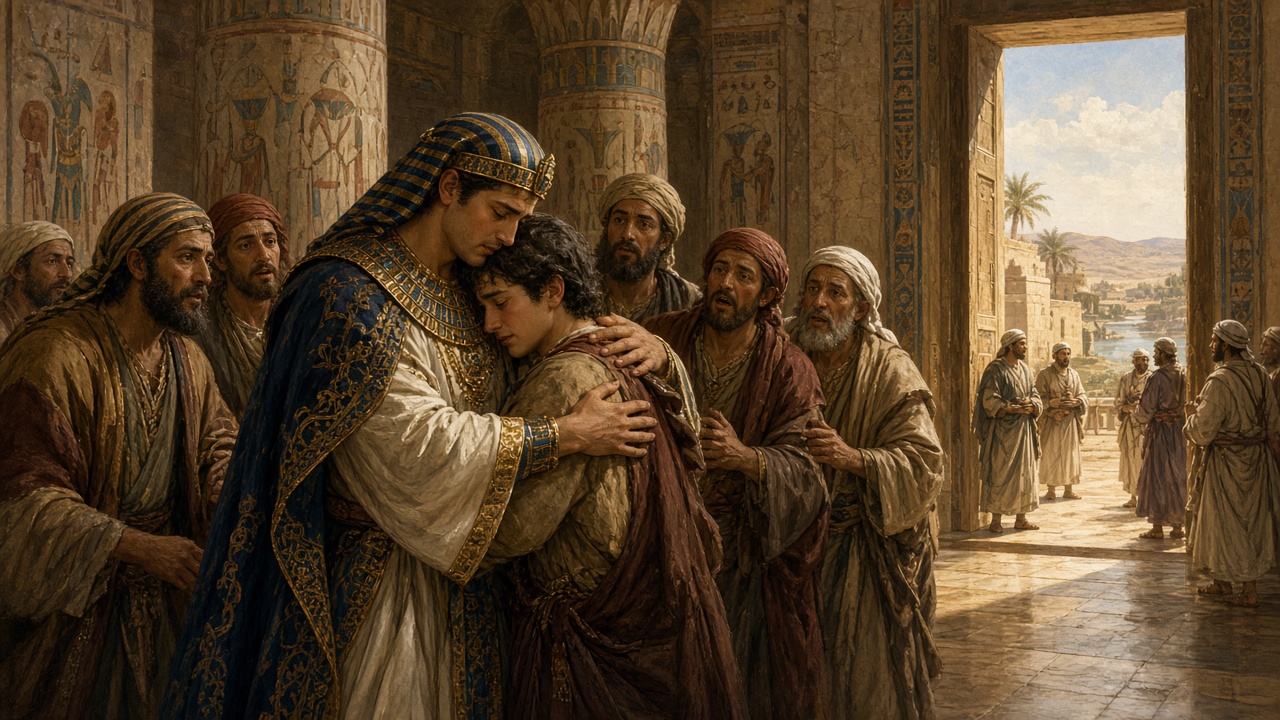
José se revela a sus hermanos
- Gosén, la región donde José dice a sus hermanos que se establezcan cerca de él con sus hijos, sus nietos, sus rebaños y sus ganados, quedaba al este del Nilo y, al parecer, no lejos de la residencia real. El Easton's Bible Dictionary (1897) señala que se menciona por primera vez en el mensaje de José a su padre y que también se llamaba tierra de Ramesés, porque las ciudades de Pitón y Ramesés estaban dentro de sus límites.Fuentes: Goshen · el propio texto bíblico
- José llora tan fuerte que los egipcios lo oyen, y la casa del faraón pronto se entera; el faraón y sus siervos se alegran al saber que los hermanos han llegado, y él les ofrece lo mejor de la tierra de Egipto. El Easton's Bible Dictionary (1897) dice que el faraón de los días de José fue probablemente Apopi, o Apopis, el último de los reyes hicsos. Añade que los reyes hicsos acogían a los pastores asiáticos, mientras que los egipcios nativos más antiguos consideraban a los pastores una abominación, aunque algunos sostienen que José llegó a Egipto en el reinado de Tutmosis III, mucho después de que los hicsos fueran expulsos.Fuentes: Pharaoh (of Joseph) · el propio texto bíblico
- Benjamín era el hijo menor de Jacob con Raquel, y José el mayor de los dos hijos de ella; su madre murió al dar a luz a Benjamín en Efrata y lo llamó Benoni, que significa hijo de mi dolor, nombre que su padre cambió por Benjamín. En el reencuentro, José abraza a Benjamín y llora, dándole trescientos siclos de plata y cinco mudas de vestidos, mientras cada uno de los otros hermanos recibe un vestido nuevo.Fuentes: Benjamin (patriarch) · Joseph (son of Jacob) · el propio texto bíblico
Notas escritas con ayuda de IA a partir de fuentes abiertas (Theographic Bible Metadata, CC BY-SA 4.0; Easton’s Bible Dictionary, dominio público) y revisadas antes de publicarse.
Lugares de este capítulo
- Egypt · 30.129, 31.308 · versículos 4, 8, 9, 13, 18, 19, 20, 23, 25, 26
- Goshen · Hoy: Goshen 1 · 30.799, 31.834 · versículo 10
- Canaan · 32.767, 35.333 · versículos 17, 25
Solo aparecen lugares identificados con alta confianza (90 % o más según las fuentes académicas reunidas por OpenBible). Mapa de la época: DARE (Digital Atlas of the Roman Empire), CC BY 4.0; mapa actual: © colaboradores de OpenStreetMap; lugares: OpenBible.info (CC BY 4.0).
Créditos y licencia de esta traducción
Nǫ̀htsı̨̨ Nı̨̨htł'è
Dogrib: Dogrib Genesis & New Testament New Testament & Portions of Old Testament
copyright © 2009 Canadian Bible Society
Language: Dogrib
Translation by: Canadian Bible Society
Tłı̨chǫ Genesis and New Testament
About Tłı̨chǫ
Tłı̨chǫ (Dogrib) is a Na-Dene (Athabaskan) language. It is spoken by the First Nations Tłı̨chǫ people in the Northwest Territories in Canada. It has the largest number of speakers of any of the Aboriginal language communities in the NWT, and is one of the official languages of the Northwest Territories.
About This Translation
This translation includes the book of Genesis and the New Testament in Tłı̨chǫ. The first edition of the Tłı̨chǫ New Testament was published in 2003. It was a historic event, as it was the first time in more than a hundred years that a complete New Testament was published for one of the Dene First Nations in the Territories. The first edition was well received and quickly sold out. In the meantime the book of Genesis had been completed. Consequently, the 2008 reprint of the Tłı̨chǫ New Testament included Genesis.
Though this translation of the New Testament and Genesis took a total of ten years, the people who worked on it built on years of labor invested by the Tłı̨chǫ people, elders, priests and missionaries, translators, educators, and linguists. The material contained in this book was checked and approved by consultants from Wycliffe Bible Translators and the Canadian Bible Society.
If you are interested in obtaining a printed copy of this Bible, please contact the Canadian Bible Society at http://www.biblescanada.com .
Copyright Information
Dogrib Genesis and New Testament © 2003, 2008 Canadian Bible Society
The text of the Bible in Tłı̨chǫ that appears in this electronic format or website is for personal use only.
Up to five hundred (500) verses of the Bible text in any form (written, visual, electronic or audio) may be quoted without permission. The quoted verses may not be more than 50% of a complete book of the Bible, or more than 25% of the total text of the work in which they are quoted. Prior written permission must be obtained for any other use of the text. Copyright acknowledgement must in all cases appear on the title or copyright page.
For more information on copyright conditions or to apply, visit http://www.biblesociety.ca/copyright .
This translation is made available to you under the terms of the
Creative Commons Attribution-Noncommercial-No Derivatives license 4.0.
You may share and redistribute this Bible translation or extracts from it in any format, provided that:
You include the above copyright and source information.
You do not sell this work for a profit.
You do not change any of the words or punctuation of the Scriptures.
Pictures included with Scriptures and other documents on this site are licensed just for use with those Scriptures and documents.
For other uses, please contact the respective copyright owners.
2014-04-22
Fuente: http://ebible.org/dgrDOGNT/ · eBible.org