Hechos 16
I 'utz laj tzij re i dios · Toca un versículo para ver sus referencias cruzadas.
I a-Timotéo ca ʼe cuʼ i ma Páblo i ma Sílas
1I ma Páblo i ma Sílas xe upon che i queb tinimit, Dérbe y Lístra. Pa Lístra xqui rik wi jun creyent u bi a-Timotéo. Ire, racʼal jun ixok creyent, aj Israel winak; xui-ri, i u kajaw i achi-le, aj Griégo winak. 2Niʼpa i creyent pa tinimit Lístra, xak i je ʼo pa tinimit Icónio, quiqui bij chi ʼutz laj achi i a-Timotéo. 3I ma Páblo craj cu cʼam bi i a-Timotéo ruʼ. Rumal-i, xqui ʼan i retal circuncision che u chʼacul, man ca cʼulax cumal i aj Israel winak xa ipa que icʼaw wi. I aj Israel winak, ʼis quetaʼam chi u kajaw ire aj Griégo winak (y n-quiqui cʼulaj ta cuʼ we n-ʼantal ti circuncision che). 4Are xe icʼaw pa tak tinimit, xqui bij chique i creyent wach qui nucʼum, wach qui bim i apostelab, junam cuʼ i nimak tak mamʼib pa Jerusalen. Xqui bij chique chi ʼo u chac quiqui ʼan cas wach i qui bim bic. 5Rumal i qui solinic ique-le, i tzobajil creyent mas xjiqui qui cʼux che i Dios. N-xui ta la ile, ʼij ʼij ca tijin qui qʼuiaric.
I ma Páblo crachicʼaj u wach jun aj Macedónia
6I u Tewal i Dios n-xu ya ta chique xe oc pa jyub Asia chu bixquil u tzij i Dios chila. Rumal-i, xe icʼaw pa jyub Frígia, xak xe icʼaw pa jyub Galácia, 7y xe upon pa mojon re i jyub Mísia. Quiqui chʼobo chi que ʼax pa jyub Bitínia, xui-ri, i u Tewal i Jesus n-xu ya ta chique chi que oquic. 8Are u ʼonquil ʼuri n-xe oc ta pa Mísia, xa xe icʼaw sucʼulic. Xe kaj pa tinimit Tróas chu chiʼ i mar. 9Chila, i ma Páblo xrachicʼaj pu waram chaʼab; xrachicʼaj u wach jun achi aj pa jyub Macedónia, aj chʼaka mar. I achi-le, tacʼal chuwach, cu bij che: “¡Saʼaj! Chat ʼax li kuʼ yoj oj aj Macedónia; choj ol a to,” cutixic, xril ire. 10Are xrachicʼaj i ma Páblo ile, juntir xka yijba kib, ʼenam-ke pa Macedónia. Lic ketaʼam chi Dios xoj u siqʼuij bi chila chu bixquil chique wach i ʼelbal chupam i qui mac.
Wach i xqui cʼulmaj i ma Páblo i ma Sílas pa Filípos
11Teʼuri xoj oc bi pa bárco, y xoj ʼel pa tinimit Tróas. I bárco ʼenam re sucʼulic cʼa che jun ral jyub setel pa nicʼaj mar; i jyub-le u bi Samotrácia. Chucab ʼij, xoj ʼe pa bárco cʼa pa tinimit Neápolis, u cwenta i Macedónia. 12Teʼuri xoj ʼe pa tinimit Filípos chi xak u cwenta i jyub Macedónia; chila je jekel wi je qʼui aj Róma winak. I tinimit Filípos mas ʼo u ʼij chiquiwach i niʼpa i tinimit chirij chuwach. Xoj qʼuiji qʼuial ʼij chila. 13Pa uxlambal ʼij, xoj ʼel tzamja re i tinimit, caka tzucuj pa quiqui mol wi quib i aj Israel chu tzʼonoxic che i Dios. Xoj upon chu chiʼ jun ya y xka rik i molbalʼib, pa qui molom wi quib juban ixokib. Xoj cubi cuʼ y xka bij chique wach u patan i Jesucrísto. 14ʼO jun chique ati Lídia u bi. I ixok-i, aj tinimit Tiatíra, aj cʼay chomik laj tak cʼul, lic pakal rajil. Ire ca tijin chu tayquil wach ca bixic, man ʼax cu coj wi u ʼij i Dios. I Dios xchʼaw ʼuri pa ranima chi cu coj retalil che wach i cu bij i ma Páblo. 15Teʼuri xu tzʼonoj u kajsaxic ya puwi, y xkajsax ya puwi ire xak piquiwi conojel niʼpa i je ʼo ruʼ ja. Teʼuri xu bij chake:
—We yix qui na piwanima chi yin in cojom u tzij i Kajwal, chix pet kuʼ, y quix canaj chi kachoch —xu bij chake.
N-xu ya ta chake coj petic, xu ʼan pen chake chi coj canaj cuʼ ruʼ ja. 16Xoʼon panok, are xoj ʼe chic pa quiqui mol wi quib i winak chu tzʼonoxic che i Dios, xka cʼulaj jun ali chi ʼo itzel tew che. Rumal i itzel tew-le, i ali ca nanic. Je ʼo u patron, péro n-quiqui toj taj, tupu qʼui i mer quiqui chʼac chirij, rumal u nanic. 17I ali-le xoj u terbej, ca siqʼuin chu bixquil i tzij-i:
—I achiab-le je u takon i Dios chi ʼAtz u ʼIj, col qui bij chiwe wach iwelbal chi sak —coʼon i ali. 18ʼIj ʼij queje ile xu ʼano; i ma Páblo lic xrix u cʼux che. Are ʼuri xu pisquilij rib y xu ʼijla i itzel tew chi ʼo che i ali. Xu bij:
—Rumal u choʼab i Jesucrísto chi ʼo wuʼ, quin bij chawe ¡chawoʼtaj can i ali-le, y jat! —xu bij.
I itzel tew juntir xroʼtaj canok. 19I rajaw i ali xquil ʼuri chi n-ta chic mer quiqui chʼac che. Rumal ʼuri xe qui chap i ma Páblo i ma Sílas y xe qui cʼam bi chiquiwach i ʼatbal tzij. 20Xe ʼe qui ya chiquiwach i juez y xqui bij:
—I achiab-i je aj Israel winak, y xa que qui chʼujersaj i winak pa ka tinimit. 21Junwi i cʼutunic col qui cʼutu chake; n-ʼus taj coj naw che, man yoj oj aj Róma winak —xe cha.
22Are ʼuri i winak xpe coywal y xe ʼe chiquij i ma Páblo i ma Sílas. Teʼuri i juez xqui tak i relsaxic qui ʼuʼ, y xqui tak qui chʼayic ruʼ u ʼab cheʼ. 23Qʼui i qui loʼxic xqui yaʼo, teʼuri xe qui cʼam bic y xe qui tzʼapij pa cárcel. Xqui bij che i aj chajil cárcel chi lic ʼutz i qui chajixic cu ʼano. 24I aj chajil cárcel are xyaʼ u mantar, xe u tzʼapij cʼa pa qʼuisbal re i cárcel. Chila xu coj wi can i cakan pa cheʼ, man n-que bin ta chic.
25I ma Páblo i ma Sílas colo tiqʼuil aʼab que tijin chu tzʼonoxic che i Dios, xak quiqui bixaj u ʼij i Dios. I juban chic winak chi je tzʼapil chila que tijin chu tayic. 26Xak teʼet xcʼun jun nim laj ucabrakan, xu silabsaj u cubibal i cárcel. Are ʼuri niʼpa i uchija xjaktaj utuquel, xak i carena, i cheʼ chi ʼo che i cakan xel chique niʼpa i je tzʼapilic. 27I aj chajinel, are xcʼun sak chuwach, xrilo chi jaktajnak i cárcel. Cu bij ire chi niʼpa i je tzʼapilic ʼis je ʼanmajnak chubic, rumal-i xresaj li u chʼichʼ cu camsaj rib cu bij ire. 28Are ʼuri i ma Páblo xsiqʼuin che:
—Ma ʼan cʼax che awib, man konojel ʼis oj ʼo chi —xu bij che.
29I aj chajinel xu tzʼon-la chi ca tzij i ʼaʼ; paʼanem xoc bic y xuqui chi cakan i ma Páblo i ma Sílas, lic ca sicsat rumal u xibriquil. 30Juntir xe resaj lok y xu tzʼonoj chique:
—Nimak tak winak, ¿wach i quin ʼano quin el chupam in mac? —coʼono.
31—Cha cuba a cʼux che i Kajwal Jesucrísto y cat el ʼuri chupam a mac, xak i awixokil i awacʼal, y niʼpa i je ʼo chi awachoch —xqui bij che.
32Teʼuri xqui cʼut u tzij i Kajwal che, xak chique conojel niʼpa i je aj pa rachoch. 33Are ʼuri, cʼa chaʼab, i aj chajinel xoc chu chʼajic pa i soctal wi chique. Teʼuri xkajsax ya puwi achi, xak piquiwi i je aj pa rachoch. 34Xe u cʼam bi i ma Páblo i ma Sílas chi rachoch y xe u tzuku. I aj chajinel, xak conojel i je ʼo chi rachoch lic que quicotic rumal u cubibal qui cʼux che i Dios.
35Chucab ʼij, i juez xe qui tak bi jujun policía ruʼ i aj chajil cárcel, xol qui bij chi que oʼtax bi i ma Páblo i ma Sílas. 36Are ʼuri, ire xu bij che i ma Páblo:
—I juez xqui tak li rason wuʼ chi quix woʼtaj bic; quiqui ya chiwe chi quix ʼec, n-ta pen —xu bij chique.
37Xui-ri, i ma Páblo xu bij chique i policía:
—N-coj ʼe taj man n-ʼus ti xqui ʼan chake. Yoj oj cach aj tinimit Róma, péro xoj qui chʼay chiquiwach i winak y xoj qui tzʼapij pa cárcel. N-ta ʼatbal tzij xqui ʼan chake pacha usucʼ, y woʼor cacaj coj coʼtaj aliʼal. Ile n-ca majaw taj; che pet i juez, choj ol quesaj —xu bij.
38I policía xe ʼe qui bij chique i juez. Ique, are xqui ta chi i ma Páblo i ma Sílas je aj Róma, xqui xij quib. 39Rumal-i xe ʼe cuʼ y xqui tzʼonoj cuybal mac chique. Teʼuri xe quesaj bi i ma Páblo i ma Sílas. Xqui tzʼonoj pawor chique chi que ʼel pa tinimit. 40Are xe ʼel pa cárcel, xe ʼe chi rachoch i ati Lídia, pa je ʼo wi i creyent. Xqui ya can u cowil qui cʼux, teʼuri xe ʼec.
¿Sabías que…?
De Listra a Filipos
- En Listra, Pablo encontró a Timoteo, un discípulo de quien hablaban bien los hermanos de Listra e Iconio, hijo de una judía creyente y de un padre griego. Queriendo llevarlo como compañero, Pablo lo circuncidó a causa de los judíos de allí, que sabían que su padre era griego. El diccionario bíblico de Easton (1897) dice que Timoteo probablemente vivía en Listra y parece haberse convertido en la visita anterior de Pablo.Fuentes: el propio texto bíblico · Timotheus
- Después de que se les impidió hablar en la provincia de Asia, Pablo y sus compañeros viajaron por Frigia y Galacia. En la frontera de Misia no se les permitió entrar en Bitinia, así que bajaron a Troas, el puerto principal de Misia, en la costa noroeste de Asia Menor, ciudad que recibió su nombre de la antigua Troya, a unas cuatro millas al norte. Allí, una visión nocturna de un hombre de Macedonia que pedía ayuda los llevó a navegar hacia esa provincia romana al norte de Grecia.Fuentes: el propio texto bíblico · Mysia · Troas · Macedonia
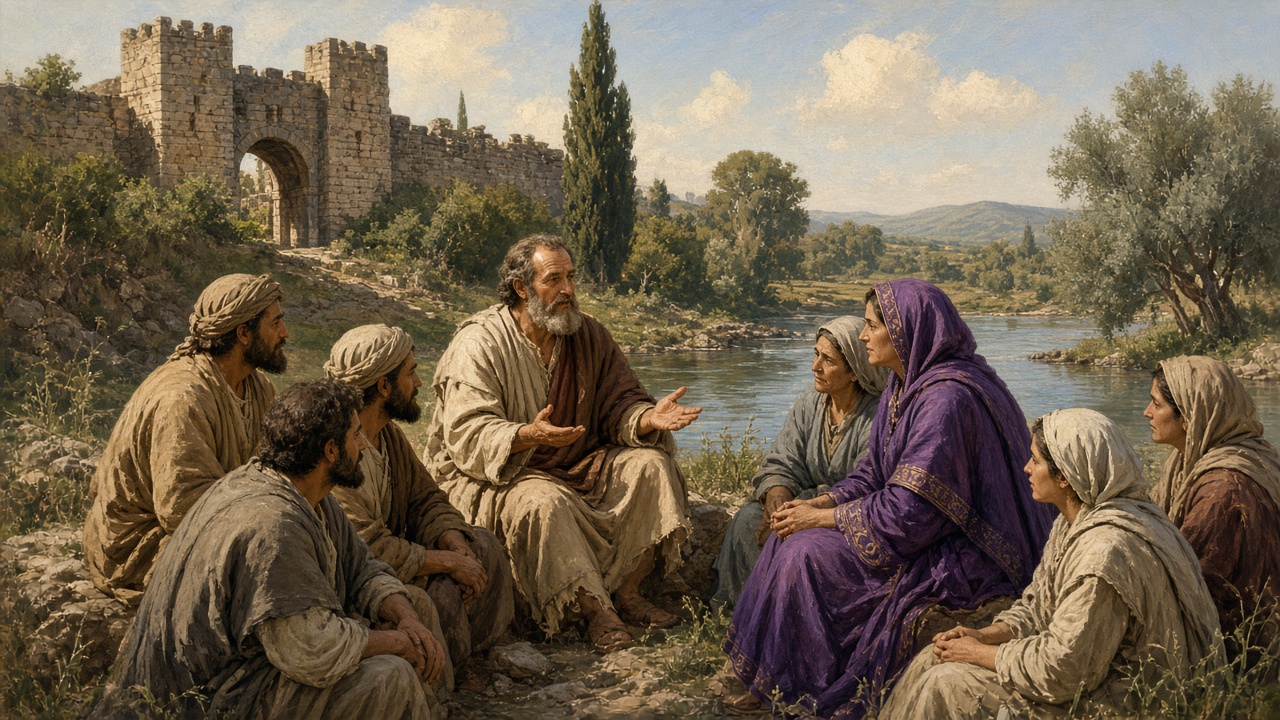
- En la colonia romana de Filipos, Pablo y sus compañeros encontraron, junto al río y fuera de la puerta de la ciudad, un lugar donde era costumbre orar, y allí se habían reunido unas mujeres. Entre ellas estaba Lidia, comerciante de telas de púrpura, de Tiatira, y adoradora de Dios; después de que ella y los de su casa fueron bautizados, convenció a los viajeros de quedarse en su casa. El diccionario bíblico de Easton (1897) la describe como una prosélita de considerable riqueza y como la primera persona en Europa que abrazó el cristianismo.Fuentes: el propio texto bíblico · Lydia
Notas escritas con ayuda de IA a partir de fuentes abiertas (Theographic Bible Metadata, CC BY-SA 4.0; Easton’s Bible Dictionary, dominio público) y revisadas antes de publicarse.
Lugares de este capítulo
- Lystra · Hoy: Tel Lystra · 37.602, 32.338 · versículos 1, 2
- Iconium · Hoy: Konya · 37.872, 32.492 · versículo 2
- Jerusalem · 31.777, 35.234 · versículo 4
- Asia · 38.400, 28.300 · versículo 6
- Galatia · 39.267, 32.983 · versículo 6
- Phrygia · 39.000, 31.000 · versículo 6
- Bithynia · 40.500, 31.000 · versículo 7
- Mysia · 40.000, 28.500 · versículos 7, 8
- Troas · Hoy: Alexandria Troas · 39.752, 26.159 · versículos 8, 11
- Greece · 37.972, 23.727 · versículo 9
- Macedonia · 41.600, 22.540 · versículos 9, 10, 12
- Neapolis · Hoy: Kavala · 40.935, 24.415 · versículo 11
- Samothrace · Hoy: Samothraki · 40.450, 25.583 · versículo 11
- Philippi · 41.012, 24.285 · versículo 12
- Thyatira · Hoy: Akhisar · 38.920, 27.837 · versículo 14
Solo aparecen lugares identificados con alta confianza (90 % o más según las fuentes académicas reunidas por OpenBible). Mapa de la época: DARE (Digital Atlas of the Roman Empire), CC BY 4.0; mapa actual: © colaboradores de OpenStreetMap; lugares: OpenBible.info (CC BY 4.0).
Créditos y licencia de esta traducción
I 'utz laj tzij re i dios
New Testament in Achi (I 'utz laj tzij re i dios)
copyright © 2009 Wycliffe Bible Translators, Inc.
Language: Achi
Dialect: Cubulco
Translation by: Wycliffe Bible Translators, Inc.
Achi, Cubulco
Achi' is a Mayan language very
closely related to K'iche' (Quiché in the older orthography). It is spoken by the
Achi people, primarily in the area of Baja Verapaz in Guatemala. There are two Achi'
dialects. Cubulco Achi' is spoken by approximately 48,000 people in the Cubulco area
west of Rabinal area. Rabinal Achi' is spoken by approximately 37,000 people in the
Rabinal area.
El Nuevo Testamento
en el idioma Achí de Cubulco de
Guatemala
Ediciones anteriores
Segunda edición
©2009, Wycliffe Bible
Translators
Primera edición
Publicado por
©1984, Sociedad Bíblica
Internacional
Copyright Information
© 2009, Wycliffe Inc. All rights reserved.
This translation text is made available to you under the terms of the Creative
Commons License: Attribution-Noncommercial-No Derivative Works. ( http://creativecommons.org/licenses/by-nc-nd/3.0/ ) In addition, you have
permission to port the text to different file formats, as long as you do not change
any of the text or punctuation of the Bible.
You may share, copy, distribute, transmit, and extract portions or quotations from
this work, provided that you include the above copyright information:
You must give Attribution to the work.
You do not sell this work for a profit.
You do not make any derivative works that change any of the actual words or
punctuation of the Scriptures.
Permissions beyond the scope of this license may be available if you contact us
with your request. If you want to revise a translation, use a translation in an
adaptation, or use a translation commercially, we will consider your request.
NT:segunda edición
The New Testament
in Achi
© 2009, Wycliffe Inc. All rights reserved.
This translation is made available to you under the terms of the
Creative Commons Attribution-Noncommercial-No Derivatives license 4.0.
You may share and redistribute this Bible translation or extracts from it in any format, provided that:
You include the above copyright and source information.
You do not sell this work for a profit.
You do not change any of the words or punctuation of the Scriptures.
Pictures included with Scriptures and other documents on this site are licensed just for use with those Scriptures and documents.
For other uses, please contact the respective copyright owners.
2013-01-05
Fuente: http://ebible.org/acr-acc/ · eBible.org