Zechariah 12
YAUBADA YANA VONA'AWAUFAUFA 'IVAUNA · Tap a verse to see its cross-references.
Vemogai bwaikina kumanina i loveniga faifaina
10'Auvea i vona i vo, 'Awaie Devida tubunavo wata me Ielusalema yadi nuanua a na luve'ivaudi bega ma ediavo i na ve'isanuakalikali, wata nuanuadi i na vevelu'ui 'waikuye 'aivaita faifaina.
I na 'iseku, yau kumaniku basenadi i loveniku nika i na vemogai 'wa da vo kwamana tubu'eana yawaina i da 'a'ava, i na tainu'wanu'wa bani'odi tubu'edakumeta yawaina i da 'a'ava. 11'Aiatanina 'waineye Ielusalema nageneye nuavita wata vemogai bwaikaotogina, 'wa da vo basenadi Adadi-limoni i mogaia Megido laube'una 'waineye.
Did you know?
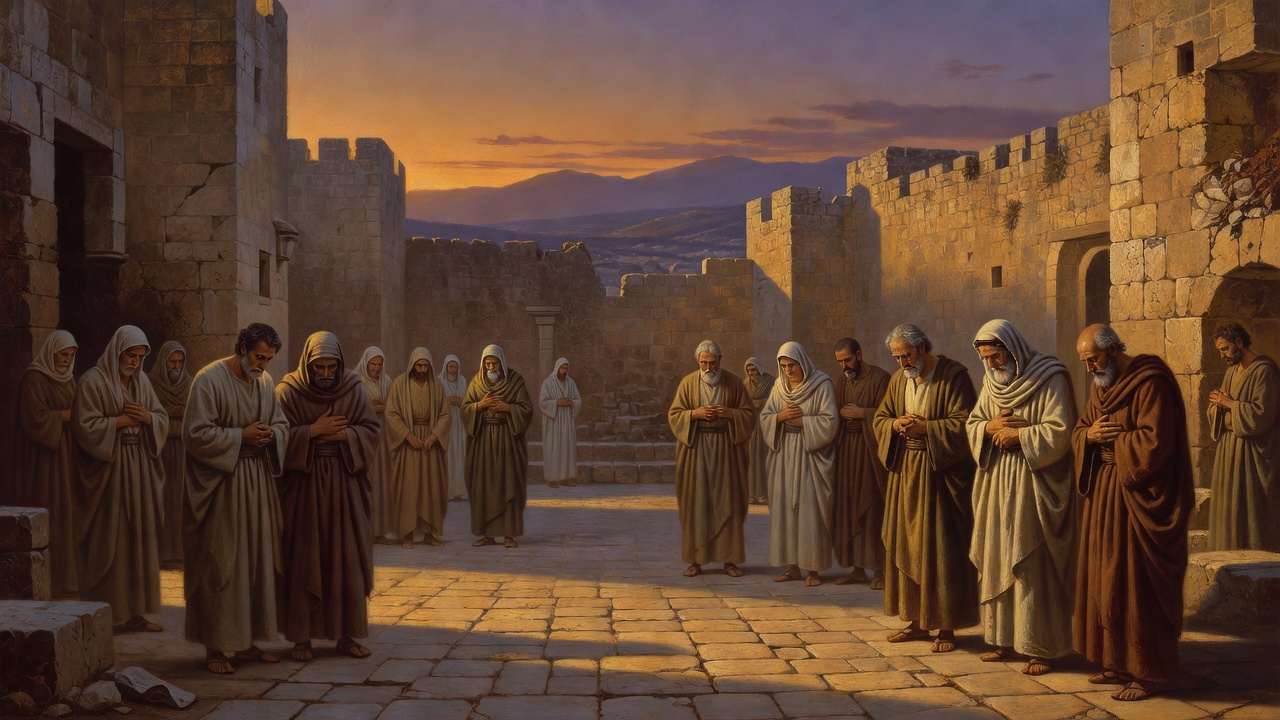
Deliverance and Mourning in Jerusalem
- The reference to mourning at Hadad-rimmon in the plain of Megiddo recalls the national grief over King Josiah, who was mortally wounded near that location. Megiddo's broad valley was a strategic corridor and a frequent battlefield in ancient times.Sources: Hadad-rimmon · Megiddo · the Bible text itself
- The prophecy lists specific families in separate mourning, including the royal lineages of David and his son Nathan, as well as the priestly house of Levi. This emphasizes that profound grief and personal contemplation would encompass all strata of society, from leaders to individual households.Sources: David · Nathan · Levi (patriarch) · the Bible text itself
- Jerusalem is described through vivid imagery, such as a heavy, immovable stone that injures anyone attempting to lift it, and a cup that intoxicates attacking armies. These metaphors underscore divine defense of the city against invading nations.Sources: Jerusalem · the Bible text itself
Notes written with AI assistance from open sources (Theographic Bible Metadata, CC BY-SA 4.0; Easton’s Bible Dictionary, public domain) and reviewed before publishing.
Places in this chapter
- Jerusalem · 31.777, 35.234 · verses 2, 3, 5, 6, 7, 8, 9, 10, 11
- Megiddo · Today: Tel Megiddo · 32.585, 35.184 · verse 11
Only places identified with high confidence are shown (90% or more according to the scholarly sources compiled by OpenBible). Period map: DARE (Digital Atlas of the Roman Empire), CC BY 4.0; modern map: © OpenStreetMap contributors; places: OpenBible.info (CC BY 4.0).
Credits and license for this translation
YAUBADA YANA VONA'AWAUFAUFA 'IVAUNA
The New Testament in the Iamalele dialect of the Ubuvala Language of Papua New Guinea
Nupela Testamen long tokples Ubuvala long Niugini
copyright © 1984, 1988, 2025 Wycliffe Bible Translators, Inc. and SIL Papua New Guinea
Language: Ubuvala (Iamalele)
Dialect: Iamalele
Translation by: SIL PNG
Contributor: Wycliffe Bible Translators
This translation is made available to you under the terms of the
Creative Commons Attribution-Noncommercial-No Derivatives license 4.0.
You may share and redistribute this Bible translation or extracts from it in any format, provided that:
You include the above copyright and source information.
You do not sell this work for a profit.
You do not change any of the words or punctuation of the Scriptures.
Pictures included with Scriptures and other documents on this site are licensed just for use with those Scriptures and documents.
For other uses, please contact the respective copyright owners.
2026-09-30
Source: http://png.bible/yml/ · eBible.org