Ezra 3
YAUBADA YANA VONA'AWAUFAUFA 'IVAUNA · Tap a verse to see its cross-references.

About this book
About Ezra
- Easton's Bible Dictionary (1897) says Ezra was probably the author of at least the greater part of the book, and also of Chronicles, whose close forms Ezra's opening passage. It dates the record from Cyrus's decree in 536 B.C. to Ezra's reformation in 456 B.C., about eighty years. Articles on Ezra and Artaxerxes place the second return in the seventh year of Artaxerxes, called Longimanus, and give that year as 459 or 458 B.C.Sources: Easton: Ezra, Book of · Ezra · Artaxerxes
- The book records events at the close of the Babylonian exile. Cyrus, king of Persia and conqueror of Babylon, issued a decree freeing the Jews. In Cyrus's first year Zerubbabel led back 42,360 exiles, besides a large number of servants, and in the second year he raised an altar and laid the temple foundation on ruins left by Nebuchadnezzar.Sources: Easton: Ezra, Book of · Cyrus · Zerubbabel
- Easton describes two principal divisions. Chapters 1–6 cover the first return until the new temple was completed and dedicated in the sixth year of Darius Hystapes, which he dates to 515 B.C. Chapters 7–10 give the second return under Ezra and events in Jerusalem after his arrival, following a gap of about sixty years.Sources: Easton: Ezra, Book of
- Easton notes that the book was once included in Nehemiah, the Jews regarding the two as one volume, while the Vulgate still distinguishes them as I and II Esdras. Rehum, called Artaxerxes' chancellor, tried to turn the king against rebuilding Jerusalem's walls and temple. Before leaving Babylon, Ezra's company gathered by the Ahava, taken either as a Mesopotamian river flowing into the Euphrates or as a place.Sources: Easton: Ezra, Book of · Rehum · Ahava
Notes written with AI assistance from open sources (Theographic Bible Metadata, CC BY-SA 4.0; Easton’s Bible Dictionary, public domain) and reviewed before publishing.
Tomotoga 'eba velomu i yogona-vaitugani
1Me Isileli 'ifwaidi i vila-vaituganidi yadi 'atamana 'waidie, i nagoga 'ana tugusa weta'i 'ana ve-7 'waineye, matatabudi i luvetubama Ielusalema 'atamana bwaikina nageneye, yadi nuanua 'aitamogana 'wainega. 2Nika Dosadaka natuna iavetana Iesua 'ifwaidi tovelomu taiadi, wata Salatiela natuna iavetana Selubabela ma yana 'aila'avo me Isileli yadi Yaubada 'ana 'eba velomu i yogona-vaitugani, nika bei i na velomu bani'odiga yadi veimea i mai Yaubada yana tofolova Mosese 'wainega. 3Avinodi i ve'alakolokololo 'awalawanina 'ana tomotogavo 'waidie, 'eba velomu i yogoni 'ana kabutu'uye, yadi 'anivelena-maimaiga i velomuyedi i 'a'anikabu 'Auvea 'waineye 'awa'awai wata lavilavi 'aitamogana 'aitamogana 'waidie.
Tomotoga 'Auvea yana Vanuga 'Eba Velu'ui i yogona-vaitugani
7Me Isileli, kumanidiavo i vila-vaituganidi yadi 'atamana 'waidie, me Fesia yadi Kini Sailusi yana veimea i vematayakeyakeni bega matatabudi mani i luvetubamidi kileu 'adi toyadala wata vanuga 'adi to'aiyogona i tutulidi. Welavi sida i tovotovoi me Lebanoni yadi 'awalaweye bega me Isileli 'ani'ani, ufa 'iwanina wata bunama i luvetubamidi i tutula me Saidoni wata me Taia 'waidie, welavinidi i talagidi i miedi eyaga 'waineamo 'atamana Iofa 'waineye. |alt="Building" src="16_Ne_03_01_RG.jpg" size="span" loc="half page" copy="WBT" ref="3:7"
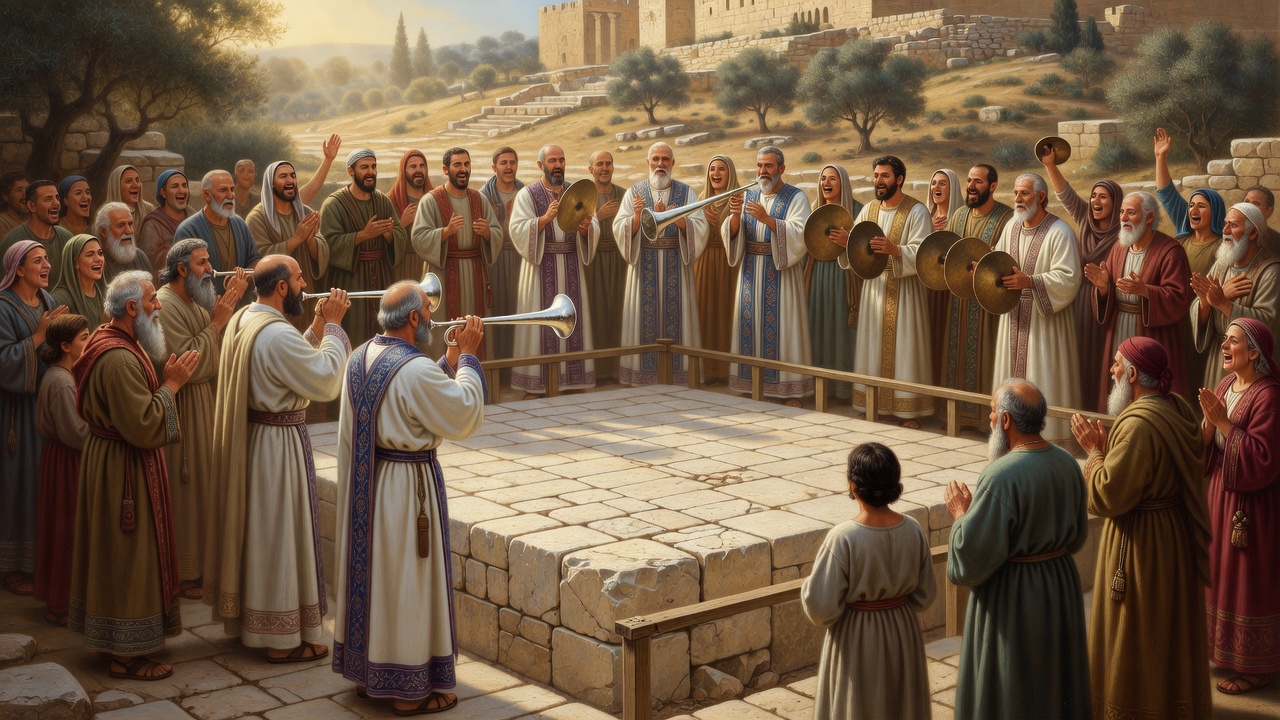
8Tomotoganidi i viladi i le'wai Ielusalema i nagoga malamala 'ana veluga i veluagai we'e weta'i 'ana veluga 'waineye, i velamu Yaubada yana Vanuga 'Eba Velu'ui i na yogona-vaitugani 'atamana Ielusalema 'waineye. To'aiyogonanidi side 'adi wagava. Salatiela natuna Selubabela, Dosadaka natuna Iesua ma yana 'aila'avo tovelomu 'ifwaidi taiadi wata tomotoganidi Livai 'ana wauma 'wainega, tomotoga matatabudi taiadi. We'e tomotoganidi Livai 'ana wauma 'wainega 'adi malamala 20 bega i lakaga i venua'ivinedi tofolovavo i na 'isave'avinidi. Tomotoga i folofolova Yaubada yana Vanuga 'Eba Velu'ui 'waineye malamala 21 nagedie nika vanuga i ve'a'avai.
Did you know?
Rebuilding the Altar and Temple Foundation
- The returned exiles restored sacrificial worship on the temple mount before beginning major construction. Under Zerubbabel and the priest Jeshua, they rebuilt the altar on its original site to resume daily offerings and celebrate the Feast of Tabernacles before laying the temple foundation.Sources: the Bible text itself · Zerubbabel · Joshua
- To secure timber for the rebuilding effort, the community paid masons and carpenters, and sent food, drink, and oil to Tyre and Sidon to transport cedar logs from Lebanon by sea to the port of Joppa, as permitted by Cyrus, king of Persia.Sources: the Bible text itself · Lebanon · Joppa · Cyrus
- Laying the foundation of the house of the Lord triggered intense, mixed reactions. While many shouted joyfully to the accompaniment of trumpets and cymbals, older priests, Levites, and family heads who remembered the first temple wept aloud.Sources: the Bible text itself
Notes written with AI assistance from open sources (Theographic Bible Metadata, CC BY-SA 4.0; Easton’s Bible Dictionary, public domain) and reviewed before publishing.
Places in this chapter
- Jerusalem · 31.777, 35.234 · verses 1, 8
- Great Sea · Today: Mediterranean Sea · 31.805, 34.170 · verse 7
- Joppa · Today: Jaffa · 32.054, 34.753 · verse 7
- Lebanon · 33.540, 35.584 · verse 7
- Persia · 34.806, 48.516 · verse 7
- Sidon · Today: Sandikli archaeological site in Sidon · 33.561, 35.372 · verse 7
- Tyre · 33.271, 35.196 · verse 7
Only places identified with high confidence are shown (90% or more according to the scholarly sources compiled by OpenBible). Period map: DARE (Digital Atlas of the Roman Empire), CC BY 4.0; modern map: © OpenStreetMap contributors; places: OpenBible.info (CC BY 4.0).
Credits and license for this translation
YAUBADA YANA VONA'AWAUFAUFA 'IVAUNA
The New Testament in the Iamalele dialect of the Ubuvala Language of Papua New Guinea
Nupela Testamen long tokples Ubuvala long Niugini
copyright © 1984, 1988, 2025 Wycliffe Bible Translators, Inc. and SIL Papua New Guinea
Language: Ubuvala (Iamalele)
Dialect: Iamalele
Translation by: SIL PNG
Contributor: Wycliffe Bible Translators
This translation is made available to you under the terms of the
Creative Commons Attribution-Noncommercial-No Derivatives license 4.0.
You may share and redistribute this Bible translation or extracts from it in any format, provided that:
You include the above copyright and source information.
You do not sell this work for a profit.
You do not change any of the words or punctuation of the Scriptures.
Pictures included with Scriptures and other documents on this site are licensed just for use with those Scriptures and documents.
For other uses, please contact the respective copyright owners.
2026-09-30
Source: http://png.bible/yml/ · eBible.org