Genesis 46
Buki Tabu Beyabeyana · Tap a verse to see its cross-references.
Yakobo ilobi Itipita
1Mwa Yakobo ikwasa ana gogo meuloili ikalaili yo saugana iyawatagili Biyasiba, ipwaoli tamana Aisake ana Yaubada koina. 2Yo Yaubada kenogite koina iwalolau boniyai mena iwaloba, “Yakobo. Yakobo.” Yakobo iwaloba, “Yau elete.” 3Yo iwaloba, “Yau Yaubada, tamam ana Yaubada, tabu kumamatausi lobi Itipita kaiwena. Kaiwenaele kani gwalugwalumwao yayadebalalali. 4Kani yau mekaukava kowa talobi Itipita na kani yakele-yavivilayoimiu. Yo am sauga boita koina natum Yosepa mekamkava iboma nimana mena kani manim ikausili.” 5Biyasiba ilogabaen na Yakobo natunao, tamali sikalai yo natuliyao yo waineliyao sitaulili waga niuniuli kolili kin iyayawasali kolili. 6Tabe besiele ali yakayakan yo tabe gogo meuloina Kenani koina sikalaili yo Yakobo me ana bodao meuloili silobi Itipita. 7Natunao tatao yo tubunao tatao, natunao sinesineo yo tubunao sinesineo ana bodao meuloili ilobi-yegili Itipita.
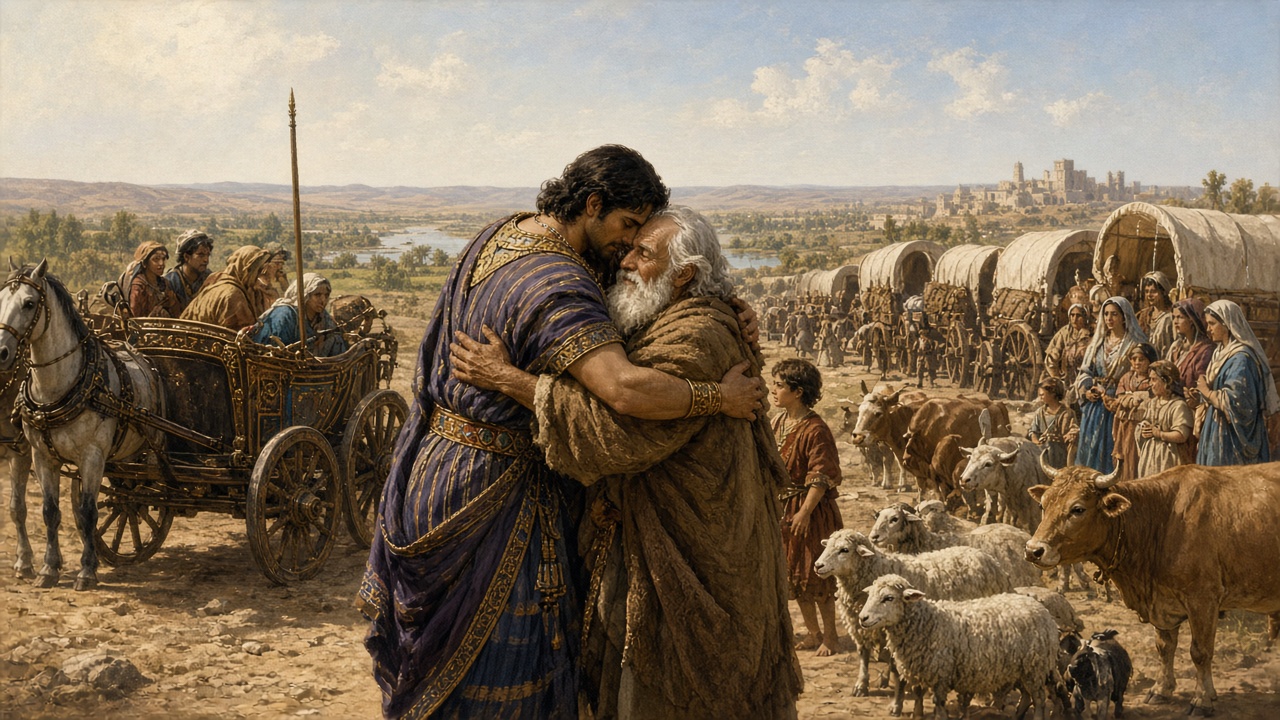
28Kabo Yakobo Yuda iyawasa-bagunayan ilobi Yosepa koina ineli Gosen kana kamwasa kaiwena. Saugana siyawatagili Gosen bwaimwa Itipita dedei kalona mena, 29Yosepa ana waga niuniuli iwalo sikatububun yo isae tamana igitai Gosen koina. Saugana Yosepa iyawatagili koina, tamana isapwali yo ivalam sauga imamalawe. 30Kabo Yakobo iwalolau Yosepa koina iwaloba, “Kabona kabo yatalamwagau tem yaboita, kaiwena iyaele yaboma mangu mena yagitaiwoko yakato kowa iyaelemo meyawasim.”
Did you know?
Israel Goes Down to Egypt
- As Israel set out for Egypt with all that he had, he stopped at Beersheba and offered sacrifices to the God of his father Isaac. Beersheba, meaning well of the oath or well of seven, was a well Abraham dug and named after a compact with Abimelech; when Isaac reopened it, he gave it the same name. It was a favorite dwelling of both patriarchs, and there that night God spoke to Jacob in a vision, telling him not to fear going down to Egypt, for he would make him a great nation there.Sources: the Bible text itself · Beersheba
- Jacob sent Judah ahead to Joseph for directions to Goshen, an Egyptian district east of the Nile, apparently near the royal residence, where the family remained until the Exodus. Easton's Bible Dictionary (1897) calls it the best of the land, now a desert, and also the land of Rameses. Joseph told his brothers to say they had raised livestock from youth, so they might settle there, because shepherds were detestable to the Egyptians; that dictionary suggests Pharaoh was probably Apopi, last of the Hyksos, who welcomed these Asiatic shepherds, while native Egyptians abhorred them, though some argue Joseph arrived later, under Thothmes III, after the Hyksos were expelled.Sources: the Bible text itself · Goshen · Pharaoh (of Joseph)
- The chapter counts sixty-six of Jacob's direct descendants who came to Egypt, not counting the wives of his sons, and seventy when Joseph's two sons already born in Egypt are included. Leah's sons and her daughter Dinah are named in that tally, although Easton's Bible Dictionary (1897) says Leah herself had died in Canaan before the journey and was buried in the cave of Machpelah; Rachel had died earlier giving birth to Benjamin and was buried on the way to Ephrath, that is, Bethlehem. Manasseh and Ephraim were born to Joseph in Egypt by Asenath, daughter of Potiphera, priest of On, a center of sun-worship that the Septuagint and Vulgate call Heliopolis.Sources: the Bible text itself · Leah · Rachel · On
Notes written with AI assistance from open sources (Theographic Bible Metadata, CC BY-SA 4.0; Easton’s Bible Dictionary, public domain) and reviewed before publishing.
Places in this chapter
- Egypt · 30.129, 31.308 · verses 1, 3, 4, 5, 6, 7, 8, 20, 26, 27
- Canaan · 32.767, 35.333 · verses 6, 12, 31
- Heliopolis · Today: Ain Shams · 30.129, 31.308 · verse 20
- Goshen · Today: Goshen 1 · 30.799, 31.834 · verses 28, 29, 34
Only places identified with high confidence are shown (90% or more according to the scholarly sources compiled by OpenBible). Period map: DARE (Digital Atlas of the Roman Empire), CC BY 4.0; modern map: © OpenStreetMap contributors; places: OpenBible.info (CC BY 4.0).
Credits and license for this translation
Buki Tabu Beyabeyana
Portions of the Old Testament in the Tubetube dialect of the Bwanabwana language of Papua New Guinea
Hap Olpela Testamen long tokples Tubetube long Niugini
copyright © 2019 Wycliffe Switzerland
Language: Tubetube (Bwanabwana) (Bwanabwana)
Dialect: Tubetube
This translation is made available to you under the terms of the
Creative Commons Attribution-Noncommercial-No Derivatives license 4.0.
You may share and redistribute this Bible translation or extracts from it in any format, provided that:
You include the above copyright and source information.
You do not sell this work for a profit.
You do not change any of the words or punctuation of the Scriptures.
Pictures included with Scriptures and other documents on this site are licensed just for use with those Scriptures and documents.
For other uses, please contact the respective copyright owners.
2022-08-18
Source: http://png.bible/tteo/ · eBible.org