Numbers 21
Godón Buk · Tap a verse to see its cross-references.
About this book
About Numbers
- Numbers is the fourth book of the Pentateuch. In Hebrew it is called be-midbar, “in the wilderness”; the Greek Septuagint called it Numbers, the name still usual, because it records a census in the wilderness of Sinai and a later census on the plain of Moab.Sources: Easton: Numbers, Book of
- Easton's Bible Dictionary (1897) presents Numbers, like the other books of the Pentateuch, as written by Moses. The history it contains runs from the second month of the second year after the Exodus to the beginning of the eleventh month of the fortieth year, about thirty-eight years and ten months.Sources: Easton: Numbers, Book of
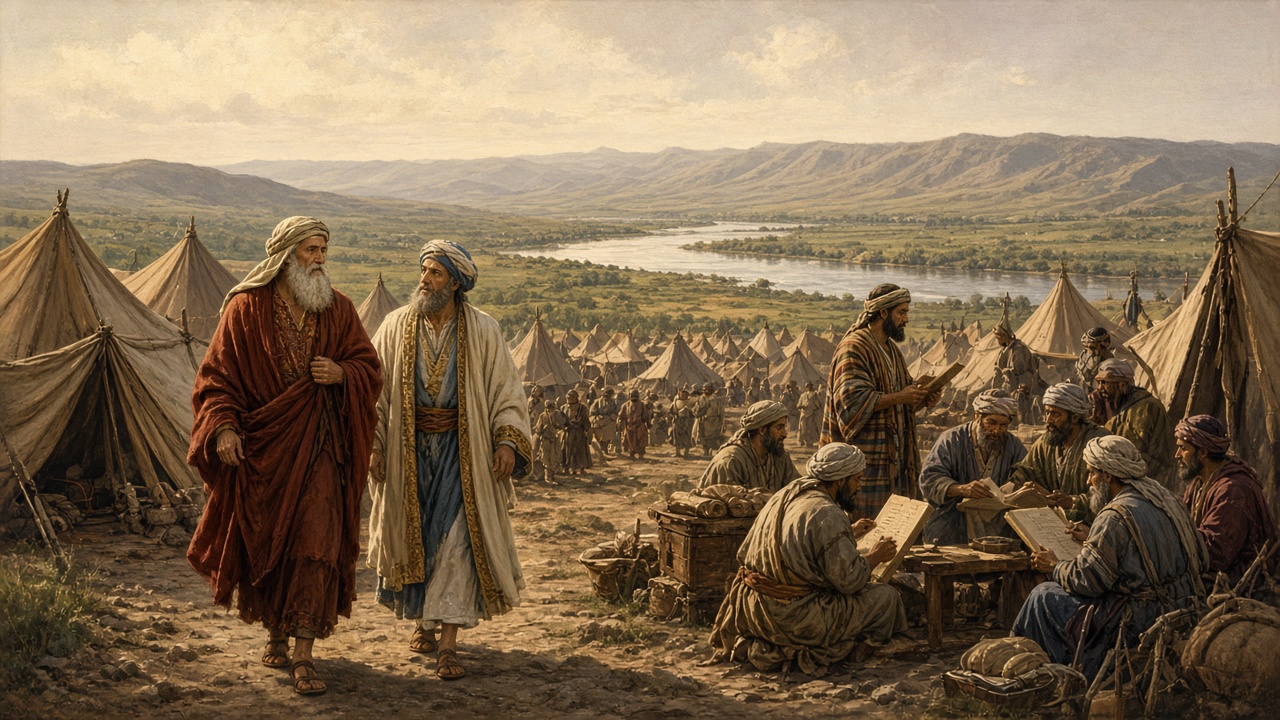
- The narrative begins at Sinai, the mountain district Israel reached in the third month after the Exodus and where they camped for about a year, and follows their route and encampments through the wilderness. It ends on the plains of Moab, east of the Jordan and the Dead Sea, opposite Jericho, their last camp before entering Canaan, the country west of the Jordan. Easton describes those years as a time of wandering in which that generation died in the wilderness, and notes that the people were fewer then than when they left Egypt.Sources: Easton: Numbers, Book of · Sinai · Moab · Canaan
- Easton divides the book into three parts: the census at Sinai and preparations to resume the march, including the Nazirite vow (1–10:10); the journey from Sinai to Moab, the sending of the spies and the report they brought back, and the people’s murmurings, eight times, at the hardships of the way (10:11–21:20); and the events on the plain of Moab before the crossing of the Jordan (21:21–36).Sources: Easton: Numbers, Book of
- While Israel was camped on the plains of Moab, Balak, son of Zippor and king of Moab, fearing them, sent to Pethor in Mesopotamia for Balaam, son of Beor, to curse them; the narrative says Balaam was unable to do so. Numbers 21:14 also cites “the book of the wars of the Lord,” a work that Easton says is uncertain, perhaps a lost writing of Israel or an Amorite record of the victories of their king Sihon.Sources: Easton: Numbers, Book of · Balaam · Balak
Notes written with AI assistance from open sources (Theographic Bible Metadata, CC BY-SA 4.0; Easton’s Bible Dictionary, public domain) and reviewed before publishing.
Brronze Tónggapórrón Gwar
4Isrrael pamkolpama Orr podo amgütóp, we ogoblórr Óe-óe Maludübóna, Idom kantrri kórzyónüm. Da módóga, pamkolpam genggorrama yazebórr kwat-kwat. 5Da i wirri taem we inóp. I dakla Godka bóktan aman koralórr, dakla Moseska wagó, “Ia e kibü Iziptgabi iade syusürri ini ⌊ngüin-koke bwóbdü⌋ nurrbarinüm? Aini alo kla babul akó nae ta babul, a kibü genggorrama kuri sazebe ini kolae alo kla alode!”
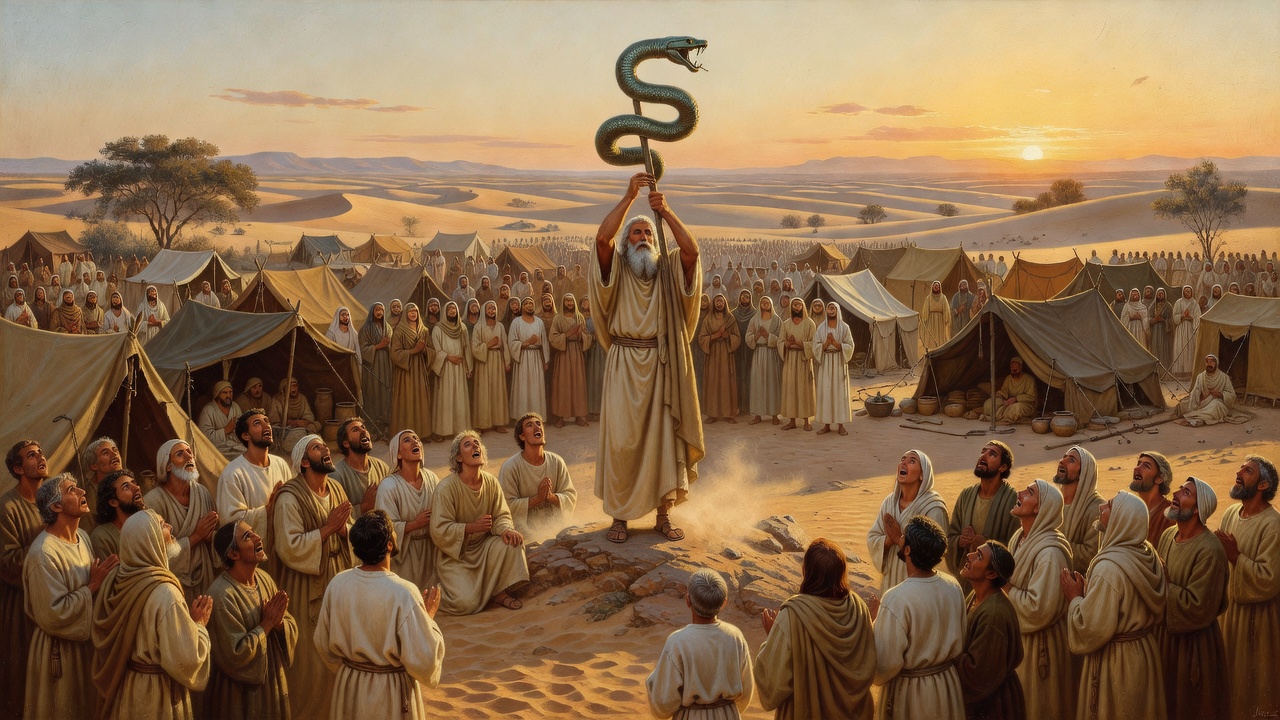
6Da ⌊ Lod⌋ büdül tarük balóng gwar ibüka we zirrtapónóp. I Isrrael pamkolpam nólóngnóp, da abüna igósidi nurrbarinónóp. 7Módóga, pamkolpama Moseska we togobórr da oyaka we bóktónóp wagó, “Ki kolae tonarr tónggapórre, ne bóktan amórre Lodka akó marüka. Gyaurka, ma kya tóre eko, kubó Lod ini gwar ia zirrnapórre kibükagab.” Da Moses ene pamkolpamabkü tóre we ekorr. 8Lod Moseska we bóktanórr wagó, “Balóng Gwar tónggapó brronze, da kokrrapan nugup pokodó errgóta, da nibiób nólóngórre, kubó ki ngakónónóm. I sab igósidi ngyaberre.” 9Da Moses brronze gwar we tónggapónórr, da we emngyelórr nugup pokodó. Gwara nibiób nólóngórre, da nóma yazilóp brronze tónggapórrón gwardó, i dólóng bainóp. Moses nugup poko amoanda brronze tónggapórrón gwarpükü.|alt="Moses holding bronze snake on pole" src="lll2-20.tif" size="span" ref="21:9"
Did you know?
The Bronze Serpent and the March Beyond the Arnon
- When the Israelites grew impatient during their journey around Edom and complained about the lack of food and water, venomous snakes appeared in the camp. Moses was instructed to craft a bronze serpent and mount it on a pole so that anyone bitten could look at it and live.Sources: the Bible text itself
- This chapter cites an otherwise unknown ancient Hebrew text called the Book of the Wars of the LORD to delineate the boundary along the Arnon river, which separated the Moabites from the Amorites.Sources: the Bible text itself · Arnon
- The passage includes an ancient poem mentioning Chemosh, the deity worshipped by the Moabites. The poem recounts how Sihon king of the Amorites had previously conquered Moabite lands from Heshbon down to the Arnon before Israel defeated him in battle.Sources: the Bible text itself · Chemosh · Sihon · Heshbon
Notes written with AI assistance from open sources (Theographic Bible Metadata, CC BY-SA 4.0; Easton’s Bible Dictionary, public domain) and reviewed before publishing.
Places in this chapter
- Negeb · 31.245, 34.841 · verse 1
- Edom · 30.746, 35.604 · verse 4
- Way of the Red Sea · Today: road between the Dead Sea and the Gulf of Aqaba · 29.727, 34.998 · verse 4
- Egypt · 30.129, 31.308 · verse 5
- Moab · Today: Moab 1 · 31.181, 35.701 · verses 11, 13, 15, 20, 26, 28, 29
- Valley of Zered · Today: Wadi al Hasa · 31.027, 35.485 · verse 12
- Arnon · Today: Wadi Mujib · 31.466, 35.573 · verses 13, 14, 24, 26, 28
- Waheb · Today: within 50 km of Sufeh · 31.666, 35.817 · verse 14
- Jeshimon · 31.470, 35.223 · verse 20
- King’s Highway · 31.955, 35.934 · verse 22
- Ammon · 31.955, 35.934 · verse 24
- Jabbok · Today: Zarqa River · 32.115, 35.543 · verse 24
- Dibon · Today: Tall Dhiban · 31.502, 35.777 · verse 30
- Medeba · Today: Madaba · 31.716, 35.795 · verse 30
- Bashan · 32.781, 35.935 · verse 33
Only places identified with high confidence are shown (90% or more according to the scholarly sources compiled by OpenBible). Period map: DARE (Digital Atlas of the Roman Empire), CC BY 4.0; modern map: © OpenStreetMap contributors; places: OpenBible.info (CC BY 4.0).
Credits and license for this translation
Godón Buk
Portions of the Holy Bible in the Gizrra language of Western Province, Papua New Guinea
Buk Baibel long tokples Gizrra long Niugini
copyright © 2019 Wycliffe Bible Translators, Inc.
Language: Gizrra
Translation by: Wycliffe Bible Translators, Inc.
This translation is made available to you under the terms of the
Creative Commons Attribution-Noncommercial-No Derivatives license 4.0.
You may share and redistribute this Bible translation or extracts from it in any format, provided that:
You include the above copyright and source information.
You do not sell this work for a profit.
You do not change any of the words or punctuation of the Scriptures.
Pictures included with Scriptures and other documents on this site are licensed just for use with those Scriptures and documents.
For other uses, please contact the respective copyright owners.
2024-07-01
Source: http://png.bible/tof/ · eBible.org