Deuteronomy 4
Godón Buk · Tap a verse to see its cross-references.

About this book
About Deuteronomy
- Easton's Bible Dictionary (1897) explains that the Greek name Deuteronomion, the second law, gave us Deuteronomy: a second statement of laws already promulgated. It says the division of the Pentateuch into five books was probably first made by the Greek translators, whom the Vulgate follows. Jews name the book from its opening Hebrew words, 'Elle haddabharim, These are the words.Sources: Easton: Deuteronomy
- Easton's Bible Dictionary (1897) presents Deuteronomy as chiefly three discourses delivered by Moses a short time before his death, spoken to all Israel in the eleventh month of the last year of their wanderings in the wilderness. It says the story of his death and burial was written by some other hand, probably that of Joshua, who succeeded him as leader of Israel.Sources: Easton: Deuteronomy · Joshua
- The discourses of Deuteronomy are set in the plains of Moab, east of the Jordan and opposite Jericho, Israel's last encampment before entering Canaan, a region then held by the Amorites. East of the Jordan the Israelites had defeated Sihon, king of the Amorites, whose country ran from the Arnon to the Jabbok, and Og, king of Bashan, whose kingdom was given to Reuben, Gad, and half the tribe of Manasseh.Sources: Easton: Deuteronomy · Moab · Sihon · Og
- Easton's Bible Dictionary (1897) describes three discourses: the first (1-4:40) recapitulates forty years in the wilderness, exhorts obedience to the divine ordinances, and warns against forsaking the God of their fathers; the second (5-26:19), the body of the book, restates the law given at Mount Sinai and instructs Israel for life in Canaan; the third (chapters 27-30) sets out blessings for the obedient and the curse on the rebellious, urging faithfulness to the covenant.Sources: Easton: Deuteronomy
- Easton's Bible Dictionary (1897) adds three appendices after the addresses: a song which God had commanded Moses to write (32:1-47), blessings pronounced on the separate tribes (chapter 33), and the story of his death (32:48-52) and burial (chapter 34). In Hebrew manuscripts the Pentateuch forms one scroll; Jews divided this book into eleven parshioth, and the English Bible contains thirty-four chapters.Sources: Easton: Deuteronomy
Notes written with AI assistance from open sources (Theographic Bible Metadata, CC BY-SA 4.0; Easton’s Bible Dictionary, public domain) and reviewed before publishing.
Moses Isrrael Pamkolpam Arüng Bóktan Nókyenóp Godón Bóktan Arrkrrum
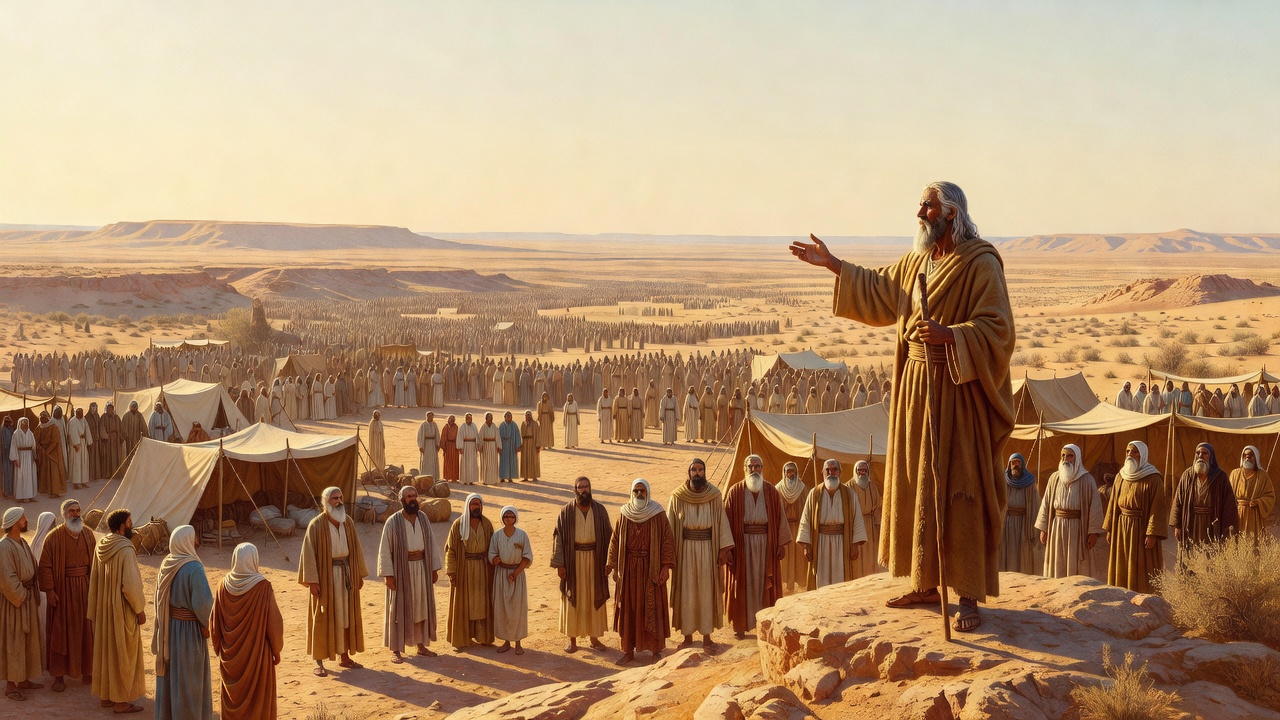
1Moses Isrrael pamkolpamdó bóktanórr wagó, “Isrrael pamkolpam! Errkya ini wirri bóktan akó gida tübarrkrru, ka yabü ne kla umul baindóla. Da kürü bóktan mumyamónlamke yabiób ngyabenóm akó barrbünüm ene Keinan tüp apadóm, ⌊ Lod⌋, yabü abalbobatalab God, ne tüp akyanóm kainda. 2Darrü poko amngyelgu ka yabü amorranóm ne bóktan alióndóla, akó olgab aman-gu. A Lod, yabü God, oya gida bóktan poko mumyamónlamke, ka yabü ne arüng bóktan alióndóla.
6“Godón gida bóktan poko gangga irrbünam akó mumyamónlamke! Zitülkus módóga, e sab Godón bóktan nóma mamoan kwarilo, bwób-bwób pamkolpama sab yabü ⌊wirri gyagüpitótók⌋ eserre akó e küp iazan bómzyatódakla. I ne sab Godón ini bóktanbóka nóma barrkrrue, sab igó bóktórre wagó, ‘Amkoman, ini wirri bwób pamkolpam wirri gyagüpitótók isako akó i ⌊küp bómzyatódako⌋!’
7“Darrü bwób babula, wa ia wirria, darrü godpükü mibü Godzane, mibü minggüpanan nótóke. Wa bóktan alkomólda, mi oyaka tangbamtinüm nóma górrgandakla. 8Darrü bwób babula, wa ia wirria, inzan morroal dümdüm wirri bóktan akó gidapükü, ka yabü ne kla alióndóla ini ngürr.”
Lod God
39Moses akó bóktanórr wagó, “Ini bóktan yazebam, da moboküpdü irrbünam wagó, Lod blaman klamab Gode, kwitüm akó ini tüpdü. Darrü God myamem babula. 40We ngarkwatódó, oya wirri bóktan akó gida karrkukus emorronam, ka yabü ne arüng bóktan alióndóla errkya. Ene igósüm yabüka akó yabü olmalbobataldó sab morroal asi yarile akó e sab kokrrap iade ngyabenane ini tüpdü, Lod yabü God, ne kla akyanda metat ngyabenóm.”
Did you know?
A Call to Obedience and the Cities of Refuge
- Moses reminded Israel that at Mount Horeb they heard God's voice from the fire but saw no visible form. This absence of a physical appearance served as the primary foundation for the strict prohibition against making any carved image or idol of God.Sources: the Bible text itself · Horeb
- The text cites the incident at Baal-peor, where Israelites who followed the Moabite deity were destroyed. Moses pointed out that those who remained faithful survived, using this recent event as a clear warning against idolatry.Sources: the Bible text itself · Baal · Baal-peor
- After defeating the Amorite kings Sihon and Og, Moses designated three cities of refuge east of the Jordan: Bezer, Ramoth, and Golan. These locations provided asylum for individuals who caused an unintentional, non-malicious death.Sources: the Bible text itself · Sihon · Og · Golan
Notes written with AI assistance from open sources (Theographic Bible Metadata, CC BY-SA 4.0; Easton’s Bible Dictionary, public domain) and reviewed before publishing.
Places in this chapter
- Peor · Today: within 1 km of Khirbet Ayun Musa · 31.777, 35.738 · verse 3
- Mount Horeb · Today: Jebel Musa · 28.540, 33.973 · verses 10, 15
- Jordan · Today: Jordan River · 31.761, 35.558 · verses 14, 21, 22, 26, 41, 46, 47, 49
- Egypt · 30.129, 31.308 · verses 20, 34, 37, 45, 46
- Bashan · 32.781, 35.935 · verses 43, 47
- Gilead · Today: Gilead 1 · 32.187, 35.692 · verse 43
- Ramoth · Today: Tall er Rumeith · 32.500, 36.015 · verse 43
- Mount Hermon · 33.400, 35.850 · verse 48
- Valley of the Arnon · Today: Wadi Mujib · 31.466, 35.573 · verse 48
- Arabah · 30.417, 35.151 · verse 49
- Salt Sea · Today: Dead Sea · 31.500, 35.500 · verse 49
Only places identified with high confidence are shown (90% or more according to the scholarly sources compiled by OpenBible). Period map: DARE (Digital Atlas of the Roman Empire), CC BY 4.0; modern map: © OpenStreetMap contributors; places: OpenBible.info (CC BY 4.0).
Credits and license for this translation
Godón Buk
Portions of the Holy Bible in the Gizrra language of Western Province, Papua New Guinea
Buk Baibel long tokples Gizrra long Niugini
copyright © 2019 Wycliffe Bible Translators, Inc.
Language: Gizrra
Translation by: Wycliffe Bible Translators, Inc.
This translation is made available to you under the terms of the
Creative Commons Attribution-Noncommercial-No Derivatives license 4.0.
You may share and redistribute this Bible translation or extracts from it in any format, provided that:
You include the above copyright and source information.
You do not sell this work for a profit.
You do not change any of the words or punctuation of the Scriptures.
Pictures included with Scriptures and other documents on this site are licensed just for use with those Scriptures and documents.
For other uses, please contact the respective copyright owners.
2024-07-01
Source: http://png.bible/tof/ · eBible.org