Genesis 29
Godón Buk · Tap a verse to see its cross-references.
Zeikob Leibanón Müót Basirrdü Abzilürr
1Zeikob tótókóm akó we bupadórr. Abüsa nólgabi banikda, wa ama ene pamkolpamab tüpdü wamlórr. 2Da módóga, kwat-kwat wa nae badu sesenórr pórrpótyapdó. Ene pokodó aüd ⌊sip⌋ kopo koralórr, ngón bagólórr badu kabedó. Ene sipab nae anón badu yarilürr. Da nae badu kugupi ait poko wirri ingülküpi murrausürrün yarilürr. 3Blaman sip ngabkan kolpama tibiób sippükü nóma kwób tóbazenórre, sip ngabkan kolpama badu murraus ingülküp kubó ugón yanerre ene kugupidügab. I tibiób sip nae ugón nómyerre. Ene sipab nae anóna nóma blakóne, ene ingülküp kubó akó salkomórre tóba pabodó murrausüm.
4Zeikob ene sip ngabkan pam nümtinóp wagó, “Kürü gómdamal, e ia nubógabakla?”
I darrem bóktan yalkomólóp wagó, “Ki Arran wirri basirrdügabakla.”
5Zeikob akó ibü nümtinóp wagó, “E ia Leibanónbóka umulakla, Na-orrón bobat?”
I bóktan yalkomólóp wagó, “Ó, ki umulakla oyabóka.”
6Zeikob bamtin bóktan poko akó nümtinóp wagó, “Ia wa taiase?”
I bóktan yalkomólóp wagó, “Ó, wa taiase. Ngaka, oya óp olom Rreizel wóni tóba sippükü tótókdo.”
7Zeikob bóktanórr wagó, “Ngakónam, ini abüs singülküpa. Ini we abüs küp kokea sip darrpan pokodó amarrum. E sip nae nómyenam, da kubó akó yakonamke twal alom.”
8I bóktan yalkomólóp wagó, “Ki gaodó kokeakla, kókó kubó blaman sipa kwób tóbazene. Da darrpan mün ki kubó ingülküp igósidi yanerre nae badu kugupi ait pokodógab. Da ki kubó sip nae ugón nómyerre.”
9Zeikob wa ene pampüküzan ikik yarilürr, Rreizel ugón tübzilürr tóba aban sippükü, zitülkus wa sip ngabkan kol warilürr. 10Rreizel Leibanón olom warilürr akó Leiban Zeikobón aipan naret yarilürr. Zeikob Rreizelón nóma osenórr, Leibanón sippükü, wa wamórr badudü, ingülküp yanenórr, badu murrausürrün kla, da tóba nungzamón aban sip nae we nómyenóp. 11Zeikob Rreizelón uprükürr, da wirribóka we yón sabinürr. 12Wa Rreizelón uzazilürr wagó, “Ka Rrebekan olomla; marü aban nungzamón.” Da Rreizel busorr ab azazilüm.
13Leiban ene bóktan nóma arrkrrurr wagó, kürü bólbótan oloma kuri tame, wa büsai wamórr oya asenóm. Oya amiógürr, iprükürr, da oya ipadórr, idódürr tóba müótüdü. Zeikob adrratórr oyaka blaman ne klama tómbapónónóp. 14Leiban Zeikobka bóktanórr wagó, “Amkoman, ma kürü kólbanan okómópdógabla akó kólbanan óedógabla.” Zeikob Leibanka darrpan melpalóm ngyabenórr.
Zeikob Ibü Nümiógürr, Lia akó Rreizel
15Ene melpal kakóm, Leiban Zeikobka we bóktanórr wagó, “Ma wa kürü minggüpanan nungzamónla, da ma sab kürü popa zaget koke tómbapolo. Ma kürü kyal, marü darrem sab laró kwarile.”
16Leibanón nis ngul olom nis namülnürri. Ngaen kol ngi Lia, akó solo kupo ngi Rreizel. 17Lian ilküp agür ngarkwatódó koke namülnürri, a Rreizel ma amkoman morroalan agurr kol dólóng warilürr. 18Zeikobón amkoman ⌊moboküpdü ubia⌋ wamórr Rreizelka, da wa bóktanórr Leibanka wagó, “Ka sab 7 pailüm zaget namulo marünkü, marü solo kupo óp olom Rreizelón amiógüm.”
19Leiban bóktanórr wagó, “Morroal igósa, ka oya sab marü mókyeno, a darrü pam koke. Ae namülün kankü.” 20Da Zeikob zaget yarilürr 7 pailüm Rreizelón amiógüm. Ene tonarra igó bainürr, wamaka aüd ngürr koralórr oyaka, zitülkus oya amkoman moboküpdü ubi yarilürr Rreizelka.
217 Pail kakóm Zeikob bóktanórr Leibanka wagó, “Ma kürü kol ugó kókya. Kürü zaget ngarkwata kuri blakóne. Ki kubó usadi umtuli.”
22Leiban blaman ene basirr kolpam ngibaunürr, da kol amióg tóre we tónggapónórr. 23Ene irrüb Leiban tóba ngul olom Lian ugón tudódürr Zeikobón amiógüm. Da i ma usadi we umturri. 24(Leiban tóba ⌊leba zaget⌋ ngulmokur ngi Zilpa Lian okyanórr oya leba zaget kolóm bainüm.)
25Da módóga, darrü irrbi Zeikob Lian osenórr. Zeikob wamórr kókó Leibanka da bóktanórr wagó, “Ma kürüka ini ia poko tónggapóna? Ka wa tai Rreizelónkü zaget namülnürrü, ta ia koke? Ma kürü iade ilklió külina?”
26Leiban bóktan yalkomólórr wagó, “Kibü gida ala inzan babula, solo kupo ngaen-gógópan akyanóm müór. Wata kubó müór ngaen-gógópan nareta ipüde. 27Ngaen-gógópan ma darrpan udai kol apad tóre elakono, ene udai kakóm ki sab marü solo kupo óp olom igósidi mókyerre, ma ne akó 7 pailüm zaget nóma namulo kürünkü.”
28Zeikob abinürr, da ene barnginwóm elakónórr ene udai kugupidü Liadi, da Leiban oya tóba óp olom Rreizelón kolóm we ekyanórr. 29(Leiban tóba leba zaget ngulmokur, ngi Bila, Rreizelón okyanórr oya leba zaget kolóm bainüm.) 30Zeikob Rreizelón upadórr, usadi umturri, da oya amkoman moboküpdü wirrian ubi yarilürr Rreizelka; Liaka ma taiwan ubi koke. Da wa akó ngibürr 7 pail amanórr Leibanónkü zagetóm.
Zeikobón Olmal
31Da ⌊ Lod⌋ nóma esenórr Zeikobón moboküpdü ubi koke yarilürr Liaka, wa oya kwat tapasukurr olmal basenóm. A Rreizel wa olmal balngón-koke kol warilürr. 32Lia bikóm esenórr, mórranórr olom siman. Wa ngi ngyesilürr Rruben. Wa igó bóktanórr wagó, “ Lod amkoman esenórr kürü müp, kürü müóran moboküpdü ubi kubó kürüka igósidi yarile.”
33Lia akó bikóm esenórr, darrü siman olom ilngumilürr. Igó bóktanórr wagó, “Zitülkus Lod igó arrkrrurr, kürü müóran moboküpdü ubi babula kürüka, da wa akó kürü ini igósidi kókyene.” Da wa igósidi ngi ngyesilürr Simion.
34Wa akó bikóm esenórr, da nóma mórranórr, wa bóktanórr wagó, “Ini aüd ngim siman olom ilngumila kólba müórankü. Ini tonarr wa sab kürü minggüpanan arróbórrón yarile.” Da wa olommokur igósidi ngi ngyesilürr Libae.
35Lia bikóm akó esenórr. Nóma mórranórr, siman olom ilngumilürr. Wa bóktanórr wagó, “Ini tonarr ka Lodón yagurlo.” Wa oya igósidi ngi ngyesilürr Zuda. Ene kakóm, oya olmal basena ugón piküp bainürr.
Did you know?
Jacob’s Marriages in Haran
- Jacob fled to Haran, where his uncle Laban lived, in the land of the people of the east. The city, also called the city of Nahor and identified with Harran, stood on the Belik, a tributary of the Euphrates, about seventy miles above the Belik’s junction with that river, in Upper Mesopotamia. Laban was the son of Bethuel and the grandson of Nahor, Abraham’s brother; Laban’s sister Rebekah was Isaac’s wife.Sources: Haran · Laban · Nahor (brother of Abraham) · the Bible text itself
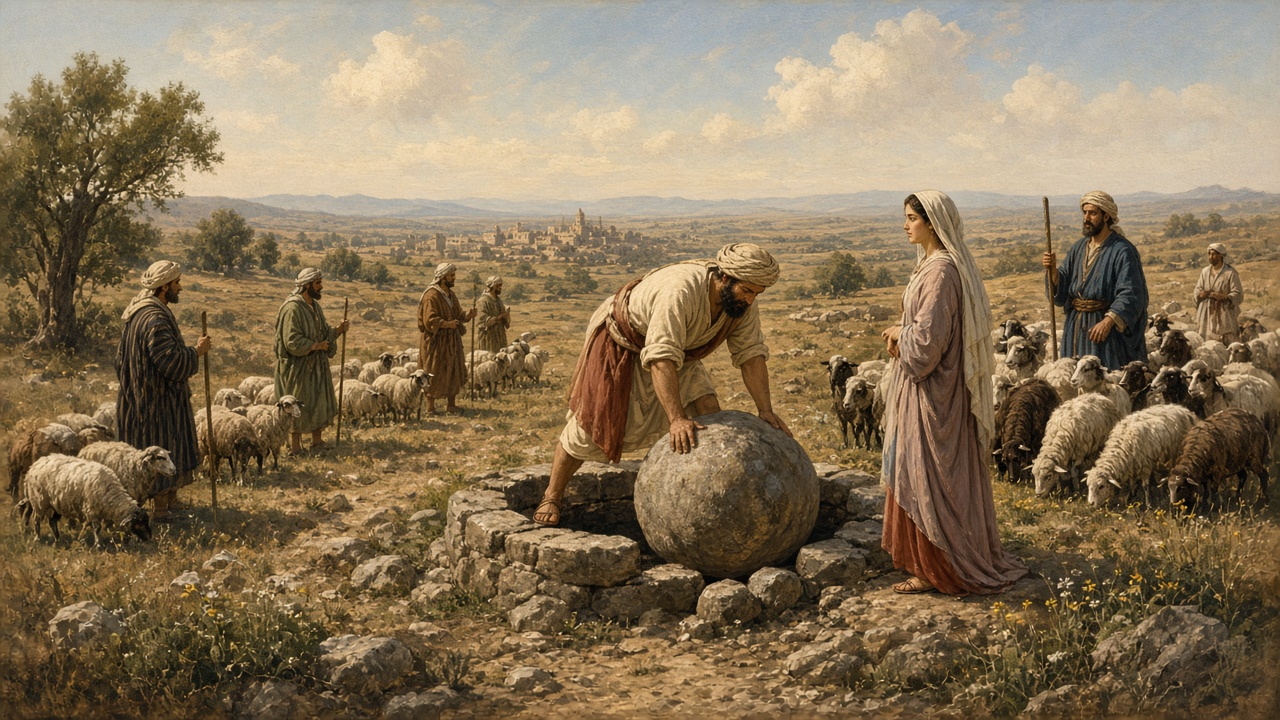
- The well was closed by a large stone that the shepherds rolled away only after all the flocks had gathered, then put back in place. Rachel, whose name is given as “ewe,” was a shepherdess bringing her father’s sheep, and Jacob, who had himself lived as a shepherd, moved the stone and watered his uncle’s flock.Sources: Rachel · Jacob (Israel) · the Bible text itself
- Leah, the elder sister, is called “weary,” and she is described as weak-eyed, or tender-eyed; Rachel, the younger, was shapely and beautiful. Jacob served seven years for Rachel, but at the evening feast Laban gave him Leah, saying it was not the custom there to give the younger daughter in marriage before the older, and then gave him Rachel for another seven years—fourteen in all. Leah’s first sons were Reuben, whose name is given as “Behold a son,” and then Simeon, Levi, and Judah; in naming them she spoke of the LORD seeing her affliction, hearing that she was unloved, her husband becoming attached to her, and her praise of the LORD.Sources: Leah · Rachel · Reuben · the Bible text itself
Notes written with AI assistance from open sources (Theographic Bible Metadata, CC BY-SA 4.0; Easton’s Bible Dictionary, public domain) and reviewed before publishing.
Places in this chapter
- East · Today: region around Amman · 31.955, 35.934 · verse 1
- Haran · Today: Harran · 36.864, 39.033 · verse 4
Only places identified with high confidence are shown (90% or more according to the scholarly sources compiled by OpenBible). Period map: DARE (Digital Atlas of the Roman Empire), CC BY 4.0; modern map: © OpenStreetMap contributors; places: OpenBible.info (CC BY 4.0).
Credits and license for this translation
Godón Buk
Portions of the Holy Bible in the Gizrra language of Western Province, Papua New Guinea
Buk Baibel long tokples Gizrra long Niugini
copyright © 2019 Wycliffe Bible Translators, Inc.
Language: Gizrra
Translation by: Wycliffe Bible Translators, Inc.
This translation is made available to you under the terms of the
Creative Commons Attribution-Noncommercial-No Derivatives license 4.0.
You may share and redistribute this Bible translation or extracts from it in any format, provided that:
You include the above copyright and source information.
You do not sell this work for a profit.
You do not change any of the words or punctuation of the Scriptures.
Pictures included with Scriptures and other documents on this site are licensed just for use with those Scriptures and documents.
For other uses, please contact the respective copyright owners.
2024-07-01
Source: http://png.bible/tof/ · eBible.org