Genesis 28
Godón Buk · Tap a verse to see its cross-references.
1Aesak Zeikobón ngyaunürr, da bles yónürr. Oya arüng bóktan ekyanórr wagó, “Sab Keinan kol apadgu. 2Bupa errkyadan, da ugó wam Padan Arram bwóbdü, moba aipan aban müótüdü, ngi Betuel. Mobankü kol olgabi upadke, Leibanón ópal olmaldógab, marü nuguzamón ab nótókse. 3Wirrian Arüng God marü sab ki bles myó akó marü küppükü ki myó, igósüm ma sab abün bwóbab pamkolpamab abbobat namulo! 4Wa sab marü ki bles kyó akó marü olmalbobatal, wa Eibrra-amónzan bles syónürr. Ene igósüm, ini tüp sab marü yarile, ma errkya ne ngyabendóla mogob pamzan, God Eibrra-amón ne tüp sekyanórr!” 5Aesak Zeikobón we zirrapónórr Padan Arram, Leibanka, Betuelón siman olom. Wa Arram bwób pam yarilürr, Rrebekan naret, Zeikob a Isao, ibü aip.
Isao Akó Darrü Keinan Kol Upadórr
6Isao umul bainürr wagó, Aesak Zeikobón kuri bles yónürr akó oya we zirrapónórr Padan Arram, olgabi kol apadóm. Wa ta umul bainürr wagó, Aesak Zeikobón nóma bles yónürr, wa oya arüng bóktan ekyanórr wagó, “Ma sab Keinan kol apadgu.” 7Wa akó umul bainürr wagó, Zeikob tóba aipab nisab bóktan kuri arrkrrurr, da wa we bupadórr Padan Arram. 8Isao ugón umul bainürr wagó, oya ab Aesak ubi-koke yarilürr Keinan kolóm. 9Da wa we wamórr Isma-elka, Eibrra-amón siman olom, akó oya óp olom we upadórr, ngi Ma-alat, Nebayotón bólbót nótó warilürr. Isao ngaen-gógópan ngibürr ne kol yazebórr, wa ma oya ibüka daniyónürr.
Zeikobón Nus Betelóm
10Zeikob Berrsyiba nóma amgatórr, ama Arran wamlórr. 11Wa darrü bwób poko nóma semrranórr, da wa we amilürr utüm, zitülkus abüsa bótao bwóbdü wamlórr. Wa darrpan ingülküp ola kla ipadórr, singül müózüm ingrinürr, da utüm we wamórr. 12Wa igó nus umtulürr wagó, bata tüpdü alanirrün yarilürr, solo ama kwit amrrarrón yarilürr. Ene batana, Godón anerrua kwit bangülürr akó tüp tübabilürr. Zeikobón nus: anerrua kwit bangürdako akó tüp babindako batana.|alt="Jabob's dream: ladder with angels" src="lll2-02.tif" size="span" loc="28:12-15" copy="Horace Knowles" ref="28:12" 13Da módóga, ⌊ Lod⌋ bata kwitüm zamngólólórr, da wa we bóktanórr wagó, “Ka Lodla, ka marü abbobat Eibrra-amón God akó marü ab Aesakón God. Ka sab marü ini tüp mókyeno, mató akó marü olmalbobatal, ma errkya ne utürrünla. 14Marü olmalbobatal sab igó korale, wamaka atang-koke buru ini tüpdüzan. I sab blaman bwób ayonórre, akó arratnórre blaman órdóma: bolmüót, solomamtae, dorrmet, akó malubarr. Ini tüpdü blaman pamkolpam sab bles bairrün korale marükama akó marü olmalbobataldóma. 15Da módóga, ka sab asi namulo mankü, akó ka marü módlanglo blaman bwóbdüma, ma nega wamlo. Ka akó sab marü kalkomolo ini tüpdü. Ka marü koke molkomolo, kókó ka sab blaman kla tómbapono, ka marü ne ⌊alkamül-koke bóktan⌋ mókyarró.”
16Zeikob nóma saogórr utürrün klama, wa bóktanórr wagó, “Amkoman, Lod asine ini bwóbdü, da ka umul-kók namüla wagó, Lod asine aini.” 17Wa gum yarilürr, da bóktanórr wagó, “Ini wata gyabi akó gum angón bwóba! Ini darrü kla kokea: ini amkoman Godón müóte; ini amkoman kwitüdü bamsel mamtaea!”
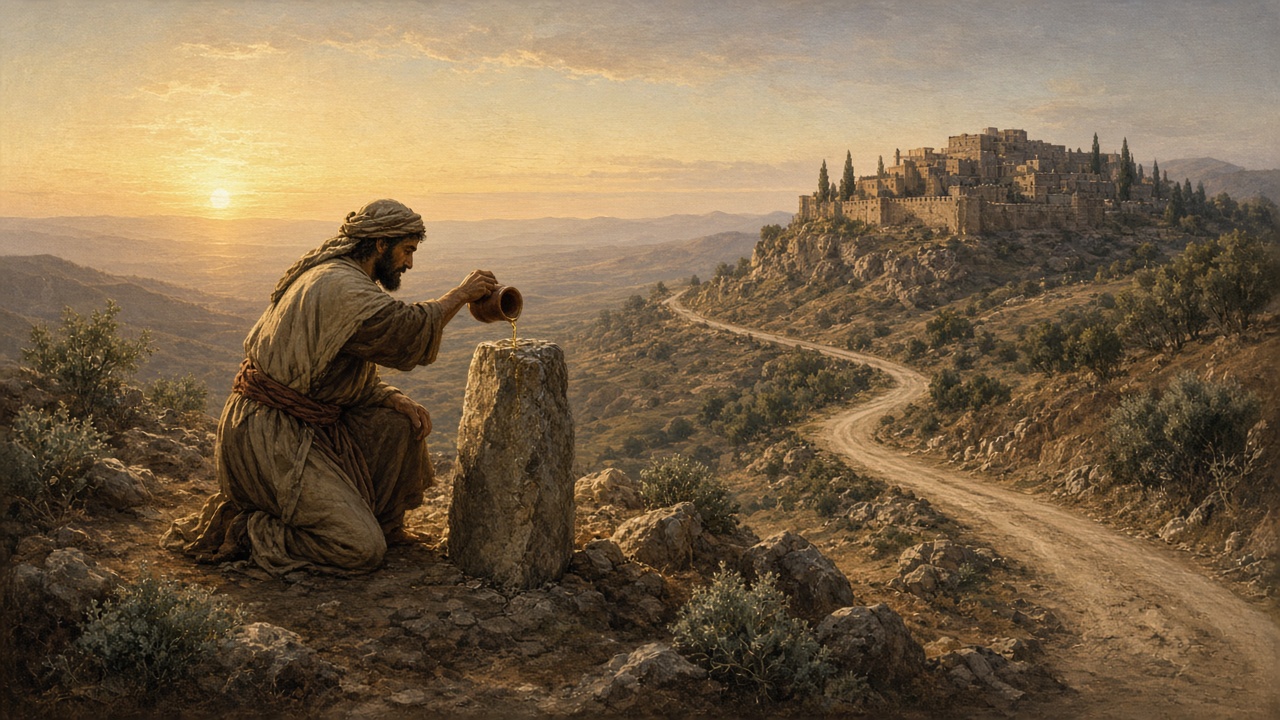
18Irrbianande darrü ngürr nóma türsümülürr, tóba müózüm ne ingülküp ingrinürr, da ipadórr, ama alaninürr oya ene poko gyagüpi amaiküm. Da ⌊olib⌋ oel we ekanórr ene ingülküp kwitüdü. 19Wa ene bwób ngi we ngyesilürr Betel. (Da ngaen ene wirri basirr igó ngilianónóp, Luz.) 20Da Zeikob ⌊arüng alkamül-koke bóktan⌋ tónggapónórr Lodka. Wa igó yarilürr wagó, “God ne kürüka asi nóma yarile, akó wa ne kürü nóma kódlangle ini bwób mamoande, akó wa ne kürü alo kla akó mórrkenyórr bamelóm nóma klióle, 21akó ka ne sab morroal nóma alkomolo kólba aban basirrdü, da Lod ama sab igósidi kürü God yarile. 22Ini ingülküp, ka ne kla alanindóla marü gyagüpdü ódódóm, sab Godón ⌊ótók⌋ müót yarile. Blaman elklazadógab, ma sab kürü ne kla kliólo, ka sab marü ⌊wantent⌋ mókyalo.”
Did you know?
Jacob's Journey and Dream at Bethel
- Isaac sent Jacob from Beersheba to Paddan-aram to take a wife from the daughters of Laban, his mother Rebekah's brother, rather than from the Canaanite women. Paddan-aram, called the plain of Aram, is commonly regarded as the Mesopotamian district around Haran, where Laban lived; Haran, also called the city of Nahor, was where Abraham stayed after leaving Ur until his father Terah died.Sources: the Bible text itself · Paddan-aram · Haran · Laban
- The place where Jacob dreamed, set up as a pillar the stone he had put under his head, and poured oil on it was the royal Canaanite city of Luz; he renamed it Bethel. Easton's Bible Dictionary (1897) locates Bethel in central Palestine, about ten miles north of Jerusalem, and notes that the name was at first apparently given to a sanctuary in the neighborhood of Luz, and was not given to the city itself until after the tribe of Ephraim conquered it.Sources: the Bible text itself · Luz · Bethel (of Palestine)
- When Esau learned that Isaac had blessed Jacob and ordered him not to marry a Canaanite woman, he went to Ishmael and married Mahalath, sister of Nebaioth and daughter of Abraham's son Ishmael, in addition to the wives he already had. Easton's Bible Dictionary (1897) also calls her Bashemath and notes that Esau's three wives receive different names in the Edomite genealogy of Genesis 36 from those given in the narrative of Genesis 26 and 28.Sources: the Bible text itself · Bashemath
Notes written with AI assistance from open sources (Theographic Bible Metadata, CC BY-SA 4.0; Easton’s Bible Dictionary, public domain) and reviewed before publishing.
Places in this chapter
- Canaan · 32.767, 35.333 · verses 1, 6, 8
- Haran · Today: Harran · 36.864, 39.033 · verse 10
- Luz · Today: Beitin · 31.923, 35.241 · verse 19
Only places identified with high confidence are shown (90% or more according to the scholarly sources compiled by OpenBible). Period map: DARE (Digital Atlas of the Roman Empire), CC BY 4.0; modern map: © OpenStreetMap contributors; places: OpenBible.info (CC BY 4.0).
Credits and license for this translation
Godón Buk
Portions of the Holy Bible in the Gizrra language of Western Province, Papua New Guinea
Buk Baibel long tokples Gizrra long Niugini
copyright © 2019 Wycliffe Bible Translators, Inc.
Language: Gizrra
Translation by: Wycliffe Bible Translators, Inc.
This translation is made available to you under the terms of the
Creative Commons Attribution-Noncommercial-No Derivatives license 4.0.
You may share and redistribute this Bible translation or extracts from it in any format, provided that:
You include the above copyright and source information.
You do not sell this work for a profit.
You do not change any of the words or punctuation of the Scriptures.
Pictures included with Scriptures and other documents on this site are licensed just for use with those Scriptures and documents.
For other uses, please contact the respective copyright owners.
2024-07-01
Source: http://png.bible/tof/ · eBible.org