2 Chronicles 36
Godón Buk · Tap a verse to see its cross-references.

About this book
About 2 Chronicles
- Easton's Bible Dictionary (1897) reports that Jewish tradition, which he says was universally received until the middle of the seventeenth century, regarded Ezra as the author of Chronicles, an opinion he finds supported by many points of resemblance and contact with the Book of Ezra. He dates the composition after the Babylonian exile, probably between 450 and 435 B.C., noting that the language is, in its general character, Aramaean, like other books written after the exile, and that the writer gives details of Zerubbabel's family.Sources: Easton: Chronicles, Books of
- The two books of Chronicles were originally one. In the Masoretic Hebrew the title is Dibre hayyamim, “Acts of the Days,” which Jerome rendered Chronicon, hence Chronicles; the Septuagint divides the work and calls it Paraleipomena, “things omitted” or “supplements,” because it contains many things omitted in the Books of Kings. Easton groups the contents in four parts: genealogies in the line of Israel down to David, the reign of David, Solomon’s reign in the first nine chapters of the second book, and the history of the separate kingdom of Judah until the return from the Babylonian exile.Sources: Easton: Chronicles, Books of
- Easton presents these books as didactic rather than primarily historical: the writer’s principal aim appears to be moral and religious truth, and he gives less prominence to political events than Samuel and Kings do, and more to ecclesiastical institutions. He adds that the genealogies were an important part of the Hebrew state’s public records, the basis both for distributing and holding land and for arranging and conducting temple service, to which the Levites and their descendants alone were entitled.Sources: Easton: Chronicles, Books of
- The first nine chapters of 2 Chronicles recount the reign of Solomon, David’s son by Bathsheba, whom his father chose as successor. The remaining chapters follow the separate kingdom of Judah until the return from the Babylonian exile. Rehoboam succeeded Solomon, while the ten tribes revolted and invited Jeroboam, who had fled to Egypt, to become their first king.Sources: Easton: Chronicles, Books of · Solomon · Rehoboam · Jeroboam
- The book closes with the proclamation of Cyrus permitting the Jews to return to their own land. Easton notes that this ending and the beginning of Ezra are almost identical in expression, and he treats Ezra as a continuation of Chronicles.Sources: Easton: Chronicles, Books of
Notes written with AI assistance from open sources (Theographic Bible Metadata, CC BY-SA 4.0; Easton’s Bible Dictionary, public domain) and reviewed before publishing.
Zerrusalem Wirri Basirr Kulainóp
14Blaman Zuda balngomól ⌊prrist⌋ akó blaman pamkolpam, ibü ta amkoman banguna blakónórr, da i akó dadan kolae we tómbapónónóp mogob pamkolpama ne ngazirr kla tómbapón koralórr, obae god elklaza tómbapónde akó ⌊ótókde⌋. I ⌊ Lodón⌋ Müót inzan kolae tulmili ⌊tómanan⌋ ngitanónóp, Lod tüób ne müót gyabi yónürr. 15Lod tüób, ibü abalbobatalab God, ibü metat ikik bókrran yarilürr, tóba ⌊prropeta⌋ ibüka nóma bóktan kwarilürr, zitülkus oya gyaur asi yarilürr tóba pamkolpamabkü akó tóba Müótankü. 16A i Godón menyam pam ngüóng bóngyal kwarilürr, ibü bóktan alzizi aman koralórr, akó prropet ⌊tiz bangón⌋ koralórr, kókókó Lod ngürsilüm we bainürr. Oya güb ain myamem nabe yarilürr.
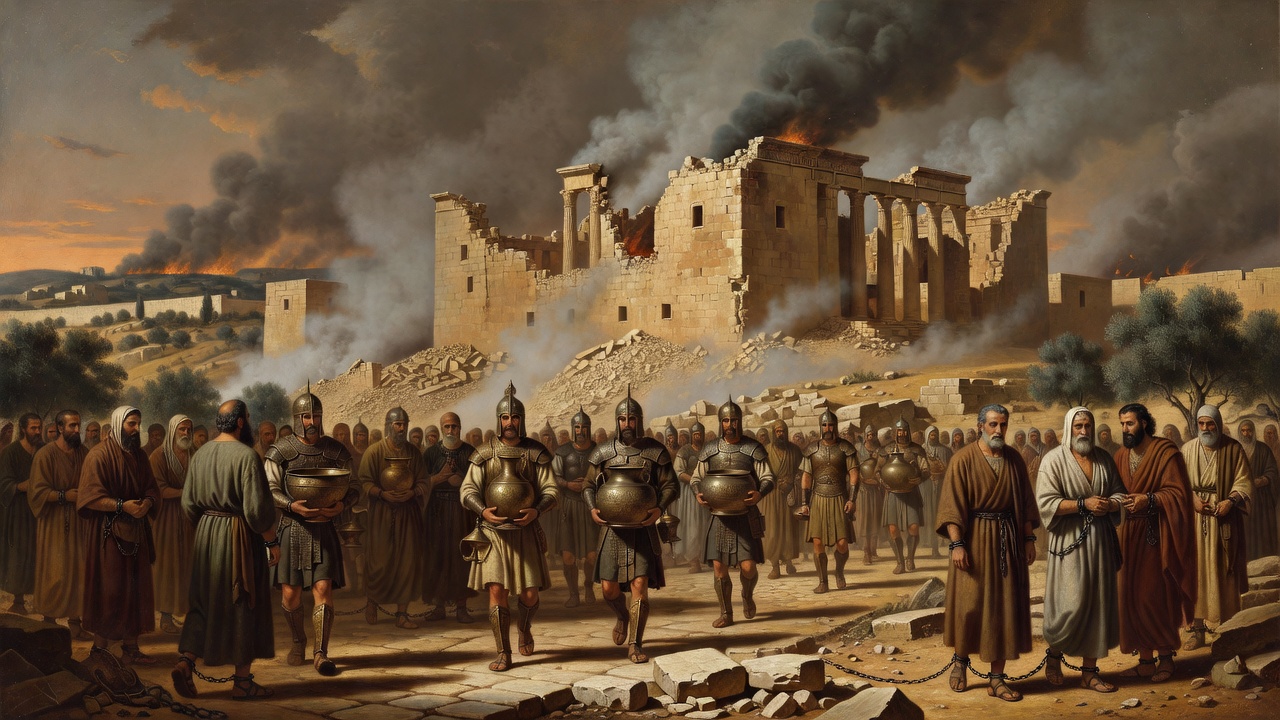
17Da God Babilonia isab king we zirrsapónórr Zuda pamkolpamdó. Ibü küsil pam we ekrrónóp gazirr turriki, Lodón ⌊Gyabi Müótüdü⌋. Kingan gyaur babul yarilürr, wa ia küsil pam yarilürr, ia küsil kol, ia epep myang, ta ia arüng-koke. God blaman pamkolpam wata kingan tangdó irrbünürr. 18Ene Godón Gyabi Müótüdü ne elklaza kwarilürr, ia wa wirri darrem kla ó ia kari darrem klama, akó Gyabi Müótüdü ne mórrel kwarilürr, wa blaman we imarrurr ama Babilon. I ta akó kingan akó oya ngi pamab mórrel blaman yazebóp. 19Godón Gyabi Müót uri amzikóp akó Zerrusalem wirri basirr ne kotarra amarükürrün yarilürr, ene kotarrpükü ta ilgütóp. Wirri pamab morroal wirri müót blaman sentenóp akó wirri darrem elklaza kolae nyónónóp.
20Gazirr turrik nidi nurutóp, ibü Babilon we barrmünürr. Babilonia kinga ibü ⌊leba zaget⌋ tómbapónóm we irrbünürr tóbankü akó olmalabkü, kókó Saerrus, Perrsia king, bwób nóma ipadórr. 21Ene igósüm, Lodón bóktana küppükü bainürr, Zerremaea ne bóktan simaikürr wagó, “Tüpa piküp ngyabele, 70 pailüm ngón agóle tóba ngón agón morroal apadóm, wa koke ne ngón agón ipadórr abün pailüm.”
22Zerremaean taedógab ne bóktana tubrranórr, Lod oya ne poko ekyanórr, Lod ene bóktan küppükü yónürr. Ngaen-gógópan pail ne kla yarilürr, king Saerrus Perrsia nóma alngomól yarilürr, Lod ini gyagüpitótók ekyanórr oya moboküpdü, zürük bóktan angrinüm akó wialómóm tóba dudu kantrriankü. 23Wagó, “Perrsia kantrrian king Saerrus igó bóktanda wa, ‘ Lod, kwitüm God, ini tüpdü blaman kingan bwób kürü kuri küline. Wa kürü kuri küngrine oyankü müót aelóm Zerrusalemóm, Zuda kantrridü. Ma ne oya pam nótó nóma namulo, Lod marü God asi ki yarilün mankü, da ma podo kasilke, ene müót akó aelóm.’”
Did you know?
The Fall of Jerusalem and the Decree of Cyrus
- In the final decades of Judah, foreign rulers repeatedly dictated the royal succession in Jerusalem. Pharaoh Neco of Egypt deposed Jehoahaz and placed his brother Eliakim on the throne under the name Jehoiakim, while King Nebuchadnezzar of Babylon later installed Zedekiah.Sources: the Bible text itself · Jehoiakim · Zedekiah
- Nebuchadnezzar and his Chaldean forces destroyed Jerusalem by burning down the temple and royal palaces, breaking down the city walls, and carrying the sacred vessels and surviving population into exile in Babylon.Sources: the Bible text itself · Jerusalem · Babylon
- In fulfillment of the word spoken through the prophet Jeremiah, the land lay desolate for seventy years until Cyrus, king of Persia, issued a royal decree granting the Jewish exiles permission to return and rebuild the house of God in Jerusalem.Sources: the Bible text itself · Cyrus · Jeremiah
Notes written with AI assistance from open sources (Theographic Bible Metadata, CC BY-SA 4.0; Easton’s Bible Dictionary, public domain) and reviewed before publishing.
Places in this chapter
- Jerusalem · 31.777, 35.234 · verses 1, 2, 3, 4, 5, 6, 9, 10, 11, 14, 19, 23
- Egypt · 30.129, 31.308 · verses 3, 4
- Babylon · 32.543, 44.422 · verses 6, 7, 10, 17, 18, 20
- Chaldea · 30.962, 46.104 · verse 17
- Persia · 34.806, 48.516 · verses 20, 22, 23
Only places identified with high confidence are shown (90% or more according to the scholarly sources compiled by OpenBible). Period map: DARE (Digital Atlas of the Roman Empire), CC BY 4.0; modern map: © OpenStreetMap contributors; places: OpenBible.info (CC BY 4.0).
Credits and license for this translation
Godón Buk
Portions of the Holy Bible in the Gizrra language of Western Province, Papua New Guinea
Buk Baibel long tokples Gizrra long Niugini
copyright © 2019 Wycliffe Bible Translators, Inc.
Language: Gizrra
Translation by: Wycliffe Bible Translators, Inc.
This translation is made available to you under the terms of the
Creative Commons Attribution-Noncommercial-No Derivatives license 4.0.
You may share and redistribute this Bible translation or extracts from it in any format, provided that:
You include the above copyright and source information.
You do not sell this work for a profit.
You do not change any of the words or punctuation of the Scriptures.
Pictures included with Scriptures and other documents on this site are licensed just for use with those Scriptures and documents.
For other uses, please contact the respective copyright owners.
2024-07-01
Source: http://png.bible/tof/ · eBible.org