Zephaniah 1
Biblica® Open Nueva Biblia Viva 2008 · Tap a verse to see its cross-references.
About this book
About Zephaniah
- Easton's Bible Dictionary (1897) presents Zephaniah, whose name it explains as "Jehovah has concealed" or "Jehovah of darkness," as the son of Cushi and great-grandson of Hezekiah, and as the ninth of the minor prophets. It dates his prophecy to the reign of Josiah, king of Judah (641–610 B.C.), and says he was contemporary with Jeremiah, with whom he had much in common.Sources: Easton: Zephaniah · Zephaniah · Cushi
- Amon, Josiah's father, restored idolatry in Judah, and Easton reads Zephaniah 1:4 and 3:4, 11 as referring to that reign. The same dictionary links Zephaniah 1:4–6 with the worship of Baal and Zephaniah 1:5 with Malcham, described as the national idol of the Ammonites. Josiah, who came to the throne at eight, is presented as later acting against the idolatry that prevailed.Sources: Amon · Josiah · Baal · Malcham
- Easton's Bible Dictionary outlines the book as an introduction announcing judgment on the world and on Israel because of their transgressions (1:1–6), a description of the judgment (1:7–18), an exhortation to seek God while there is still time (2:1–3), judgment on other peoples (2:4–15), what it calls the hopeless misery of Jerusalem (3:1–7), and a promise of salvation (3:8–20).Sources: Easton: Zephaniah
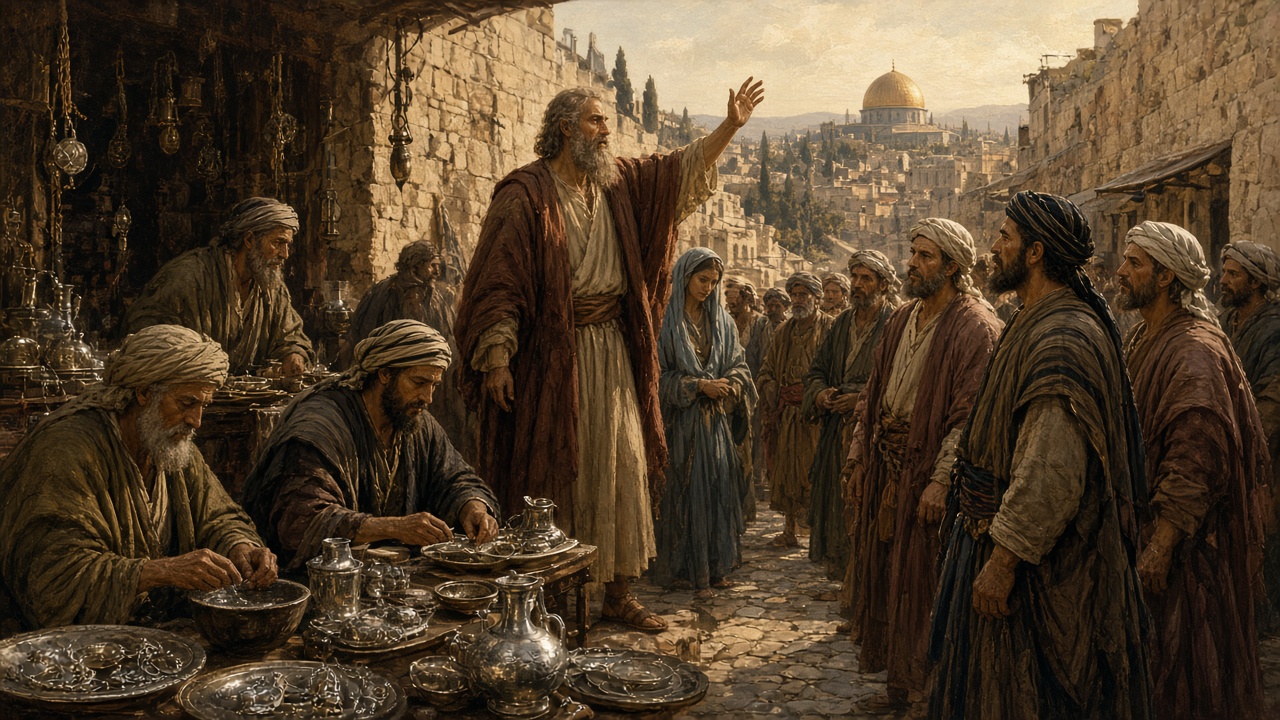
- Zephaniah 1:11 names the Mortar, a place in or near Jerusalem inhabited by silver merchants. It has been conjectured that this was the Phoenician quarter of the city, where traders of that nation lived.Sources: Mortar
Notes written with AI assistance from open sources (Theographic Bible Metadata, CC BY-SA 4.0; Easton’s Bible Dictionary, public domain) and reviewed before publishing.
1Cuando Josías, hijo de Amón, reinaba en Judá, el Señor le dio un mensaje al profeta Sofonías. Este era hijo de Cusí, quien, a su vez, era hijo de Guedalías, nieto de Amarías y bisnieto de Ezequías.
Advertencia sobre la destrucción venidera
2«Arrasaré por completo con todo lo que hay sobre la tierra, dice el Señor.
3»Arrasaré con hombres y animales por igual. Los ídolos y quienes los adoran desaparecerán de la tierra. Aun las aves del cielo y los peces del mar perecerán. Acabaré con los habitantes de toda la tierra, dice el Señor.
Juicio contra Judá
4»Aplastaré a Judá, junto con Jerusalén, con mi puño, y destruiré a todos los que rinden homenaje a Baal. Acabaré con los sacerdotes idólatras, de manera que hasta el recuerdo de ellos desaparecerá. 5Acabaré con todos los que se suben a los terrados para rendir homenaje al sol, la luna y las estrellas. Destruiré a todos los que me rinden homenaje a mí, pero al mismo tiempo rinden homenaje al dios Moloc. 6Destruiré también a los que antes rendían homenaje al Señor, pero ya no lo hacen, y a los que nunca lo han amado ni han querido saber de él.
7»¡Debe guardarse un silencio respetuoso en la presencia de Dios el Señor! Ha llegado el día terrible de su juicio. Ha preparado una gran matanza contra su pueblo, y ha escogido a sus convidados. 8El día del juicio castigaré a los jefes y príncipes de Judá, y a todos los que llevan vestiduras extranjeras. 9Sí, yo castigaré a los que siguen las costumbres paganas, a los que roban y llenan las casas de sus amos con ganancias obtenidas por la violencia y el fraude, y a los que presentan cosas robadas como ofrenda en el templo del Señor.
10»Gritos pidiendo auxilio se oirán en aquel día desde la puerta del barrio llamado Los Pescados, aullidos desde el Barrio Nuevo, y un bullicio espantoso desde las colinas, dice el Señor.
11»¡Aúllen de pesar, ustedes que viven en el barrio del Mercado, pues todos tus comerciantes que allí habitan morirán! ¡Serán eliminados todos los que trafican con el dinero! 12En aquel día buscaré cuidadosamente por toda Jerusalén a todos los tramposos, castigaré a los que reposan tranquilos después del robo; también a los que se atreven a pensar que el Señor no interviene ni para bien ni para mal. 13Estos mismos verán cómo sus riquezas cambian de dueño, verán cómo sus casas son destruidas. No tendrán jamás la oportunidad de vivir en las casas nuevas que edificaron. No podrán beber el fruto de los viñedos que plantaron.
El gran día del Señor
14»Ese día terrible del Señor está cerca. ¡Se acerca rápidamente! Ese día será tan horrible que hasta los más valientes llorarán amargamente y habrá alboroto por todos lados. 15En ese día se descargará toda la cólera de Dios; será un día de angustia y dolor, día marcado por la ruina y la desolación, de terrible oscuridad, de nubarrones y neblina de pesar.
16»La trompeta sonará ordenando el ataque, se oirá el griterío de la guerra; caerán hasta las ciudades mejor fortificadas y las torres fuertes de la defensa. 17Por haber obrado tan mal contra el Señor, él hará que ese día todos sean angustiados y anden como ciegos sin darse cuenta ni por donde caminan. Su sangre correrá por las calles, y sus cuerpos se pudrirán sobre la tierra. 18Ese día en que el Señor desate su castigo, de nada les servirá la plata y el oro que tienen. Toda la tierra será devorada por el fuego de su ira. ¡En poco tiempo morirán todos los habitantes de la tierra!».
Did you know?
The Day of the LORD and Judgment on Idolatry
- Zephaniah traces his lineage back four generations to Hezekiah, dating his prophetic ministry to the reign of King Josiah of Judah. Josiah came to power after his father, King Amon, had restored idolatry across Judah before being assassinated by his own servants.Sources: the Bible text itself · Josiah · Amon · Hizkiah
- The chapter denounces religious syncretism in Jerusalem, where people bowed on rooftops to the host of heaven and combined their devotion to the LORD with oaths to Baal and Malcham, the national idol of the Ammonites.Sources: the Bible text itself · Baal · Malcham
- The prophecy specifies landmarks in Jerusalem that would experience turmoil, including the Fish Gate and the Mortar (or Hollow), a district inhabited by merchants who weighed out silver.Sources: the Bible text itself · Fish Gate · Mortar
Notes written with AI assistance from open sources (Theographic Bible Metadata, CC BY-SA 4.0; Easton’s Bible Dictionary, public domain) and reviewed before publishing.
Places in this chapter
- Jerusalem · 31.777, 35.234 · verses 4, 12
- Fish Gate · Today: in Jerusalem · 31.777, 35.234 · verse 10
- Second Quarter · Today: in Jerusalem · 31.777, 35.234 · verse 10
- Canaan · 32.767, 35.333 · verse 11
- Mortar · Today: in Jerusalem · 31.777, 35.234 · verse 11
Only places identified with high confidence are shown (90% or more according to the scholarly sources compiled by OpenBible). Period map: DARE (Digital Atlas of the Roman Empire), CC BY 4.0; modern map: © OpenStreetMap contributors; places: OpenBible.info (CC BY 4.0).
Credits and license for this translation
Biblica® Open Nueva Biblia Viva 2008
The Holy Bible in Spanish: Biblica® Open Nueva Biblia Viva 2008 (Bible)
copyright © 2008 Biblica, Inc.
Language: Español
Contributor: Biblica, Inc.
Biblica® Open Nueva Biblia Viva™
Copyright © 2006, 2008 by Biblica, Inc.
“Biblica” es una marca registrada en la oficina de Patentes y Marcas de los Estados Unidos por Biblica, Inc. Usado con permiso.
“Biblica” is a trademark registered in the United States Patent and Trademark Office by Biblica, Inc. Used with permission.
Creative Commons license
This work is made available under the Creative Commons Attribution-ShareAlike 4.0 International License (CC BY-SA). To view a copy of this license, visit https://creativecommons.org/licenses/by-sa/4.0 or send a letter to Creative Commons, PO Box 1866, Mountain View, CA 94042, USA.
You have permission to copy and distribute this Work, as long as you do not change it and you keep the title as it is. Changing or translating this Work will create a derivative work. When you publish this derivative work, you must list what changes you have made where people can see them, such as on a website. You must also show where the original Work is from: “The original Work by its copyright holders is available for free at www.biblica.com and open.bible .”
Notice of copyright must appear on the title or copyright page of the work as follows:
Biblica® Open Nueva Biblia Viva™
Copyright © 2006, 2008 by Biblica, Inc.
“Biblica” es una marca registrada en la oficina de Patentes y Marcas de los Estados Unidos por Biblica, Inc. Usado con permiso.
“Biblica” is a trademark registered in the United States Patent and Trademark Office by Biblica, Inc. Used with permission.
You must also make your derivative work available under the same license (CC BY-SA).
If you would like to notify Biblica, Inc. regarding your translation of this work, please contact us at https://open.bible/#feedback .
This translation is made available to you under the terms of the
Creative Commons Attribution Share-Alike license 4.0.
You have permission to share and redistribute this Bible translation in any format and to make reasonable revisions and adaptations of this translation, provided that:
You include the above copyright and source information.
If you make any changes to the text, you must indicate that you did so in a way that makes it clear that the original licensor is not necessarily endorsing your changes.
If you redistribute this text, you must distribute your contributions under the same license as the original.
Pictures included with Scriptures and other documents on this site are licensed just for use with those Scriptures and documents.
For other uses, please contact the respective copyright owners.
Note that in addition to the rules above, revising and adapting God's Word involves a great responsibility to be true to God's Word. See Revelation 22:18-19.
2025-05-21
Source: http://ebible.org/spaonbv/ · eBible.org