Revelation 1
Biblica® Open Nueva Biblia Viva 2008 · Tap a verse to see its cross-references.
About this book
About Revelation
- Easton's Bible Dictionary (1897) identifies the author as the apostle John, whose name appears four times in the book (1:1, 4, 9; 22:8). The same entry says the date has generally been fixed at A.D. 96, under Domitian, while some contend for A.D. 68 or 69, under Nero. Those who favor the later date appeal to the Christian father Irenaeus, who had received information about the book from people that had seen John face to face, and who said that the Apocalypse “was seen no long time ago.”Sources: Easton: Revelation, Book of
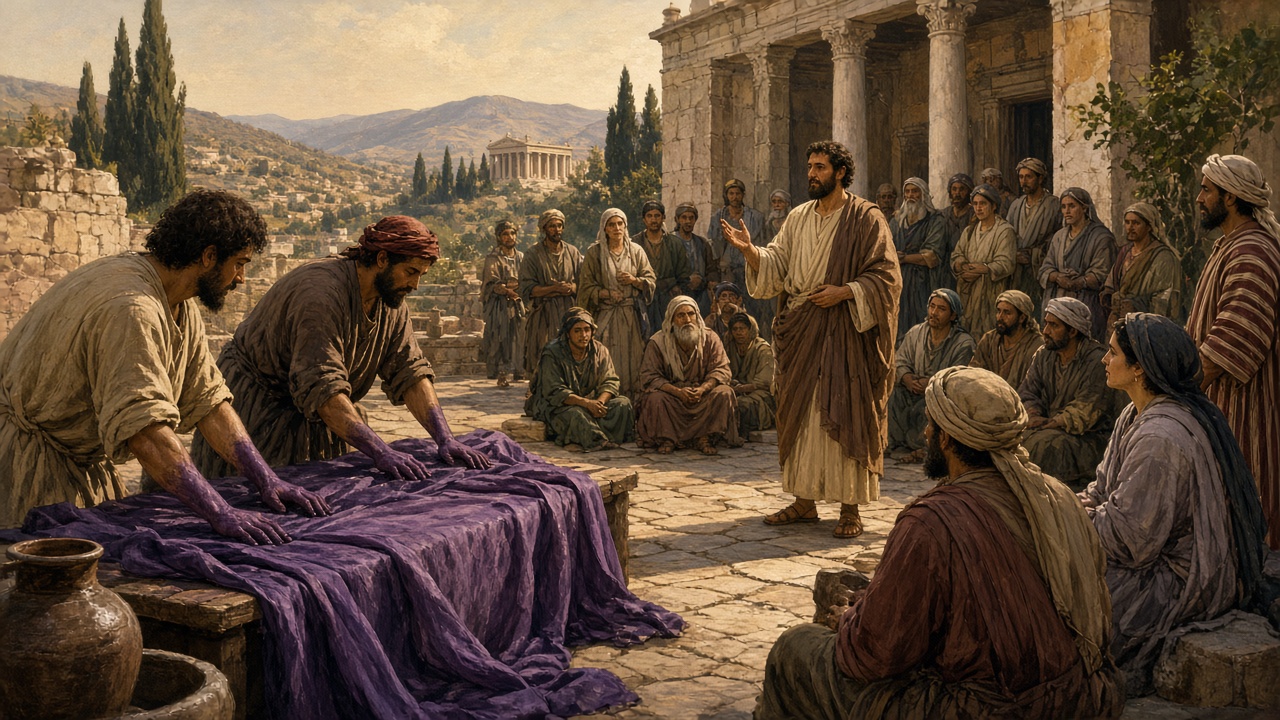
- Revelation names churches in cities of Asia Minor. Thyatira, on the borders of Lydia and Mysia and long famous for dyeing, and Sardis, the metropolis of Lydia on the river Pactolus at the foot of Mount Tmolus, were each one of the seven churches. Laodicea, on the confines of Phrygia and Lydia, beside the Lycus about forty miles east of Ephesus, is also cited; it had been called Diospolis and then Rhoas before Antiochus II of Syria rebuilt it and named it for his wife Laodice.Sources: Thyatira · Sardis · Laodicea
- Easton's Bible Dictionary (1897) calls Revelation the Apocalypse, the closing book and the only prophetical book of the New Testament canon. Citing Plummer, it says this book and the Gospel of John share the same leading ideas: one gives a magnificent vision, the other a great historic drama, of the supreme conflict between good and evil and its outcome. In both, the entry adds, Jesus Christ is the central figure, whose victory through defeat is that outcome, and his warfare and triumph are described in language saturated with the Old Testament.Sources: Easton: Revelation, Book of
- A manuscript of about the twelfth century calls the author “John the divine,” though Easton's Bible Dictionary (1897) says no reason can be assigned for that title. In the book, Satan is called “the dragon” and “the old serpent,” and Antipas is named a “faithful martyr,” of whom nothing more is certainly known.Sources: Easton: Revelation, Book of · Satan · Antipas
Notes written with AI assistance from open sources (Theographic Bible Metadata, CC BY-SA 4.0; Easton’s Bible Dictionary, public domain) and reviewed before publishing.
Prólogo
1Esta es la revelación que Dios le dio a Jesucristo para que él le muestre a sus servidores los acontecimientos que ocurrirán pronto. Jesucristo se los reveló por medio de un ángel a su siervo Juan. 2Juan puso por escrito la palabra de Dios y el testimonio de Jesucristo, y narró con veracidad todo lo que vio y oyó.
3Bendito el que lee esta profecía y benditos los que la oyen y le hacen caso, porque la hora de su cumplimiento se aproxima.
Saludos y doxología
4Yo Juan, les escribo a las siete iglesias que están en la provincia de Asia:
Gracia y paz a ustedes de Aquel que es, que era y que ha de venir, y de los siete espíritus que están delante de su trono, 5y de parte de Jesucristo, el testigo fiel, que fue el primero en levantarse de entre los muertos y que tiene autoridad sobre todos los reyes de la tierra.
Al que nos ama y derramó su sangre para libertarnos de nuestros pecados,
6y ha hecho de nosotros un reino de sacerdotes al servicio de Dios su Padre, ¡sean eternamente la gloria y el poder! ¡Amén!
7¡Miren! ¡Viene en las nubes, ante los ojos de la humanidad entera, y hasta los que lo traspasaron lo verán! Y las naciones de la tierra llorarán de pesar por él.
¡Amén! ¡Que así sea!
8«Yo soy la A y la Z, —dice el Señor Dios—, el que es, que era y que ha de venir, el Todopoderoso».
Alguien semejante al Hijo del hombre
9Yo, Juan, hermano de ustedes y compañero en el sufrimiento, en el reino y en la fortaleza que nos da Jesucristo, un día del Señor estaba en la isla de Patmos, a donde me habían desterrado por predicar la palabra de Dios y contar lo que sé de Jesucristo. Entonces quedé bajo el poder del Espíritu y escuché detrás de mí una voz que, estridente como toque de trompeta, 11me dijo:
«Escribe en un libro todo lo que veas, y envíalo a las siete iglesias que están en Asia: Éfeso, Esmirna, Pérgamo, Tiatira, Sardis, Filadelfia y Laodicea».
12Cuando me volví para mirar al que me hablaba, vi siete candeleros de oro. 13En medio de los candeleros estaba un personaje muy parecido al Hijo del hombre, vestido de un manto que le llegaba hasta los pies, y ceñido al pecho con una banda de oro.
14Tenía el pelo blanco como la lana o la nieve, y los ojos penetrantes como llamas de fuego. 15Sus pies parecían como bronce al rojo vivo en un horno, y su voz retumbaba tan fuerte como una catarata. 16En la mano derecha sostenía siete estrellas; de su boca salía una espada aguda de dos filos. El rostro le brillaba con el resplandor del sol cuando brilla con toda su fuerza.
17Al verlo, caí a sus pies como muerto; pero puso la mano derecha sobre mí y me dijo: «¡No temas! Soy el primero y el último, 18el que vive aunque estuvo muerto; pero ahora vivo para siempre y tengo las llaves del infierno y de la muerte.
19»Escribe lo que viste, lo que está sucediendo y lo que sucederá después. 20El significado de las siete estrellas que tengo en la mano derecha, y de los siete candeleros de oro, es el siguiente: las siete estrellas son los ángeles de las siete iglesias, y los siete candeleros son las siete iglesias.
Did you know?
A vision on Patmos for the churches of Asia
- John writes that he was on the island of Patmos because of the word of God and his testimony about Jesus. Patmos is a small, rocky, and barren island in the Sporades, in the Aegean Sea, and it is mentioned in Scripture only in this chapter. Easton's Bible Dictionary (1897) states that the emperor Domitian banished John there in A.D. 95, and that he received this revelation on the island.Sources: the Bible text itself · Patmos
- The message is addressed to seven churches in the province of Asia, the Roman province of Proconsular Asia, which covered the western part of Asia Minor and had Ephesus as its capital. John is told to write on a scroll what he sees and send it to Ephesus, Smyrna, Pergamum, Thyatira, Sardis, Philadelphia, and Laodicea, the seven churches of that province.Sources: the Bible text itself · Asia
- Ephesus, the provincial capital, bore the Roman title "the first and greatest metropolis of Asia." It was known for the temple of Diana and for an open-air theatre, the largest in the world, able to hold 50,000 spectators. Thyatira, on the borders of Lydia and Mysia, was famous for dyeing; Sardis, the metropolis of Lydia, stood on the river Pactolus at the foot of Mount Tmolus; and Laodicea lay about forty miles east of Ephesus, on the banks of the Lycus.Sources: Ephesus · Thyatira · Sardis · Laodicea
Notes written with AI assistance from open sources (Theographic Bible Metadata, CC BY-SA 4.0; Easton’s Bible Dictionary, public domain) and reviewed before publishing.
Places in this chapter
- Asia · 38.400, 28.300 · verses 4, 11
- Patmos · 37.325, 26.542 · verse 9
- Ephesus · 37.939, 27.341 · verse 11
- Laodicea · Today: Laodicea on the Lycus · 37.836, 29.108 · verse 11
- Pergamum · Today: Pergamon · 39.132, 27.184 · verse 11
- Philadelphia · Today: Alaşehir · 38.350, 28.517 · verse 11
- Sardis · 38.488, 28.040 · verse 11
- Smyrna · Today: Izmir · 38.419, 27.138 · verse 11
- Thyatira · Today: Akhisar · 38.920, 27.837 · verse 11
Only places identified with high confidence are shown (90% or more according to the scholarly sources compiled by OpenBible). Period map: DARE (Digital Atlas of the Roman Empire), CC BY 4.0; modern map: © OpenStreetMap contributors; places: OpenBible.info (CC BY 4.0).
Credits and license for this translation
Biblica® Open Nueva Biblia Viva 2008
The Holy Bible in Spanish: Biblica® Open Nueva Biblia Viva 2008 (Bible)
copyright © 2008 Biblica, Inc.
Language: Español
Contributor: Biblica, Inc.
Biblica® Open Nueva Biblia Viva™
Copyright © 2006, 2008 by Biblica, Inc.
“Biblica” es una marca registrada en la oficina de Patentes y Marcas de los Estados Unidos por Biblica, Inc. Usado con permiso.
“Biblica” is a trademark registered in the United States Patent and Trademark Office by Biblica, Inc. Used with permission.
Creative Commons license
This work is made available under the Creative Commons Attribution-ShareAlike 4.0 International License (CC BY-SA). To view a copy of this license, visit https://creativecommons.org/licenses/by-sa/4.0 or send a letter to Creative Commons, PO Box 1866, Mountain View, CA 94042, USA.
You have permission to copy and distribute this Work, as long as you do not change it and you keep the title as it is. Changing or translating this Work will create a derivative work. When you publish this derivative work, you must list what changes you have made where people can see them, such as on a website. You must also show where the original Work is from: “The original Work by its copyright holders is available for free at www.biblica.com and open.bible .”
Notice of copyright must appear on the title or copyright page of the work as follows:
Biblica® Open Nueva Biblia Viva™
Copyright © 2006, 2008 by Biblica, Inc.
“Biblica” es una marca registrada en la oficina de Patentes y Marcas de los Estados Unidos por Biblica, Inc. Usado con permiso.
“Biblica” is a trademark registered in the United States Patent and Trademark Office by Biblica, Inc. Used with permission.
You must also make your derivative work available under the same license (CC BY-SA).
If you would like to notify Biblica, Inc. regarding your translation of this work, please contact us at https://open.bible/#feedback .
This translation is made available to you under the terms of the
Creative Commons Attribution Share-Alike license 4.0.
You have permission to share and redistribute this Bible translation in any format and to make reasonable revisions and adaptations of this translation, provided that:
You include the above copyright and source information.
If you make any changes to the text, you must indicate that you did so in a way that makes it clear that the original licensor is not necessarily endorsing your changes.
If you redistribute this text, you must distribute your contributions under the same license as the original.
Pictures included with Scriptures and other documents on this site are licensed just for use with those Scriptures and documents.
For other uses, please contact the respective copyright owners.
Note that in addition to the rules above, revising and adapting God's Word involves a great responsibility to be true to God's Word. See Revelation 22:18-19.
2025-05-21
Source: http://ebible.org/spaonbv/ · eBible.org