Mark 2
Biblica® Open Nueva Biblia Viva 2008 · Tap a verse to see its cross-references.
Jesús sana a un paralítico
1Días más tarde, Jesús regresó a Capernaúm. La noticia de que estaba en casa se esparció rápidamente. 2Y pronto la gente llenó tanto la casa que no quedó sitio para nadie más ni siquiera frente a la puerta. Y él predicaba la palabra.
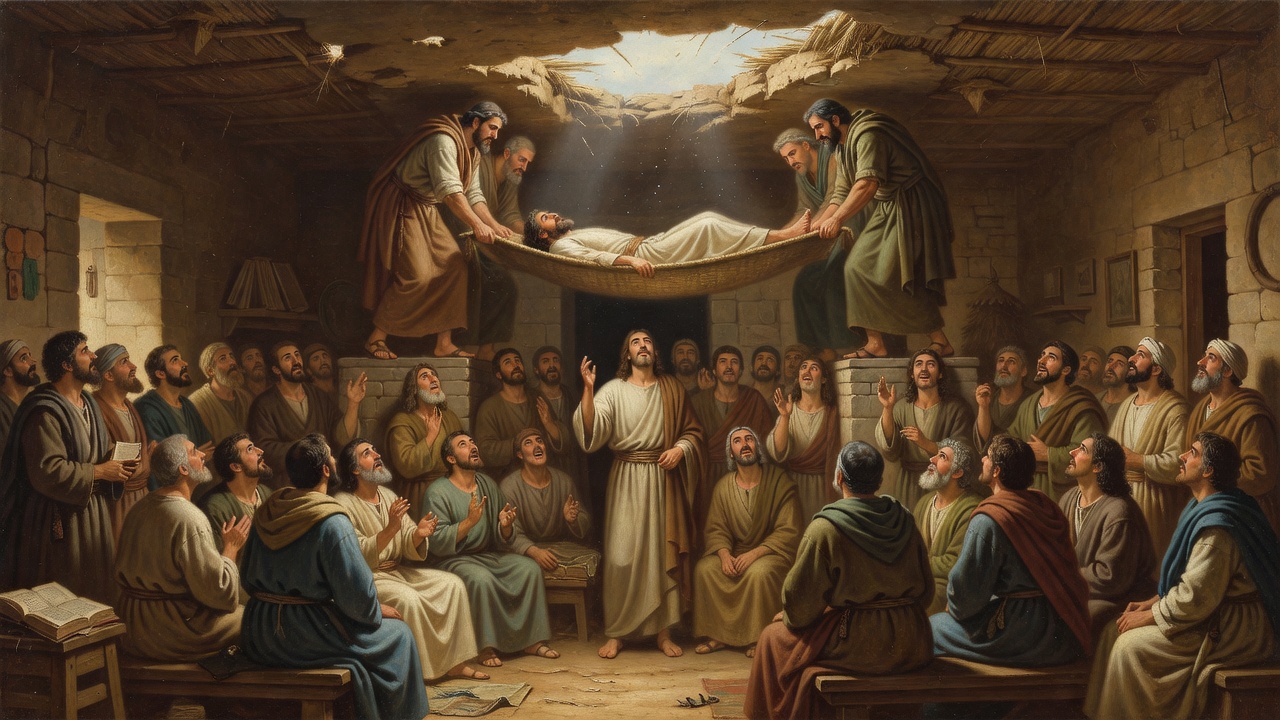
3Entonces llegaron cuatro hombres llevando a un paralítico. 4Como no pudieron pasar entre la multitud para llegar a Jesús, subieron a la azotea, hicieron una abertura en el techo, exactamente encima de donde estaba Jesús, y entre los cuatro bajaron la camilla en la que yacía el paralítico.
5Cuando Jesús vio la fe de ellos, le dijo al paralítico:
―Hijo, tus pecados quedan perdonados.
6Algunos maestros de la ley que estaban allí sentados pensaron: 7«¿Cómo se atreve a hablar así? ¡Eso es una blasfemia! ¡Dios es el único que puede perdonar los pecados!».
8Jesús les leyó el pensamiento y les dijo:
―¿Por qué piensan ustedes así? 9¿Qué es más fácil, decirle al paralítico “tus pecados quedan perdonados” o decirle: “Levántate, toma tu camilla y anda”? 10Pues voy a probarles que yo, el Hijo del hombre, tengo potestad para perdonar los pecados.
Entonces se dirigió al paralítico y le dijo:
11―A ti te digo, levántate, recoge la camilla y vete.
12El hombre se levantó de inmediato, tomó su camilla y se abrió paso entre la asombrada concurrencia que, entre alabanzas a Dios, exclamaba:
―Jamás habíamos visto nada parecido.
Llamamiento de Leví
13Jesús salió de nuevo a la orilla del lago y allí le enseñaba al gentío que acudía a él.
14Caminando por el lugar, vio a Leví, hijo de Alfeo, sentado en la mesa donde cobraba los impuestos.
―Sígueme —le dijo Jesús.
Y Leví se levantó y lo siguió.
15Leví invitó a Jesús y a sus discípulos a comer. También invitó a comer a muchos cobradores de impuestos y a otros pecadores. Ya eran muchos los que seguían a Jesús.
16Cuando algunos de los maestros de la ley, que eran fariseos, vieron a Jesús comiendo con aquella gente, les preguntaron a los discípulos:
―¿Cómo es que este come con recaudadores de impuestos y con pecadores?
17Jesús, que oyó lo que decían, les replicó:
―Los enfermos son los que necesitan médico, no los sanos. No he venido a llamar a los justos sino a los pecadores.
Le preguntan a Jesús sobre el ayuno
18Al ver que los discípulos de Juan y los de los fariseos ayunaban, algunos se acercaron a Jesús y le preguntaron:
―¿Por qué tus discípulos no ayunan también?
19Jesús les respondió:
―¿Se abstendrán acaso de comer en un banquete de bodas los amigos del novio mientras el novio esté con ellos? 20Llegará el momento cuando el novio les será quitado, y entonces ayunarán. 21Nadie remienda un vestido viejo con una tela nueva, porque el parche se encoge y rompe el vestido, y la rotura que queda es mayor que la anterior. 22¿Y a quién se le ocurriría poner vino nuevo en odres viejos? El vino nuevo reventaría los odres y se perderían el vino y los odres. El vino nuevo se echa en odres nuevos.
Señor del sábado
23Un día de reposo, pasaron por los trigales Jesús y sus discípulos, y estos se pusieron a arrancar espigas. 24Los fariseos le preguntaron a Jesús:
―¿Por qué hacen ellos lo que está prohibido hacer en el día de reposo?
25Jesús les respondió:
―¿Nunca han leído lo que hizo David una vez que él y sus compañeros tuvieron hambre? 26Cuando Abiatar era el sumo sacerdote, David entró en la casa de Dios y comió de los panes consagrados a Dios, que sólo los sacerdotes podían comer. Y no sólo comió él, sino que también dio a sus compañeros.
27»El sábado se hizo para el ser humano y no el ser humano para el sábado. 28Por eso, el Hijo del hombre es Señor incluso del sábado».
Did you know?
Forgiveness, a Tax Collector, and the Sabbath
- Capernaum, “Nahum’s town,” was a Galilean city not mentioned in the Old Testament. Easton's Bible Dictionary (1897) says that after Jesus was expelled from Nazareth it became his “own city,” which fits Mark’s report that people heard he was home and packed the house until there was no room even outside the door. Four men then uncovered the roof, made an opening, and lowered a paralyzed man on his mat.Sources: Capernaum · the Bible text itself
- The man at the tax booth was Levi, son of Alphaeus, a tax collector in Capernaum. Easton's Bible Dictionary (1897) says he had been known as Levi and took the name Matthew—a common Jewish name after the Exile, meaning “gift of God”—possibly in grateful memory of his call. The same day, it says, he gave a great farewell feast for Jesus and his disciples, and probably for many former associates, the gathering Mark describes with tax collectors and sinners.Sources: Matthew · Alphaeus · the Bible text itself
- Challenged because his disciples picked heads of grain on the Sabbath, Jesus spoke of David entering the house of God and eating the consecrated bread, lawful only for the priests, “during the high priesthood of Abiathar,” and sharing it with his hungry companions. Easton's Bible Dictionary (1897) identifies Abiathar as the son of the high priest Ahimelech, who escaped when his father and the priests of Nob were killed, carried away the ephod, and joined David in the cave of Adullam.Sources: Abiathar · the Bible text itself
Notes written with AI assistance from open sources (Theographic Bible Metadata, CC BY-SA 4.0; Easton’s Bible Dictionary, public domain) and reviewed before publishing.
Credits and license for this translation
Biblica® Open Nueva Biblia Viva 2008
The Holy Bible in Spanish: Biblica® Open Nueva Biblia Viva 2008 (Bible)
copyright © 2008 Biblica, Inc.
Language: Español
Contributor: Biblica, Inc.
Biblica® Open Nueva Biblia Viva™
Copyright © 2006, 2008 by Biblica, Inc.
“Biblica” es una marca registrada en la oficina de Patentes y Marcas de los Estados Unidos por Biblica, Inc. Usado con permiso.
“Biblica” is a trademark registered in the United States Patent and Trademark Office by Biblica, Inc. Used with permission.
Creative Commons license
This work is made available under the Creative Commons Attribution-ShareAlike 4.0 International License (CC BY-SA). To view a copy of this license, visit https://creativecommons.org/licenses/by-sa/4.0 or send a letter to Creative Commons, PO Box 1866, Mountain View, CA 94042, USA.
You have permission to copy and distribute this Work, as long as you do not change it and you keep the title as it is. Changing or translating this Work will create a derivative work. When you publish this derivative work, you must list what changes you have made where people can see them, such as on a website. You must also show where the original Work is from: “The original Work by its copyright holders is available for free at www.biblica.com and open.bible .”
Notice of copyright must appear on the title or copyright page of the work as follows:
Biblica® Open Nueva Biblia Viva™
Copyright © 2006, 2008 by Biblica, Inc.
“Biblica” es una marca registrada en la oficina de Patentes y Marcas de los Estados Unidos por Biblica, Inc. Usado con permiso.
“Biblica” is a trademark registered in the United States Patent and Trademark Office by Biblica, Inc. Used with permission.
You must also make your derivative work available under the same license (CC BY-SA).
If you would like to notify Biblica, Inc. regarding your translation of this work, please contact us at https://open.bible/#feedback .
This translation is made available to you under the terms of the
Creative Commons Attribution Share-Alike license 4.0.
You have permission to share and redistribute this Bible translation in any format and to make reasonable revisions and adaptations of this translation, provided that:
You include the above copyright and source information.
If you make any changes to the text, you must indicate that you did so in a way that makes it clear that the original licensor is not necessarily endorsing your changes.
If you redistribute this text, you must distribute your contributions under the same license as the original.
Pictures included with Scriptures and other documents on this site are licensed just for use with those Scriptures and documents.
For other uses, please contact the respective copyright owners.
Note that in addition to the rules above, revising and adapting God's Word involves a great responsibility to be true to God's Word. See Revelation 22:18-19.
2025-05-21
Source: http://ebible.org/spaonbv/ · eBible.org