Haggai 1
Biblica® Open Nueva Biblia Viva 2008 · Tap a verse to see its cross-references.
About this book
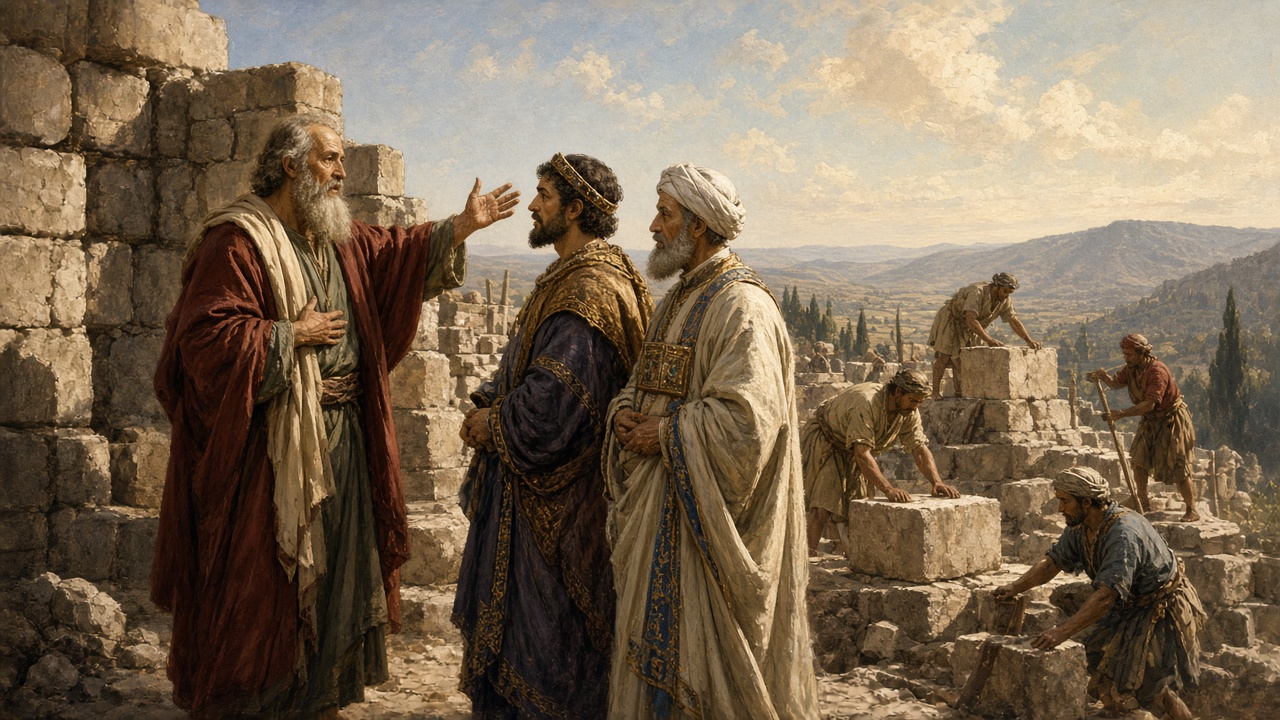
About Haggai
- Easton's Bible Dictionary (1897) presents Haggai, whose name it explains as “Festive,” as one of the twelve so-called minor prophets. He was the first of three whose ministry belonged to the period of Jewish history that began after the return from captivity in Babylon; Zechariah was his contemporary, and Malachi, in that account, came about a hundred years later. Scarcely anything is known of his personal history: he may have been one of the captives taken to Babylon by Nebuchadnezzar, and he began his ministry about sixteen years after the Return.Sources: Easton: Haggai · Haggai
- A biographical note calls Zerubbabel the son of Shealtiel and also the son of Pedaiah, explaining the latter as grandson or nephew of Shealtiel. In the first year of Cyrus, king of Persia, he led the first band of returning Jews, 42,360 people besides a large number of servants, at the close of seventy years of captivity. In the second year after the Return he erected an altar and laid the temple foundation on the ruins of the temple destroyed by Nebuchadnezzar; the same note also gives him the Persian name Sheshbazzar.Sources: Zerubbabel · Shealtiel
- Easton says the rebuilding of the temple was stopped through the intrigues of the Samaritans and, after fifteen years of suspension, was resumed through the efforts of Haggai and Zechariah. By their exhortations they roused the people from lethargy and induced them to use a favorable opportunity created by a change in the policy of the Persian government. Joshua, son of Jozadak, was high priest of the Jews under Zerubbabel and is named with him in Haggai.Sources: Easton: Haggai · Haggai · Joshua
- Easton's Bible Dictionary characterizes Haggai's prophecies by a simple, weighty dignity and by emphatic repetition addressed alike to prince, priest, and people: “Be strong” (Haggai 2:4) and “Consider your ways” (1:5, 7; 2:15, 18). Citing Stanley, it presents those refrains as pressing the hearers to examine their own hearts and consciences and to hold fast to the work they had to do.Sources: Easton: Haggai
Notes written with AI assistance from open sources (Theographic Bible Metadata, CC BY-SA 4.0; Easton’s Bible Dictionary, public domain) and reviewed before publishing.
Primer oráculo: Exhortación a reedificar el templo
1Por medio del profeta Hageo, el Señor les envió un mensaje a Zorobabel, hijo de Salatiel, que era el gobernador de Judá, y al jefe de los sacerdotes Josué, hijo de Josadac. Esto sucedió el día primero del mes sexto del segundo año del reinado de Darío, rey de Persia.
2El Señor Todopoderoso les preguntó: «¿Por qué andan todos diciendo que todavía no es tiempo de reedificar mi templo en Jerusalén?».
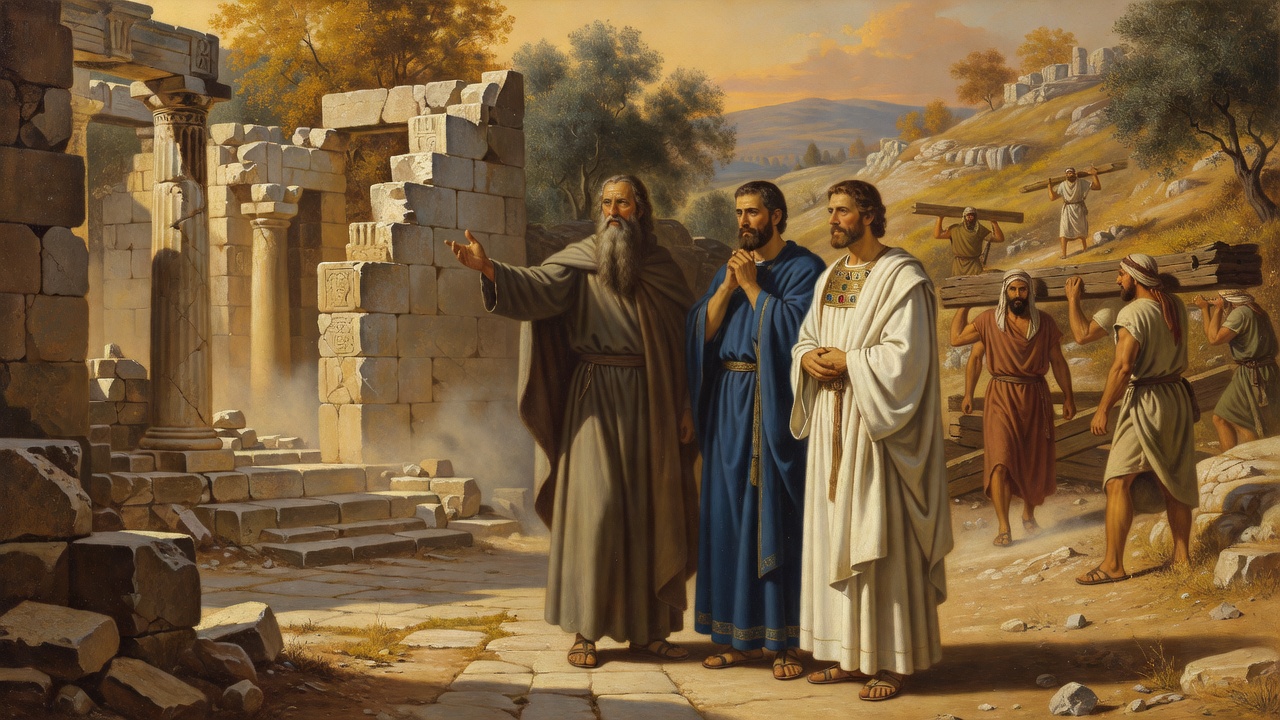
3Luego, el Señor les volvió a hablar a través del profeta Hageo: 4«¿Cómo es posible que ustedes vivan en casas bien hermosas, mientras mi templo permanece en ruinas? 5Yo, que soy el Señor Todopoderoso, les digo: ¡Tengan mucho cuidado con lo que están haciendo! 6Siembran mucho, pero recogen poco; comen, pero quedan con hambre; beben, pero quedan con sed; se visten, pero la ropa no los calienta; y el salario no les alcanza para nada.
7»¡Piensen muy bien lo que están haciendo! Se los digo yo, el Señor Todopoderoso. 8Suban a las montañas, traigan madera y reedifiquen mi templo. Eso me alegrará mucho y ustedes serán recompensados. Lo digo yo, el Señor.
9»Esperan mucho, pero reciben poco. Lo que logran guardar en sus casas, yo lo hago desaparecer de un soplo. ¿Por qué? Porque mi templo yace en ruinas y a ustedes nada les importa. Su única preocupación es el adorno de sus propias casas. Lo digo yo, el Señor Todopoderoso.
10»A consecuencia de esa negligencia suya es que yo me he enojado y decidido no enviarles la lluvia necesaria para sus cosechas. 11En realidad he decidido que haya sequía en el valle y sobre los montes; una sequía que hará marchitar el trigo, las uvas, los olivares y todas sus cosechas; una sequía que destruirá todo aquello por lo que han trabajado arduamente, de modo que tanto ustedes como sus animales padecerán sed y hambre».
12Entonces Zorobabel, hijo de Salatiel, gobernador de Judá, el jefe de los sacerdotes Josué, hijo de Josadac, y el resto de la gente sintió mucho miedo. Por eso estuvieron dispuestos a obedecer el mensaje que el Señor su Dios les había enviado por medio del profeta Hageo.
13Entonces, después de que cambiaron de actitud, el Señor envió de nuevo al profeta Hageo para que les dijera: «Yo estaré con ustedes ayudándoles a cumplir este buen propósito». 14Fue así como el Señor animó a Zorobabel, hijo de Salatiel, gobernador de Judá, al jefe de los sacerdotes Josué, hijo de Josadac, y al resto del pueblo para que comenzaran a trabajar en la reconstrucción del templo de su Dios, el Señor Todopoderoso. 15Así que comenzaron los trabajos el día veinticuatro del mes sexto del segundo año del reinado de Darío, rey de Persia.
Did you know?
A Call to Rebuild the Temple
- Haggai began his prophetic ministry in the second year of the Persian king Darius, about sixteen years after the return from Babylonian captivity. Temple reconstruction had been suspended for fifteen years while the people focused on building their own paneled houses, prompting Haggai to challenge them to resume the work.Sources: the Bible text itself · Haggai
- The prophetic message was directed to Zerubbabel son of Shealtiel, the governor of Judah who had led the first large group of returnees from Babylon, and Joshua son of Jehozadak, the high priest. Just over three weeks after Haggai spoke, the leaders and the remnant of the people obeyed and restarted construction on the temple.Sources: the Bible text itself · Zerubbabel · Joshua
- Haggai was the first of three prophets whose ministry belonged to the post-exilic period of Jewish history, followed by his contemporary Zechariah and later by Malachi about a century afterward.Sources: Haggai
Notes written with AI assistance from open sources (Theographic Bible Metadata, CC BY-SA 4.0; Easton’s Bible Dictionary, public domain) and reviewed before publishing.
Credits and license for this translation
Biblica® Open Nueva Biblia Viva 2008
The Holy Bible in Spanish: Biblica® Open Nueva Biblia Viva 2008 (Bible)
copyright © 2008 Biblica, Inc.
Language: Español
Contributor: Biblica, Inc.
Biblica® Open Nueva Biblia Viva™
Copyright © 2006, 2008 by Biblica, Inc.
“Biblica” es una marca registrada en la oficina de Patentes y Marcas de los Estados Unidos por Biblica, Inc. Usado con permiso.
“Biblica” is a trademark registered in the United States Patent and Trademark Office by Biblica, Inc. Used with permission.
Creative Commons license
This work is made available under the Creative Commons Attribution-ShareAlike 4.0 International License (CC BY-SA). To view a copy of this license, visit https://creativecommons.org/licenses/by-sa/4.0 or send a letter to Creative Commons, PO Box 1866, Mountain View, CA 94042, USA.
You have permission to copy and distribute this Work, as long as you do not change it and you keep the title as it is. Changing or translating this Work will create a derivative work. When you publish this derivative work, you must list what changes you have made where people can see them, such as on a website. You must also show where the original Work is from: “The original Work by its copyright holders is available for free at www.biblica.com and open.bible .”
Notice of copyright must appear on the title or copyright page of the work as follows:
Biblica® Open Nueva Biblia Viva™
Copyright © 2006, 2008 by Biblica, Inc.
“Biblica” es una marca registrada en la oficina de Patentes y Marcas de los Estados Unidos por Biblica, Inc. Usado con permiso.
“Biblica” is a trademark registered in the United States Patent and Trademark Office by Biblica, Inc. Used with permission.
You must also make your derivative work available under the same license (CC BY-SA).
If you would like to notify Biblica, Inc. regarding your translation of this work, please contact us at https://open.bible/#feedback .
This translation is made available to you under the terms of the
Creative Commons Attribution Share-Alike license 4.0.
You have permission to share and redistribute this Bible translation in any format and to make reasonable revisions and adaptations of this translation, provided that:
You include the above copyright and source information.
If you make any changes to the text, you must indicate that you did so in a way that makes it clear that the original licensor is not necessarily endorsing your changes.
If you redistribute this text, you must distribute your contributions under the same license as the original.
Pictures included with Scriptures and other documents on this site are licensed just for use with those Scriptures and documents.
For other uses, please contact the respective copyright owners.
Note that in addition to the rules above, revising and adapting God's Word involves a great responsibility to be true to God's Word. See Revelation 22:18-19.
2025-05-21
Source: http://ebible.org/spaonbv/ · eBible.org