Genesis 37
Biblica® Open Nueva Biblia Viva 2008 · Tap a verse to see its cross-references.
Los sueños de José
1Jacob se fue a vivir a la tierra de Canaán, donde su padre había vivido como extranjero. 2Esta es la historia de la familia de Jacob:
José, el hijo de Jacob, tenía diecisiete años. Su trabajo consistía en apacentar los rebaños de su padre, en compañía de los hijos de Bilhá y de Zilpá, que eran concubinas de Jacob. Pero José le informaba a su padre de la mala conducta de aquellos. 3Israel amaba más a José que a sus otros hijos, porque José le había nacido en su vejez. Un día Jacob le regaló una túnica de mangas largas. 4Los hermanos notaban que su padre prefería a José. Por eso, llegaron a odiarlo y no le podían hablar en buenos términos. 5Una noche José tuvo un sueño y se lo contó de inmediato a sus hermanos, lo que hizo que estos lo odiaran aún más.
6―Oigan, les voy a contar el sueño que tuve —les dijo—. 7Soñé que todos nosotros estábamos en el campo atando manojos de trigo. Mi manojo se mantuvo derecho, mientras que los de ustedes se reunieron alrededor del mío y le hicieron reverencias.
8―¿Quiere decir que vas a ser nuestro rey? —se burlaron—, y lo odiaron aún más por el sueño y porque creían que él se jactaba de ser superior a ellos.
9Luego tuvo otro sueño, y también se lo contó a sus hermanos:
―Oigan mi segundo sueño —les dijo—. Soñé que el sol, la luna y once estrellas me hacían reverencias.
10Esta vez José le contó el sueño también a su padre, después de habérselo contado a sus hermanos. Su padre lo reprendió:
―¿Qué es esto que has soñado? ¿Acaso yo, tu madre y tus hermanos vamos a inclinarnos delante de ti?
11Los hermanos se sintieron molestos y se llenaron de envidia, pero Jacob se quedó pensando qué significaría todo aquello.
José es vendido por sus hermanos
12Un día los hermanos de José llevaron los rebaños de su padre a Siquén, para apacentarlos allí. 13Pocos días después Israel llamó a José y le dijo:
―Tus hermanos están en Siquén apacentando el ganado. Anda a ver cómo están ellos y el ganado, y vuelve a avisarme.
―Muy bien —respondió José.
Entonces José salió del valle de Hebrón y se dirigió a Siquén. 15Un hombre que lo vio caminando por los campos le preguntó:
―¿A quién buscas?
16―Busco a mis hermanos y sus rebaños. ¿Los ha visto?
17―Sí —respondió el hombre—, ya no están aquí. Les oí decir que iban a Dotán.
José entonces se fue hasta Dotán y allí encontró a sus hermanos. 18Pero cuando ellos lo vieron, lo reconocieron a la distancia y decidieron matarlo.
19―¡Ahí viene el soñador! —exclamaron—. Vamos, matémoslo y echémoslo en una cisterna. Luego le diremos a nuestro padre que algún animal salvaje se lo comió. ¡Veremos en qué paran sus sueños!
21Cuando Rubén escuchó esto, intentó salvarle la vida a José.
―No lo matemos —dijo—; no debemos derramar sangre. Echémoslo vivo dentro de la cisterna. Así morirá sin que lo toquemos.
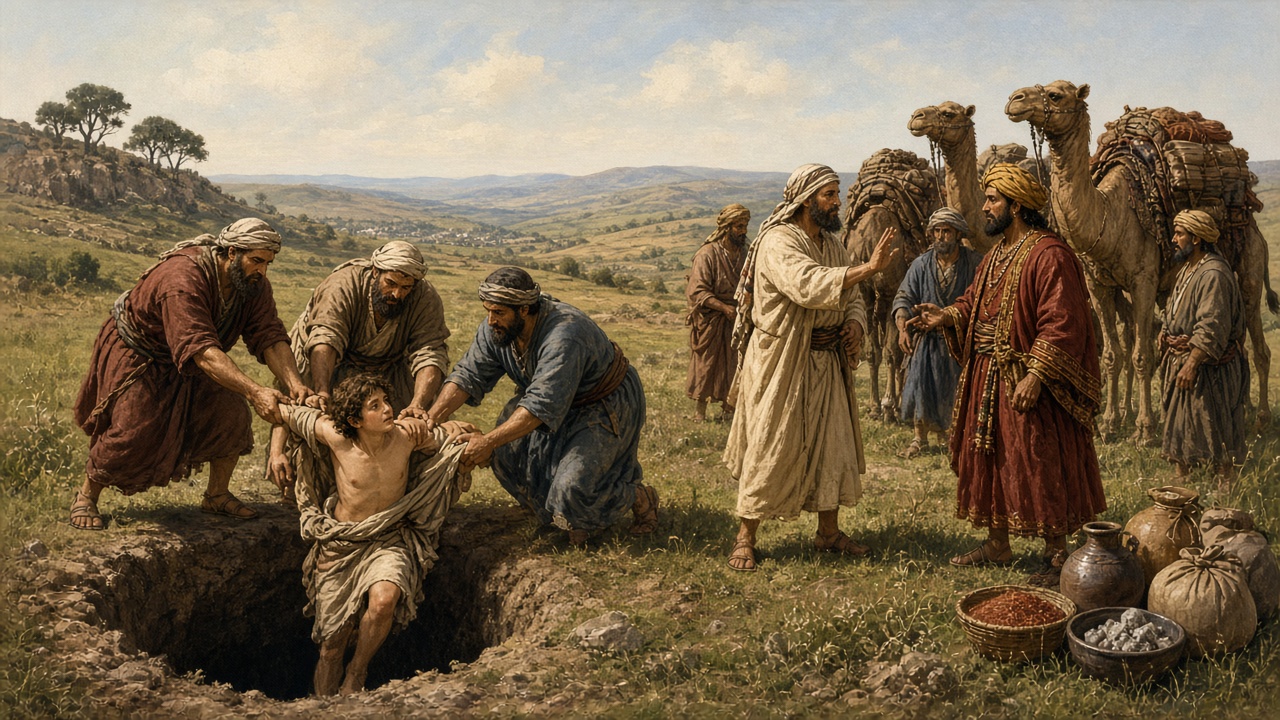
El plan de Rubén era sacarlo más tarde y enviarlo a casa de su padre. 23Cuando José llegó donde ellos estaban, le quitaron su túnica de mangas largas, 24y lo arrojaron a una cisterna vacía. 25Luego se sentaron a comer. De repente vieron a la distancia una caravana de Ismaelitas que venían de Galaad. Sus camellos iban cargados de perfumes, especias y bálsamos que llevaban a vender a Egipto.
26―¡Miren! —dijo Judá a los demás—. Allá vienen unos ismaelitas. ¡Vendámosles a José! ¿Para qué hemos de matarlo y cargar con esta culpa en la conciencia? No seamos responsables de su muerte porque, después de todo, es nuestro hermano.
Todos los hermanos estuvieron de acuerdo. 28Cuando llegaron los comerciantes, sacaron a José de la cisterna y se lo vendieron por veinte monedas de plata. Los comerciantes siguieron el viaje llevando consigo a José hasta Egipto. 29Un poco más tarde llegó Rubén (que había estado fuera cuando pasaron los ismaelitas) y fue hasta la cisterna para sacar a José. Cuando vio que José no estaba allí, rasgó sus ropas lleno de angustia y de frustración.
30―El muchacho no está; y yo, ¿dónde me meto ahora?
31Ellos entonces tomaron un cabrito, lo degollaron y con la sangre mancharon la túnica de José. 32Luego le llevaron la túnica a Jacob para que la identificara.
―Encontramos esto en el campo —le dijeron—. ¿Será la túnica de José?
33El padre la reconoció de inmediato.
―Sí, es la túnica de mi hijo. Algún animal salvaje destrozó a mi hijo y se lo comió.
34Entonces Israel rasgó su ropa y se vistió de ropas ásperas e hizo duelo por su hijo, y lo lloró durante varias semanas. 35Toda su familia trató en vano de consolarlo. Pero él decía: «No dejaré de llorar hasta que muera y me reúna con mi hijo». Y seguía llorando.
36Mientras tanto en Egipto, José fue vendido a Potifar por los mercaderes. Potifar era un funcionario del faraón, rey de Egipto. Era nada menos que el capitán de la guardia.
Did you know?
Joseph Sold by His Brothers
- Israel loved Joseph more than his other sons because he was the child of his old age, and he made him a robe of many colors. Easton's Bible Dictionary (1897) reads the Hebrew of Genesis 37:3 as a long, full garment with sleeves, the kind worn by the children of nobles. When the brothers saw that favor, they hated him and could not speak a kind word to him.Sources: Joseph (son of Jacob) · the Bible text itself
- Jacob sent seventeen-year-old Joseph from the Valley of Hebron to see how his brothers and the flocks were faring; they had pastured near Shechem and then gone on to Dothan. Easton's Bible Dictionary (1897) calls Dothan a famous pasture ground with two wells, identified with modern Tell-Dothan about twelve miles north of Samaria among the hills of Gilboa, and says it is mentioned on monuments in 1600 BC. There the brothers saw a caravan of Ishmaelites coming from Gilead, their camels carrying spices, balm, and myrrh on the way down to Egypt.Sources: Dothan · Gilead · the Bible text itself
- Reuben, Jacob's eldest son by Leah, tried to save Joseph from death and planned to return him to their father. Judah then persuaded the brothers to sell Joseph to the Ishmaelites rather than shed his blood. In Egypt the Midianites sold him to Potiphar, an officer of Pharaoh and captain of the guard; Easton's Bible Dictionary (1897) explains that name as 'dedicated to Ra,' the sun-god, and takes the title to mean, probably, chief of the state police, with a margin reading 'chief of the executioners.'Sources: Reuben · Judah (patriarch) · Potiphar · the Bible text itself
Notes written with AI assistance from open sources (Theographic Bible Metadata, CC BY-SA 4.0; Easton’s Bible Dictionary, public domain) and reviewed before publishing.
Places in this chapter
- Canaan · 32.767, 35.333 · verse 1
- Shechem · Today: Tell Balatah · 32.214, 35.282 · verses 12, 13, 14
- Valley of Hebron · 31.525, 35.102 · verse 14
- Egypt · 30.129, 31.308 · verses 25, 28, 36
- Gilead · Today: Gilead 1 · 32.187, 35.692 · verse 25
Only places identified with high confidence are shown (90% or more according to the scholarly sources compiled by OpenBible). Period map: DARE (Digital Atlas of the Roman Empire), CC BY 4.0; modern map: © OpenStreetMap contributors; places: OpenBible.info (CC BY 4.0).
Credits and license for this translation
Biblica® Open Nueva Biblia Viva 2008
The Holy Bible in Spanish: Biblica® Open Nueva Biblia Viva 2008 (Bible)
copyright © 2008 Biblica, Inc.
Language: Español
Contributor: Biblica, Inc.
Biblica® Open Nueva Biblia Viva™
Copyright © 2006, 2008 by Biblica, Inc.
“Biblica” es una marca registrada en la oficina de Patentes y Marcas de los Estados Unidos por Biblica, Inc. Usado con permiso.
“Biblica” is a trademark registered in the United States Patent and Trademark Office by Biblica, Inc. Used with permission.
Creative Commons license
This work is made available under the Creative Commons Attribution-ShareAlike 4.0 International License (CC BY-SA). To view a copy of this license, visit https://creativecommons.org/licenses/by-sa/4.0 or send a letter to Creative Commons, PO Box 1866, Mountain View, CA 94042, USA.
You have permission to copy and distribute this Work, as long as you do not change it and you keep the title as it is. Changing or translating this Work will create a derivative work. When you publish this derivative work, you must list what changes you have made where people can see them, such as on a website. You must also show where the original Work is from: “The original Work by its copyright holders is available for free at www.biblica.com and open.bible .”
Notice of copyright must appear on the title or copyright page of the work as follows:
Biblica® Open Nueva Biblia Viva™
Copyright © 2006, 2008 by Biblica, Inc.
“Biblica” es una marca registrada en la oficina de Patentes y Marcas de los Estados Unidos por Biblica, Inc. Usado con permiso.
“Biblica” is a trademark registered in the United States Patent and Trademark Office by Biblica, Inc. Used with permission.
You must also make your derivative work available under the same license (CC BY-SA).
If you would like to notify Biblica, Inc. regarding your translation of this work, please contact us at https://open.bible/#feedback .
This translation is made available to you under the terms of the
Creative Commons Attribution Share-Alike license 4.0.
You have permission to share and redistribute this Bible translation in any format and to make reasonable revisions and adaptations of this translation, provided that:
You include the above copyright and source information.
If you make any changes to the text, you must indicate that you did so in a way that makes it clear that the original licensor is not necessarily endorsing your changes.
If you redistribute this text, you must distribute your contributions under the same license as the original.
Pictures included with Scriptures and other documents on this site are licensed just for use with those Scriptures and documents.
For other uses, please contact the respective copyright owners.
Note that in addition to the rules above, revising and adapting God's Word involves a great responsibility to be true to God's Word. See Revelation 22:18-19.
2025-05-21
Source: http://ebible.org/spaonbv/ · eBible.org