Genesis 33
Biblica® Open Nueva Biblia Viva 2008 · Tap a verse to see its cross-references.
Encuentro de Jacob con Esaú
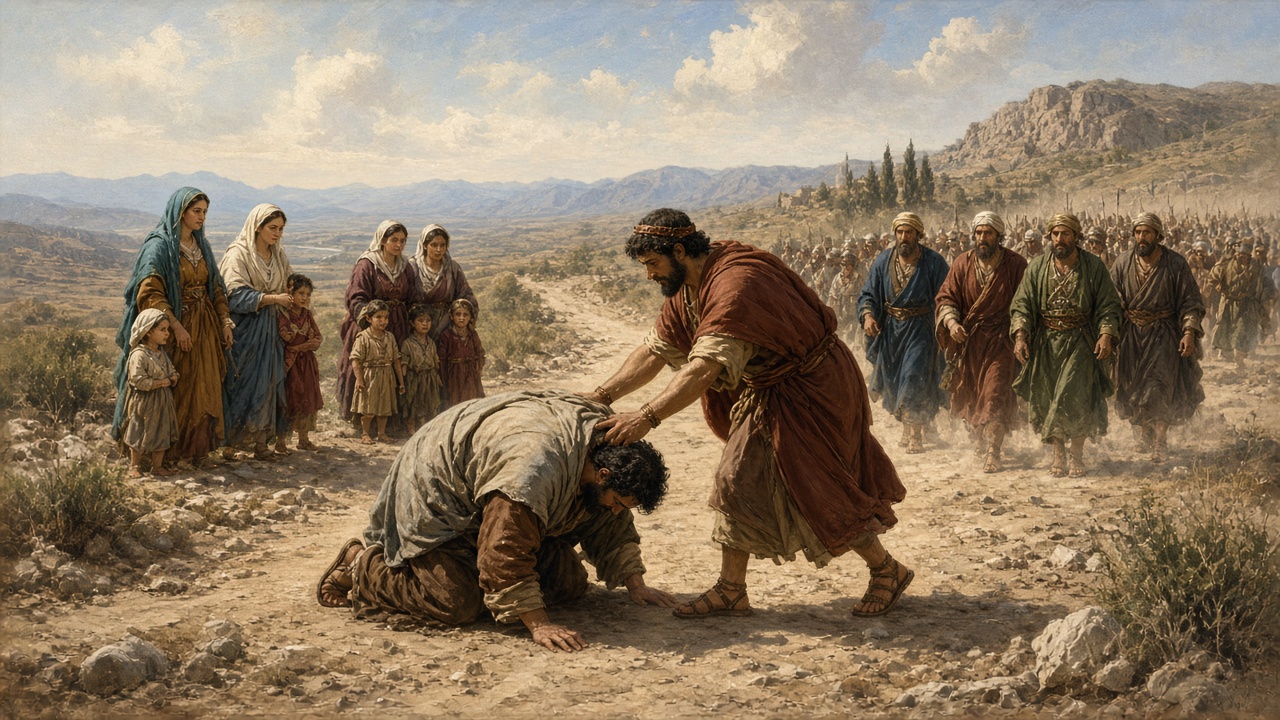
1A la distancia, Jacob vio a Esaú que llegaba con cuatrocientos hombres. Entonces repartió a sus hijos entre Lea, Raquel y las dos siervas. 2Al frente de todos puso a las dos siervas junto con sus hijos, luego a Lea y sus hijos, y finalmente a Raquel y su hijo José. 3Luego Jacob pasó al frente. Cuando estuvo cerca de su hermano, se inclinó siete veces delante de él. 4Esaú, al verlo, corrió a su encuentro, lo abrazó afectuosamente y lo besó; y ambos se pusieron a llorar. 5Entonces Esaú vio a las mujeres y a los niños, y preguntó:
―¿Quiénes son estas personas que están contigo?
―Son los hijos que Dios, por su amor, me ha dado —respondió Jacob.
6Las concubinas se adelantaron con sus hijos y se inclinaron ante Esaú. 7Luego Lea y sus hijos se acercaron y también se inclinaron ante Esaú. Finalmente, llegaron Raquel y José y también se inclinaron.
8―¿Y para qué era todo ese ganado que he encontrado en el camino mientras venía hacia acá? —preguntó Esaú.
Jacob contestó:
―Son obsequios que te envié para ganarme tu favor.
9―Hermano mío, yo tengo bastante —dijo Esaú—. Déjalos para ti.
10―No, te ruego que los aceptes —dijo Jacob—, porque al verte me parece estar viendo a Dios mismo, pues me has recibido con mucha bondad. 11Por favor, acepta mis obsequios. Dios ha sido muy misericordioso conmigo y me ha dado muchas riquezas.
Tanto insistió Jacob, que al fin Esaú aceptó los regalos.
12―Bueno, ahora pongámonos en marcha —dijo Esaú—. Mis hombres y yo nos quedaremos con ustedes y les señalaremos el camino.
13Pero Jacob respondió:
―Como puedes ver, algunos de mis hijos son pequeños, y además el ganado tiene crías, de modo que si avanzamos muy rápido, morirán. 14Ve tú adelante. Nosotros iremos detrás de ustedes, al paso de los niños y del ganado. Nos encontraremos en Seír.
15―Bueno —dijo Esaú—, al menos permíteme que te deje algunos hombres para que te ayuden y sirvan de guía.
―No —insistió Jacob—, no es necesario. Por favor, acepta mi sugerencia.
16Entonces, aquel mismo día, Esaú emprendió el regreso a Seír. 17Por su parte Jacob y su familia se fueron hasta Sucot. Allí levantó un campamento con cabañas para su ganado. Por eso es que el lugar se llama Sucot (cabañas).
18Luego llegaron a salvo a Siquén, en Canaán, y acamparon fuera de la ciudad. 19Jacob le compró a la familia de Jamor, padre de Siquén, por cien monedas de plata, un pedazo de tierra. 20Allí edificó un altar y lo llamó El Elohé Israel (Dios es el Dios de Israel).
Did you know?
Jacob Meets Esau and Camps at Shechem
- Esau, Rebekah’s hairy firstborn twin, sold his birthright to Jacob for red lentil stew; he lived as a hunter, while Jacob became a shepherd, and the story of their birth is presented as foreshadowing enmity between the brothers and the nations they founded. Even so, when Esau approaches with four hundred men, Jacob goes on ahead and bows to the ground seven times, putting the maidservants and their children first, Leah and her children next, and Rachel and Joseph last—yet Esau runs to embrace and kiss him, and both weep.Sources: Esau (Edom) · Jacob (Israel) · the Bible text itself
- That day Esau started back toward Seir, which Easton's Bible Dictionary (1897) describes as a mountainous region along the east side of the Arabah, from the southeastern end of the Dead Sea to near Akabah, the eastern branch of the Red Sea—first occupied by the Horites and later allotted to Esau’s descendants, the Edomites. Jacob went on instead to Succoth, which the same dictionary places east of the Jordan, about a mile north of the Jabbok; there he built a house and shelters for his livestock, which is why the place was called Succoth.Sources: Seir · Succoth · the Bible text itself
- After leaving Paddan-aram—commonly regarded as the plain of Mesopotamia around Haran—Jacob arrived safely at the city of Shechem in the land of Canaan and camped just outside it, in the narrow valley between Ebal on the north and Gerizim on the south. He bought the plot where he pitched his tent from the sons of Hamor, a Hivite and the father of Shechem, for a hundred pieces of silver, and there he set up an altar and called it El-Elohe-Israel.Sources: Paddan-aram · Shechem · Hamor · the Bible text itself
Notes written with AI assistance from open sources (Theographic Bible Metadata, CC BY-SA 4.0; Easton’s Bible Dictionary, public domain) and reviewed before publishing.
Places in this chapter
Only places identified with high confidence are shown (90% or more according to the scholarly sources compiled by OpenBible). Period map: DARE (Digital Atlas of the Roman Empire), CC BY 4.0; modern map: © OpenStreetMap contributors; places: OpenBible.info (CC BY 4.0).
Credits and license for this translation
Biblica® Open Nueva Biblia Viva 2008
The Holy Bible in Spanish: Biblica® Open Nueva Biblia Viva 2008 (Bible)
copyright © 2008 Biblica, Inc.
Language: Español
Contributor: Biblica, Inc.
Biblica® Open Nueva Biblia Viva™
Copyright © 2006, 2008 by Biblica, Inc.
“Biblica” es una marca registrada en la oficina de Patentes y Marcas de los Estados Unidos por Biblica, Inc. Usado con permiso.
“Biblica” is a trademark registered in the United States Patent and Trademark Office by Biblica, Inc. Used with permission.
Creative Commons license
This work is made available under the Creative Commons Attribution-ShareAlike 4.0 International License (CC BY-SA). To view a copy of this license, visit https://creativecommons.org/licenses/by-sa/4.0 or send a letter to Creative Commons, PO Box 1866, Mountain View, CA 94042, USA.
You have permission to copy and distribute this Work, as long as you do not change it and you keep the title as it is. Changing or translating this Work will create a derivative work. When you publish this derivative work, you must list what changes you have made where people can see them, such as on a website. You must also show where the original Work is from: “The original Work by its copyright holders is available for free at www.biblica.com and open.bible .”
Notice of copyright must appear on the title or copyright page of the work as follows:
Biblica® Open Nueva Biblia Viva™
Copyright © 2006, 2008 by Biblica, Inc.
“Biblica” es una marca registrada en la oficina de Patentes y Marcas de los Estados Unidos por Biblica, Inc. Usado con permiso.
“Biblica” is a trademark registered in the United States Patent and Trademark Office by Biblica, Inc. Used with permission.
You must also make your derivative work available under the same license (CC BY-SA).
If you would like to notify Biblica, Inc. regarding your translation of this work, please contact us at https://open.bible/#feedback .
This translation is made available to you under the terms of the
Creative Commons Attribution Share-Alike license 4.0.
You have permission to share and redistribute this Bible translation in any format and to make reasonable revisions and adaptations of this translation, provided that:
You include the above copyright and source information.
If you make any changes to the text, you must indicate that you did so in a way that makes it clear that the original licensor is not necessarily endorsing your changes.
If you redistribute this text, you must distribute your contributions under the same license as the original.
Pictures included with Scriptures and other documents on this site are licensed just for use with those Scriptures and documents.
For other uses, please contact the respective copyright owners.
Note that in addition to the rules above, revising and adapting God's Word involves a great responsibility to be true to God's Word. See Revelation 22:18-19.
2025-05-21
Source: http://ebible.org/spaonbv/ · eBible.org