Esther 1
Biblica® Open Nueva Biblia Viva 2008 · Tap a verse to see its cross-references.
About this book
About Esther
- Easton's Bible Dictionary (1897) places the deliverance recorded in Esther about fifty-two years after the Return, in the year of the battles of Plataea and Mycale (B.C. 479). It identifies Ahasuerus, in all probability, with Xerxes, son of Darius Hystaspes, who succeeded his father in B.C. 485 and reigned twenty-one years (B.C. 486–465). In the Septuagint the name Artaxerxes occurs for Ahasuerus.Sources: Easton: Esther · Ahasuerus
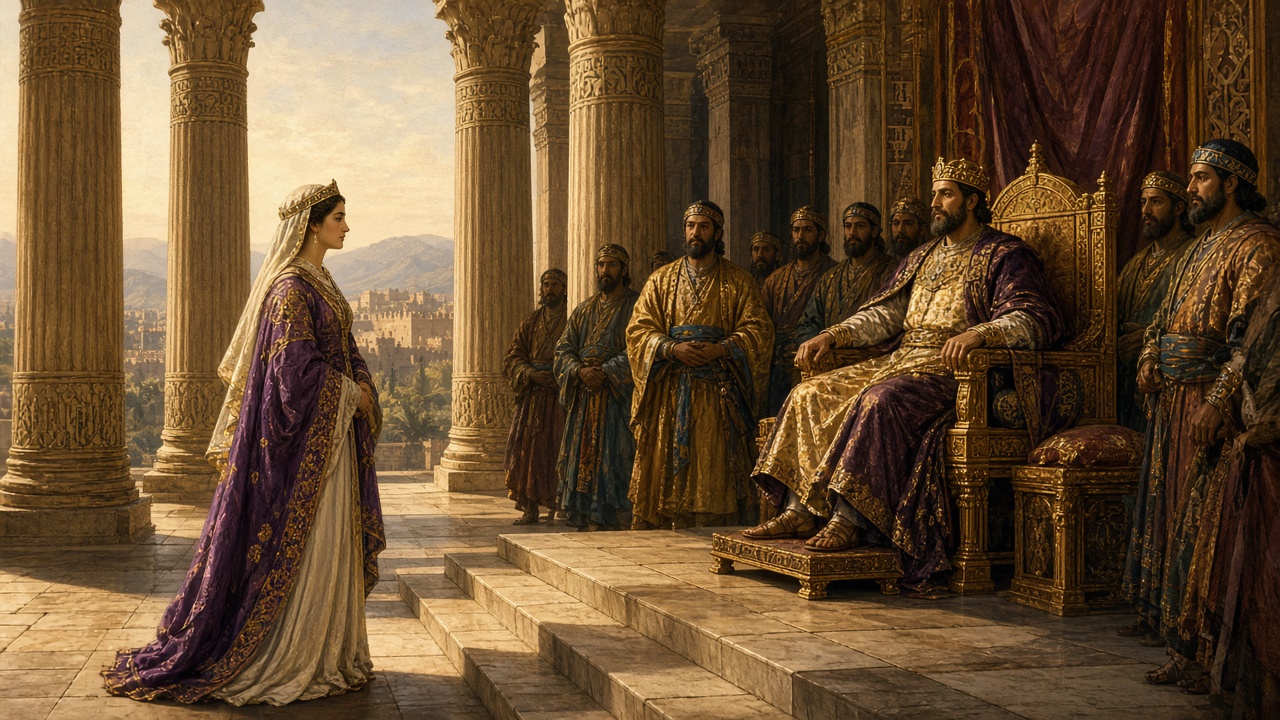
- The story is set in the Persian empire of Ahasuerus, who ruled Persia, Media, and Babylonia from India to Ethiopia. Most of the events take place at Susa, called Shushan in the palace, once the capital of Elam and now the ruins of Shush, east of the Tigris. Esther's family had not used the permission Cyrus gave the exiles to return to Jerusalem; she lived there with her cousin Mordecai, who held an office in the king's household.Sources: Ahasuerus · Susa · Easton: Esther
- After Ahasuerus divorced Vashti because she refused to appear in the banqueting hall of the palace, he chose Esther as his queen. Haman the Agagite, his vizier, was then given power to kill the Jews throughout the empire; Esther's intervention averted that catastrophe, and Haman was hanged on the gallows he had prepared for Mordecai. The Jews established the annual feast of Purim in memory of their deliverance.Sources: Easton: Esther · Vashti · Haman
- Esther was a Benjamite Jewess, the daughter of Abihail, whose Hebrew name Hadassah means myrtle; the name Esther is a Syro-Arabian modification of the Persian word satarah, which means a star. Haman, the son of Hammedatha, is called an Agagite, which the sources take to suggest descent from the royal family of the Amalekites, described as the bitterest enemies of the Jews.Sources: Easton: Esther · Haman · Hammedatha
Notes written with AI assistance from open sources (Theographic Bible Metadata, CC BY-SA 4.0; Easton’s Bible Dictionary, public domain) and reviewed before publishing.
Destitución de la reina Vasti
1Era el tercer año del reinado del rey Asuero, emperador del extenso imperio medo-persa, que estaba formado por ciento veintisiete provincias y se extendía desde la India hasta Etiopía. 2Este era el año de la gran celebración en el palacio de Susa, capital del reino, a la que el emperador había invitado a todos los gobernadores, cortesanos, y jefes del ejército de todas partes de Media y Persia. 4La fiesta duró seis meses, con un despliegue enorme de las riquezas y las glorias del imperio.
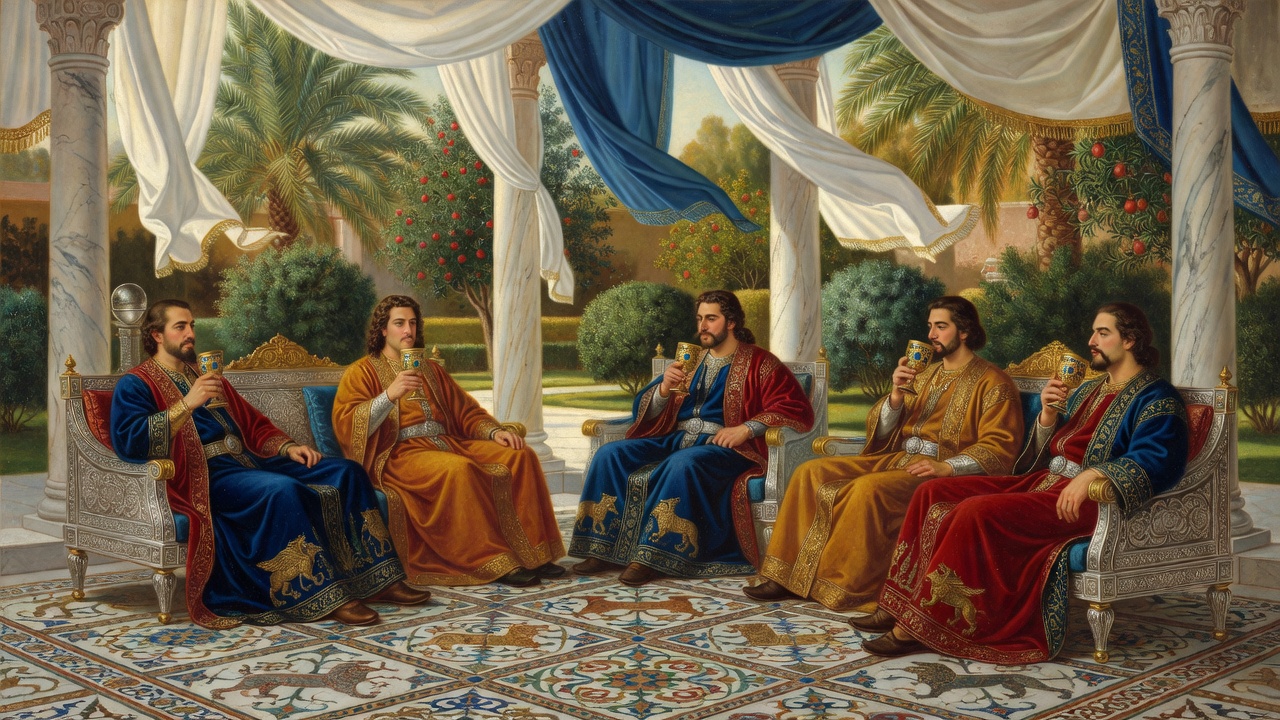
5Cuando todo terminó, el rey dio una fiesta especial para los funcionarios y sirvientes del palacio. Esta fiesta duró siete días y se celebró en los jardines del palacio, 6el cual se adornó con cortinas verdes, blancas y azules, y estaban atadas con cordones de lino y púrpura que pasaban por anillos de plata y columnas de mármol. Los reclinatorios eran de oro y plata, y estaban sobre un piso de mármol blanco y negro, con incrustaciones de alabastro y jacinto. 7Las bebidas se servían en vasos de oro de diversos diseños, y había gran abundancia de vino real, porque el rey era generoso. 8Los invitados podían beber cuanto quisieran, ya que el rey había ordenado a sus sirvientes servir a cada uno todo el vino que deseara. Sin embargo, ninguno debía ser obligado a tomar más de lo que deseara.
9La reina Vasti, por su parte, dio un banquete a las mujeres, en el palacio del rey Asuero. 10Al séptimo día, el último de la fiesta, el rey, medio embriagado con el vino, se sentía alegre y llamó a Meumán, Biztá, Jarboná, Bigtá, Abagtá, Zetar y Carcás, que eran siete servidores de su entera confianza, y les ordenó 11que fueran por la reina Vasti y la llevaran hasta donde él estaba. La reina debía presentarse luciendo la corona real en su cabeza, pues el rey quería que todos contemplaran su belleza, pues en realidad era una mujer muy hermosa. 12Pero la reina Vasti se negó a cumplir la orden que el rey le envió por medio de aquellos hombres. Esto disgustó tanto al rey que se enfureció. 13Entonces consultó a hombres expertos en las leyes y la justicia del imperio en cuanto a lo que debía hacer, pues siempre acostumbraba tratar con ellos todos los asuntos que tenían que ver con su reino. Estos hombres eran Carcena, Setar, Admata, Tarsis, Meres, Marsená y Memucán. Estos siete hombres eran jefes de Persia y Media, y tenían puestos muy importantes en el reino, pues formaban parte del consejo real.
―¿Qué debo hacer? —les preguntó—. ¿Qué castigo contempla la ley para una reina que se niega a obedecer la orden del rey, enviada por medio de sus servidores?
16Memucán tomó la palabra y les dijo al rey y a sus compañeros:
―La reina Vasti no solamente ha ofendido a Su Majestad, sino a todos los funcionarios y a todos los varones del imperio. 17Porque las mujeres, en todos los lugares del imperio, cuando se enteren de lo que la reina Vasti le ha hecho a Su Majestad, seguirán su ejemplo, y le perderán el respeto a sus maridos, pues les dirán: “Estamos enteradas de que la reina Vasti no quiso obedecer al rey, así que nosotras podemos hacer lo mismo con ustedes”. 18Tan pronto nuestras esposas, las princesas de Persia y Media, se enteren de lo que hizo la reina Vasti nos van a tratar de la misma manera. Eso hará que seamos irrespetados, lo cual causará muchos problemas y desprecios.
19»Por eso, recomiendo que, si a Su Majestad le parece bien, promulgue un edicto real, una ley de Media y Persia que no pueda ser revocada, en el que declare que la reina Vasti no podrá jamás volver a presentarse ante usted. Y Su Majestad podrá escoger a otra mujer que sea más digna de llevar el título de reina. 20Cuando este decreto sea publicado a través de todo el reino, no habrá esposa que no respete a su marido, cualquiera que sea su rango.
21Al rey y a los gobernadores les pareció bien el consejo de Mamucán. Entonces el rey 22envió cartas a todas las provincias, en todos los idiomas locales, en las que se declaraba que los hombres debían gobernar el hogar, y que debían hacer sentir su autoridad como jefes de la familia.
Did you know?
The King's Banquet and Vashti's Defiance
- King Ahasuerus is widely identified with Xerxes I (reigned 486–465 BC), who ruled an empire stretching across 127 provinces from the Indus region to Cush (Ethiopia). Most of the events recorded in the Book of Esther take place in the royal citadel of Susa.Sources: Ahasuerus · Susa · India · the Bible text itself
- In his third year, the king held a 180-day display of his kingdom's splendor, followed by a seven-day feast in the palace garden court in Susa. The lavish courtyard was decorated with fine linen hangings and gold and silver couches arranged on an elaborate mosaic floor of costly stones.Sources: the Bible text itself · Susa
- When Queen Vashti refused to appear before the king and his guests, the counselor Memucan advised issuing an unalterable decree under the laws of Persia and Media to depose her. Official letters announcing the decision were sent to all imperial provinces, each written in its own script and language.Sources: Memucan · Vashti · the Bible text itself
Notes written with AI assistance from open sources (Theographic Bible Metadata, CC BY-SA 4.0; Easton’s Bible Dictionary, public domain) and reviewed before publishing.
Places in this chapter
- Ethiopia · 16.935, 33.751 · verse 1
- India · 23.994, 67.431 · verse 1
- Susa · Today: Shush · 32.189, 48.258 · verses 2, 5
- Media · 34.806, 48.516 · verses 3, 14, 18, 19
- Persia · 34.806, 48.516 · verses 3, 14, 18, 19
Only places identified with high confidence are shown (90% or more according to the scholarly sources compiled by OpenBible). Period map: DARE (Digital Atlas of the Roman Empire), CC BY 4.0; modern map: © OpenStreetMap contributors; places: OpenBible.info (CC BY 4.0).
Credits and license for this translation
Biblica® Open Nueva Biblia Viva 2008
The Holy Bible in Spanish: Biblica® Open Nueva Biblia Viva 2008 (Bible)
copyright © 2008 Biblica, Inc.
Language: Español
Contributor: Biblica, Inc.
Biblica® Open Nueva Biblia Viva™
Copyright © 2006, 2008 by Biblica, Inc.
“Biblica” es una marca registrada en la oficina de Patentes y Marcas de los Estados Unidos por Biblica, Inc. Usado con permiso.
“Biblica” is a trademark registered in the United States Patent and Trademark Office by Biblica, Inc. Used with permission.
Creative Commons license
This work is made available under the Creative Commons Attribution-ShareAlike 4.0 International License (CC BY-SA). To view a copy of this license, visit https://creativecommons.org/licenses/by-sa/4.0 or send a letter to Creative Commons, PO Box 1866, Mountain View, CA 94042, USA.
You have permission to copy and distribute this Work, as long as you do not change it and you keep the title as it is. Changing or translating this Work will create a derivative work. When you publish this derivative work, you must list what changes you have made where people can see them, such as on a website. You must also show where the original Work is from: “The original Work by its copyright holders is available for free at www.biblica.com and open.bible .”
Notice of copyright must appear on the title or copyright page of the work as follows:
Biblica® Open Nueva Biblia Viva™
Copyright © 2006, 2008 by Biblica, Inc.
“Biblica” es una marca registrada en la oficina de Patentes y Marcas de los Estados Unidos por Biblica, Inc. Usado con permiso.
“Biblica” is a trademark registered in the United States Patent and Trademark Office by Biblica, Inc. Used with permission.
You must also make your derivative work available under the same license (CC BY-SA).
If you would like to notify Biblica, Inc. regarding your translation of this work, please contact us at https://open.bible/#feedback .
This translation is made available to you under the terms of the
Creative Commons Attribution Share-Alike license 4.0.
You have permission to share and redistribute this Bible translation in any format and to make reasonable revisions and adaptations of this translation, provided that:
You include the above copyright and source information.
If you make any changes to the text, you must indicate that you did so in a way that makes it clear that the original licensor is not necessarily endorsing your changes.
If you redistribute this text, you must distribute your contributions under the same license as the original.
Pictures included with Scriptures and other documents on this site are licensed just for use with those Scriptures and documents.
For other uses, please contact the respective copyright owners.
Note that in addition to the rules above, revising and adapting God's Word involves a great responsibility to be true to God's Word. See Revelation 22:18-19.
2025-05-21
Source: http://ebible.org/spaonbv/ · eBible.org