Deuteronomy 1
Biblica® Open Nueva Biblia Viva 2008 · Tap a verse to see its cross-references.
About this book
About Deuteronomy
- Easton's Bible Dictionary (1897) explains that the Greek name Deuteronomion, the second law, gave us Deuteronomy: a second statement of laws already promulgated. It says the division of the Pentateuch into five books was probably first made by the Greek translators, whom the Vulgate follows. Jews name the book from its opening Hebrew words, 'Elle haddabharim, These are the words.Sources: Easton: Deuteronomy
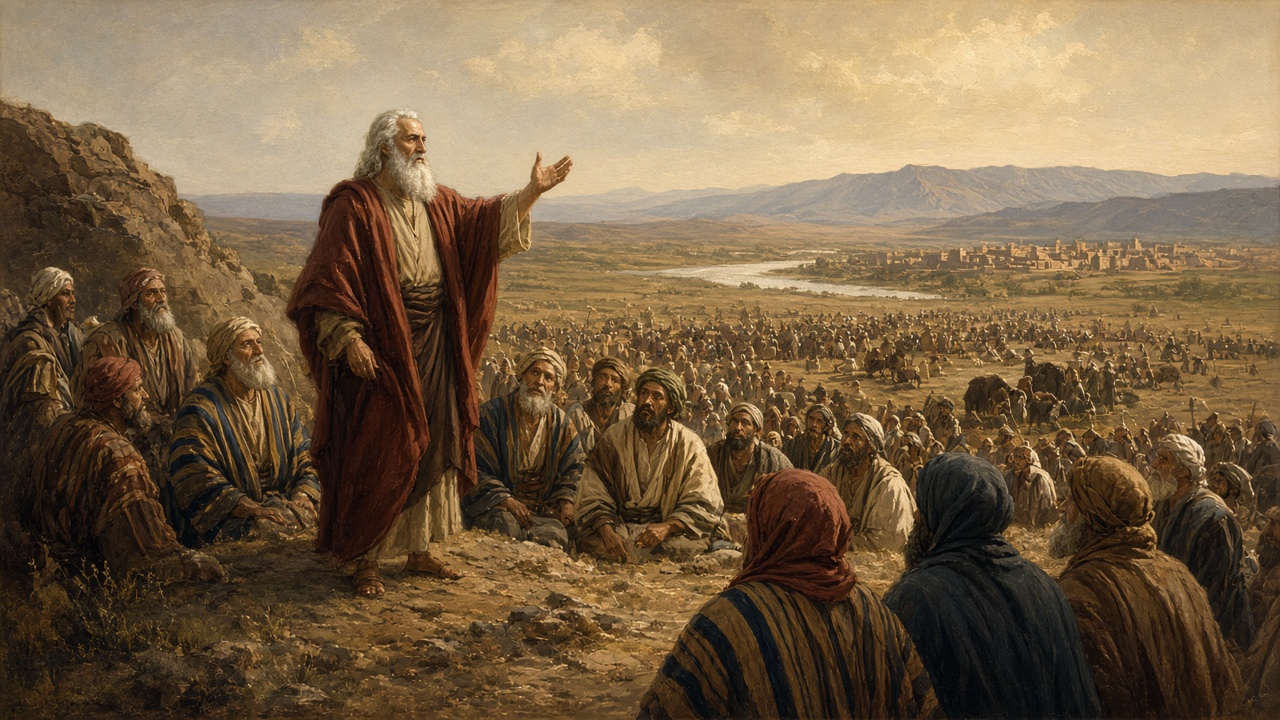
- Easton's Bible Dictionary (1897) presents Deuteronomy as chiefly three discourses delivered by Moses a short time before his death, spoken to all Israel in the eleventh month of the last year of their wanderings in the wilderness. It says the story of his death and burial was written by some other hand, probably that of Joshua, who succeeded him as leader of Israel.Sources: Easton: Deuteronomy · Joshua
- The discourses of Deuteronomy are set in the plains of Moab, east of the Jordan and opposite Jericho, Israel's last encampment before entering Canaan, a region then held by the Amorites. East of the Jordan the Israelites had defeated Sihon, king of the Amorites, whose country ran from the Arnon to the Jabbok, and Og, king of Bashan, whose kingdom was given to Reuben, Gad, and half the tribe of Manasseh.Sources: Easton: Deuteronomy · Moab · Sihon · Og
- Easton's Bible Dictionary (1897) describes three discourses: the first (1-4:40) recapitulates forty years in the wilderness, exhorts obedience to the divine ordinances, and warns against forsaking the God of their fathers; the second (5-26:19), the body of the book, restates the law given at Mount Sinai and instructs Israel for life in Canaan; the third (chapters 27-30) sets out blessings for the obedient and the curse on the rebellious, urging faithfulness to the covenant.Sources: Easton: Deuteronomy
- Easton's Bible Dictionary (1897) adds three appendices after the addresses: a song which God had commanded Moses to write (32:1-47), blessings pronounced on the separate tribes (chapter 33), and the story of his death (32:48-52) and burial (chapter 34). In Hebrew manuscripts the Pentateuch forms one scroll; Jews divided this book into eleven parshioth, and the English Bible contains thirty-four chapters.Sources: Easton: Deuteronomy
Notes written with AI assistance from open sources (Theographic Bible Metadata, CC BY-SA 4.0; Easton’s Bible Dictionary, public domain) and reviewed before publishing.
Moisés ordena salir de Horeb
1Este libro registra las palabras que Moisés dirigió al pueblo de Israel cuando estaba acampado en el valle del Arabá en el desierto de Moab, al oriente del río Jordán. Las ciudades que había en la zona eran Parán, Tofel, Labán, Jazerot y Dizahab. 2Las palabras fueron pronunciadas el primer día del mes undécimo; habían pasado cuarenta años desde el momento en que el pueblo de Israel dejó el monte Horeb (aunque el viaje a pie desde el monte Horeb hasta Cades Barnea normalmente solo dura once días, siguiendo la vía del monte Seír). 4Sijón, rey de los amorreos, había sido ya derrotado en Hesbón y el rey Og de Basán había sido derrotado en Astarot, cerca de Edrey. 5Estas, pues, son las palabras que Moisés declaró ante el pueblo de Israel:
6«Hace cuarenta años, junto al monte Horeb, el Señor, nuestro Dios, nos dijo: “Ya han estado aquí largo tiempo. 7Vayan ahora y ocupen la región montañosa de los amorreos, el valle del Arabá, el Néguev, y toda la tierra de Canaán y el Líbano: toda el área desde las costas del mar Mediterráneo hasta el río Éufrates. 8Yo se la doy a ustedes. Entren y poséanla, porque es la tierra que el Señor prometió a sus antepasados Abraham, Isaac y Jacob, y a todos sus descendientes”.
Nombramiento de jefes
9»En aquel tiempo le dije al pueblo: “Ayúdenme. Ustedes son una gran carga para que yo la lleve solo, 10porque el Señor nos ha multiplicado como las estrellas. 11Quiera él multiplicarnos mil veces más y bendecirnos como ha prometido. 12Pero ¿qué puede hacer un hombre solo para resolver las dificultades, los pleitos y los problemas que hay entre ustedes? 13Elijan, pues, hombres de cada tribu que sean sabios, experimentados y entendidos, y yo los pondré como jefes”.
14»Ellos estuvieron de acuerdo con esto. 15Entonces tomé los hombres que eligieron, varios de cada tribu, y los señalé como jefes administrativos a cargo de mil, de cien, de cincuenta y de diez para decidir en sus dificultades y ayudarles en todo. 16Les di órdenes de que fueran perfectamente justos en todo tiempo con sus hermanos y aun con los extranjeros. 17“Cuando tomen decisiones”, les dije; “no favorezcan a un hombre porque sea rico; sean justos con el grande y con el pequeño. No teman si a ellos no les agrada el fallo de ustedes, porque ustedes son jueces en el nombre de Dios. Los casos demasiado difíciles tráiganmelos a mí, y yo los resolveré”. 18Les di además varias otras instrucciones para ustedes.
Misión de los espías
19»Luego nos alejamos del monte Horeb y viajamos a través del desierto grande y terrible, y llegamos finalmente a las montañas de los amorreos a las cuales el Señor nuestro Dios nos había dirigido. Estábamos entonces en Cades Barnea (en el límite con la Tierra prometida) y le dije al pueblo: “El Señor, el Dios de nuestros antepasados, nos ha dado esta tierra. Vayan y poséanla como él nos ha dicho. No teman, ni duden”.
22»Pero los israelitas replicaron: “Deja que primero enviemos espías para descubrir el mejor camino de entrada y para decidir qué ciudades debemos capturar en primer lugar”.
23»Esto me pareció bien, por lo que elegí doce espías, uno de cada tribu. 24Los espías cruzaron las colinas y llegaron al valle de Escol, y volvieron con muestras de las frutas que allí se producían. Una sola mirada bastó para convencernos de que la tierra que el Señor nos había dado era una tierra buena.
Rebelión contra el Señor
26»Pero el pueblo no quiso entrar y se rebeló contra el mandamiento del Señor. 27Todos a una sola voz murmuraron y se quejaron en sus tiendas y dijeron: “El Señor debe aborrecernos pues nos ha sacado de Egipto para ser asesinados en el desierto por estos amorreos. 28¿A dónde vamos a entrar? Nuestros hermanos que han visitado la tierra nos han atemorizado con todo lo que nos contaron. Dicen que la gente de esa tierra es alta y fuerte, y que los muros de sus ciudades llegan hasta el cielo. Por si fuera poco, han visto gigantes allí: los descendientes de Anac”.
29»Pero yo les dije: “No teman. 30El Señor nuestro Dios irá delante, y peleará por ustedes como lo hizo en Egipto. 31Él nos ha cuidado en nuestra peregrinación por el desierto de la manera que un padre cuida a sus hijos”. 32Pero nada de lo que les dije los convenció. No quisieron creer al Señor nuestro Dios, 33quien los había guiado por el camino y había elegido los mejores lugares para que acamparan, y los había guiado con una columna de fuego por la noche y una columna de nubes durante el día.
34»El Señor oyó la queja de los israelitas y se enojó. 35Juró que nadie de esa generación viviría para ver las bondades de la tierra que había prometido a sus antepasados. 36Caleb (hijo de Jefone) es el único que, por haber confiado completamente en el Señor, recibirá, para él y sus descendientes, como heredad personal parte de la tierra sobre la cual había andado.
37»Y el Señor también se enojó conmigo por causa del pueblo, y me dijo: “Tampoco tú entrarás en la Tierra prometida. 38Josué (el hijo de Nun), tu ayudante, guiará a tu pueblo hacia ella. Anímale mientras se prepara para tomar el mando. 39La tierra se la entregaré a la nueva generación, a aquellos que según sus padres iban a morir en el desierto y todos los pequeños quienes todavía no saben distinguir entre lo bueno y lo malo. 40Por eso se dirigió a los de la antigua generación y les dijo: Ya que así lo desean, ¡regresen al desierto, camino del Mar Rojo!”.
41»Entonces ellos confesaron: “Hemos pecado; entraremos en la tierra y pelearemos por ella como el Señor nuestro Dios nos ha dicho”. Se armaron, pues, pensando que sería fácil conquistar la región. 42Pero el Señor me dijo: “Ordénales que no lo hagan, porque no iré con ellos; ¡serán derrotados!”.
43»Pero los israelitas no quisieron escuchar. En abierta rebelión contra el mandato del Señor, subieron a los montes a pelear. 44Pero los amorreos que vivían allí salieron a presentarles batalla y, como avispas, los persiguieron desde Seír hasta Jormá y mataron a muchos de ellos. 45Luego regresaron y lloraron delante del Señor, pero no los escuchó. 46Tuvieron que permanecer en Cades largo tiempo.
Did you know?
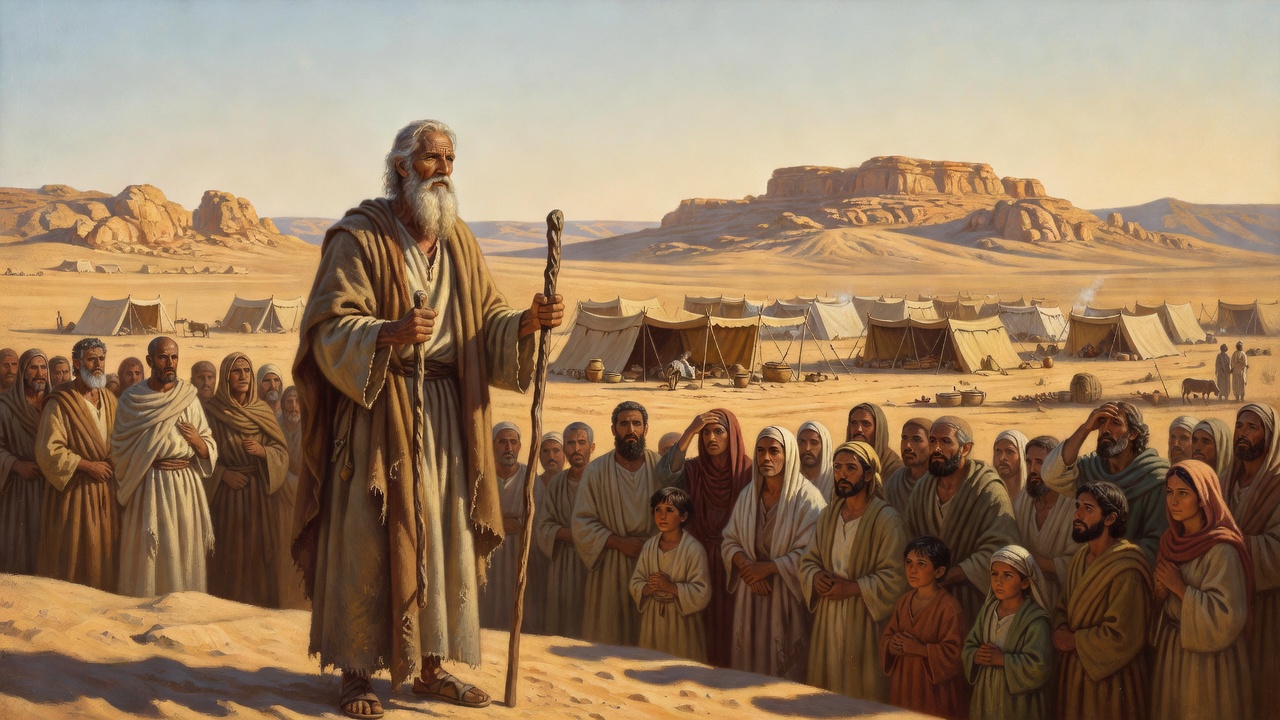
Moses Recounts Israel's Journey
- Moses addresses Israel in the plains of Moab east of the Jordan in the fortieth year after the Exodus, shortly after defeating the Amorite kings Sihon and Og. The text notes that the journey from Mount Horeb to Kadesh-barnea was normally only eleven days, contrasting that short route with the decades of wandering caused by rebellion.Sources: the Bible text itself · Sihon · Og · Kadesh-barnea
- To manage disputes as the population grew, Moses established an organized judicial system by appointing respected tribal leaders over groups of thousands, hundreds, fifties, and tens. He charged these judges to show strict impartiality, hearing the small and great alike, and giving fair judgment to both native Israelites and resident foreigners.Sources: the Bible text itself
- Recalling the crisis at Kadesh-barnea, Moses describes how twelve scouts explored Canaan and returned carrying the fertile fruit of the land. However, widespread fear of fortified cities and tall warriors led the congregation to rebel, prompting God's oath that none of that generation except Caleb and Joshua would enter the promised land.Sources: the Bible text itself · Caleb · Joshua · Kadesh-barnea
Notes written with AI assistance from open sources (Theographic Bible Metadata, CC BY-SA 4.0; Easton’s Bible Dictionary, public domain) and reviewed before publishing.
Places in this chapter
- Arabah · 30.417, 35.151 · verses 1, 7
- Jordan · Today: Jordan River · 31.761, 35.558 · verses 1, 5
- Paran · 30.303, 34.777 · verse 1
- Mount Horeb · Today: Jebel Musa · 28.540, 33.973 · verses 2, 6, 19
- Egypt · 30.129, 31.308 · verses 3, 27, 30
- Bashan · 32.781, 35.935 · verse 4
- Moab · Today: Moab 1 · 31.181, 35.701 · verse 5
- Canaan · 32.767, 35.333 · verse 7
- Euphrates · Today: Euphrates River · 31.004, 47.442 · verse 7
- Lebanon · 33.540, 35.584 · verse 7
- Negeb · 31.245, 34.841 · verse 7
- Shephelah · 31.692, 34.875 · verse 7
- Way of the Red Sea · Today: road between the Dead Sea and the Gulf of Aqaba · 29.727, 34.998 · verse 40
Only places identified with high confidence are shown (90% or more according to the scholarly sources compiled by OpenBible). Period map: DARE (Digital Atlas of the Roman Empire), CC BY 4.0; modern map: © OpenStreetMap contributors; places: OpenBible.info (CC BY 4.0).
Credits and license for this translation
Biblica® Open Nueva Biblia Viva 2008
The Holy Bible in Spanish: Biblica® Open Nueva Biblia Viva 2008 (Bible)
copyright © 2008 Biblica, Inc.
Language: Español
Contributor: Biblica, Inc.
Biblica® Open Nueva Biblia Viva™
Copyright © 2006, 2008 by Biblica, Inc.
“Biblica” es una marca registrada en la oficina de Patentes y Marcas de los Estados Unidos por Biblica, Inc. Usado con permiso.
“Biblica” is a trademark registered in the United States Patent and Trademark Office by Biblica, Inc. Used with permission.
Creative Commons license
This work is made available under the Creative Commons Attribution-ShareAlike 4.0 International License (CC BY-SA). To view a copy of this license, visit https://creativecommons.org/licenses/by-sa/4.0 or send a letter to Creative Commons, PO Box 1866, Mountain View, CA 94042, USA.
You have permission to copy and distribute this Work, as long as you do not change it and you keep the title as it is. Changing or translating this Work will create a derivative work. When you publish this derivative work, you must list what changes you have made where people can see them, such as on a website. You must also show where the original Work is from: “The original Work by its copyright holders is available for free at www.biblica.com and open.bible .”
Notice of copyright must appear on the title or copyright page of the work as follows:
Biblica® Open Nueva Biblia Viva™
Copyright © 2006, 2008 by Biblica, Inc.
“Biblica” es una marca registrada en la oficina de Patentes y Marcas de los Estados Unidos por Biblica, Inc. Usado con permiso.
“Biblica” is a trademark registered in the United States Patent and Trademark Office by Biblica, Inc. Used with permission.
You must also make your derivative work available under the same license (CC BY-SA).
If you would like to notify Biblica, Inc. regarding your translation of this work, please contact us at https://open.bible/#feedback .
This translation is made available to you under the terms of the
Creative Commons Attribution Share-Alike license 4.0.
You have permission to share and redistribute this Bible translation in any format and to make reasonable revisions and adaptations of this translation, provided that:
You include the above copyright and source information.
If you make any changes to the text, you must indicate that you did so in a way that makes it clear that the original licensor is not necessarily endorsing your changes.
If you redistribute this text, you must distribute your contributions under the same license as the original.
Pictures included with Scriptures and other documents on this site are licensed just for use with those Scriptures and documents.
For other uses, please contact the respective copyright owners.
Note that in addition to the rules above, revising and adapting God's Word involves a great responsibility to be true to God's Word. See Revelation 22:18-19.
2025-05-21
Source: http://ebible.org/spaonbv/ · eBible.org